TL;DR
Malta will give every citizen free ChatGPT Plus for a year after they complete a university-designed AI literacy course.
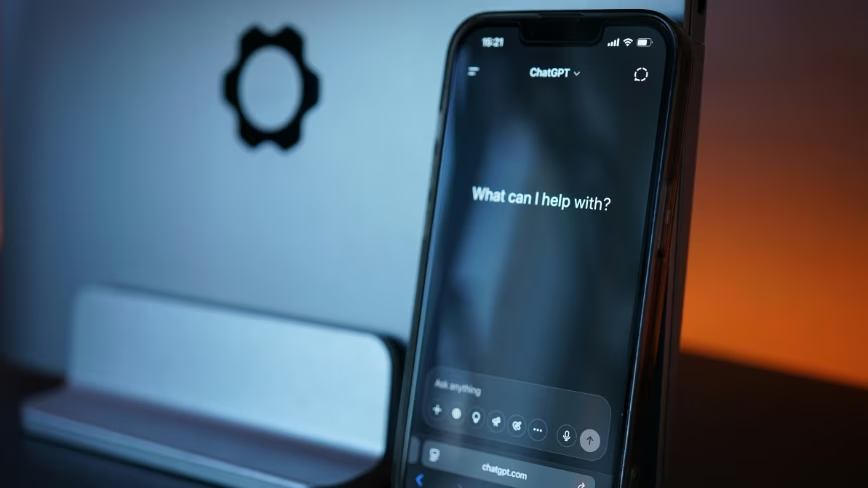
Smartphone Displaying ChatGPT app
 Credit: Tim Witzdam from Pexels/©️Contributor via Canva.com
Malta will give every citizen free ChatGPT Plus for a year after they complete a university-designed AI literacy course.
OpenAI has signed a deal with the government of Malta to provide all Maltese citizens and residents with free access to ChatGPT Plus for one year. There is one condition: they must first complete an AI literacy course developed by the University of Malta. It is the first partnership of its kind between OpenAI and a national government.
The programme, called “AI for All,” launched its first phase in May 2026. Citizens and residents registered with Malta’s online identity system can enrol in the free course, which covers what AI is, what it can and cannot do, and how to use it responsibly at home and at work. Upon completion, participants receive 12 months of ChatGPT Plus at no cost. The offer extends to Maltese citizens living abroad. The Malta Digital Innovation Authority is managing distribution to eligible participants, and the programme will scale as more people complete the course.
Malta has a population of approximately 540,000, making it the smallest EU member state. The financial terms of the deal were not disclosed. ChatGPT Plus currently costs $20 per month, meaning a full year of access for every Maltese resident would carry a nominal retail value of roughly $130 million if every resident enrolled, though OpenAI’s actual cost of provision is substantially lower than the retail price and the company is presumably offering a deeply discounted or subsidised rate. No independent confirmation from either party on the financial structure has been provided at the time of publication.
Silvio Schembri, Malta’s Minister for Economy, Enterprise and Strategic Projects, said the initiative was designed to turn “an unfamiliar concept into practical assistance for our families, students, and workers.” George Osborne, head of OpenAI for Countries, described intelligence as becoming “a national utility” and said he hoped other governments would follow Malta’s lead.
The deal fits a broader pattern of AI companies partnering with national governments to secure adoption and strategic positioning. Anthropic announced a project last year giving all teachers in Iceland access to Claude for lesson planning and classroom materials. In September 2025, OpenAI signed a partnership with the Greek government to bring its technology to secondary schools and startups. The UK government signed a memorandum of understanding with Anthropic in February 2025 to improve how people access and interact with government information and services online.
OpenAI’s international expansion has not been without complications. Its Stargate UK data centre project, announced in September 2025 as a sovereign AI infrastructure partnership with Nvidia and Nscale, was paused in April citing the high cost of British industrial electricity, which runs at more than four times US rates, and an unfavourable regulatory environment around AI copyright. Its Abu Dhabi Stargate campus drew an explicit threat from Iran’s Islamic Revolutionary Guard Corps, which released satellite footage of the facility and designated it a potential military target. The Malta partnership carries no such geopolitical risk, but it does represent a different kind of international play: not infrastructure, but adoption.
The strategic logic for OpenAI is straightforward. ChatGPT Plus subscriptions are the company’s primary consumer revenue stream, but growth in mature markets is slowing as the pool of early adopters who will pay $20 per month on their own initiative approaches saturation. Government partnerships offer a route to a different kind of user: people who would not have sought out a premium AI subscription independently but who, once trained and given access, may become long-term paying customers. Malta, with its small population and concentrated government apparatus, is a low-risk environment to test whether that theory works.
The AI literacy course is the critical design choice. By making education a prerequisite for access rather than simply distributing free subscriptions, Malta and OpenAI are attempting to solve two problems simultaneously: the adoption gap, where people do not use AI because they do not understand it, and the misuse risk, where people use AI without understanding its limitations. Whether a university course can meaningfully address either problem at scale is an open question, but the model is more thoughtful than a simple giveaway.
OpenAI has been expanding ChatGPT’s capabilities aggressively, adding personal finance tools via Plaid integration, introducing advertising, and positioning the chatbot as a platform rather than a product. The Malta deal adds another dimension: ChatGPT as public infrastructure, subsidised by a government and distributed through an education system. If other countries follow, the programme could become a template for how AI companies secure national-scale adoption without relying on consumer marketing alone.
Malta has a history of positioning itself as an early mover in technology regulation and adoption. It was among the first countries to establish a regulatory framework for blockchain and cryptocurrency, and its Malta Digital Innovation Authority was created specifically to oversee emerging technology governance. The AI for All programme extends that positioning into artificial intelligence, with the added distinction that it is the first government in the world to tie AI access to AI education at a national level.
Whether the model scales beyond a microstate with half a million people is the question that matters. For OpenAI, Malta is a proof of concept. For Malta, it is a bet that a small country can punch above its weight by being the first to treat intelligence, as Osborne put it, as a utility. The course launches this month. The results will take longer.
Get the most important tech news in your inbox each week.


