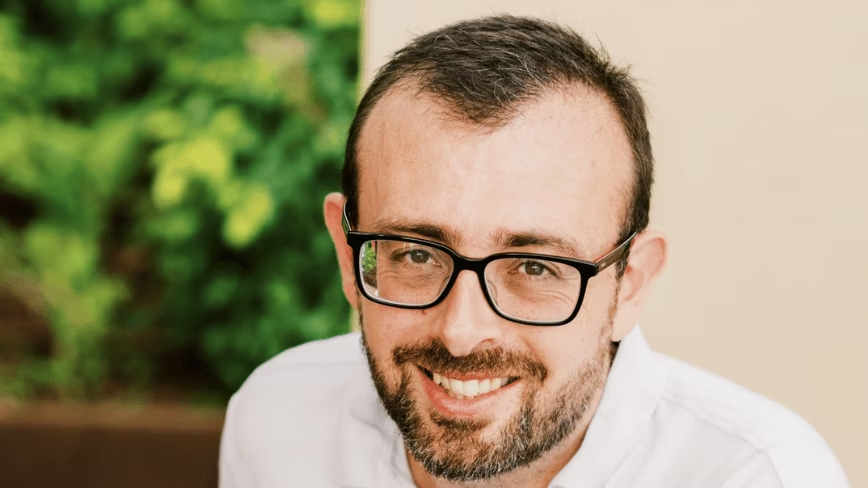
 Credit: Isara
Isara, a San Francisco startup that is building software to coordinate thousands of AI agents on complex analytical tasks, has raised $94 million at a $650 million valuation, with OpenAI among the investors. The company was founded nine months ago by two 23-year-olds. It has no product in market.
The round was first reported by The Wall Street Journal. Investors include Amity Ventures, Michael Ovitz (the former Creative Artists Agency chairman and early Uber backer), and Stanley Druckenmiller, the billionaire hedge fund manager. OpenAI’s participation is notable because one of Isara’s co-founders, Eddie Zhang, is a former OpenAI AI safety researcher. Zhang left the company to start Isara in June 2025 alongside Henry Gasztowtt, a computer science student at the University of Oxford. The pair co-authored a paper at ICML 2024 exploring how AI systems could cooperate to improve policymaking, research that serves as the intellectual foundation for the company.
Isara has since hired roughly a dozen additional researchers from Google, Meta, and OpenAI itself.
What Isara is building
The core idea is multi-agent coordination at scale. Where most current AI applications involve a single model responding to a single prompt, Isara’s architecture allows hundreds or thousands of specialised agents to communicate, divide tasks, align on goals, and produce a combined output. The founders describe this as a shift from isolated tools to coordinated teams.
The company’s demonstration so far involves approximately 2,000 agents working in concert to forecast the price of gold. The initial commercial target is investment firms, which would pay for predictive modelling software. Biotechnology and geopolitical analysis are secondary markets. The longer-term vision, as described to the Journal, is training agent swarms to track geopolitical shifts and forecast economic trends.
The technical challenge is real. Getting a single AI agent to perform reliably on a complex task is already difficult. Getting thousands to communicate without cascading errors, conflicting objectives, or compounding hallucinations is a problem that the academic literature has barely begun to address at scale. Multi-agent frameworks such as LangChain, CrewAI, and AutoGen exist, but they typically coordinate small numbers of agents on relatively structured tasks. Isara’s ambition to orchestrate thousands on open-ended analytical problems is a different order of difficulty.
The neolab phenomenon
Isara is part of a pattern that The Information has labelled “neolabs”: research-heavy AI startups founded by alumni of OpenAI, DeepMind, Anthropic, and Google Brain that operate less like traditional companies and more like privately funded research institutions. In just over a month, investors poured or discussed $2.5 billion into five such startups. More broadly, The Information estimates that more than $10 billion has now flowed into the neolab category, reflecting a bet that the next significant AI breakthroughs will come from architectures fundamentally different from the large language models that dominate the current market.
The pattern is consistent: a small team of researchers with elite credentials and publications at top conferences raises a round that values the company at hundreds of millions of dollars before revenue. The investor thesis is that foundational research capability, not a specific product, is the scarce asset worth funding. In a market where Cognition, the company behind the AI coding agent Devin, reached a $10.2 billion valuation in September 2025 with $73 million in annual recurring revenue, the logic is that the upside from a genuine breakthrough in multi-agent coordination could be enormous.
The downside is that foundational research is, by definition, uncertain. Many of the architectures being explored by neolabs, including diffusion models for reasoning, world models, and multi-agent swarms, remain unproven outside controlled demonstrations. The gap between a demo that coordinates 2,000 agents to forecast gold prices and a production system that investment firms will rely on for real capital allocation decisions is large enough to swallow a $94 million funding round.
The OpenAI angle
OpenAI’s investment raises a question that has become familiar in the AI industry: why is a frontier lab backing a startup founded by its own former employee to work on problems adjacent to its own research agenda? The most straightforward answer is strategic optionality. If multi-agent coordination becomes a critical capability, OpenAI wants exposure to the approaches being developed outside its walls. Investing $94 million at a $650 million valuation is inexpensive insurance relative to OpenAI’s own scale. The company is raising capital at a $300 billion valuation and has committed to building artificial general intelligence. A research bet on agent swarms fits within that ambition.
There is also the talent dimension. The AI industry’s most valuable resource is not compute but the researchers who know how to use it. By investing in Isara, OpenAI maintains a relationship with Zhang and his team rather than losing them entirely to the competitive landscape. This is the same dynamic that has driven investments from Google, Microsoft, and Amazon into smaller AI labs: the cost of losing top researchers is higher than the cost of funding the companies they start.
For Isara, the challenge ahead is translating a research vision into something that works reliably enough for paying customers. The agentic AI market is projected to grow from $7.8 billion in 2025 to $52.6 billion by 2030, and every major platform, from Anthropic’s Claude to Google’s Gemini to Microsoft’s Copilot, is shipping multi-agent features. Isara’s bet is that coordination at the scale of thousands of agents requires a fundamentally different architecture than these platforms offer. Whether that bet is correct, or whether the incumbents will solve the coordination problem incrementally as they scale their existing models, is the question the next 18 months will answer.
Get the TNW newsletter
Get the most important tech news in your inbox each week.


