 Credit: OpenAI
Update, 29 September 2026
This article has been updated with the regions where dots is available and a quote from an early tester. OpenAI said Pro users in the European Economic Area, Switzerland and the UK will not get dots for now.
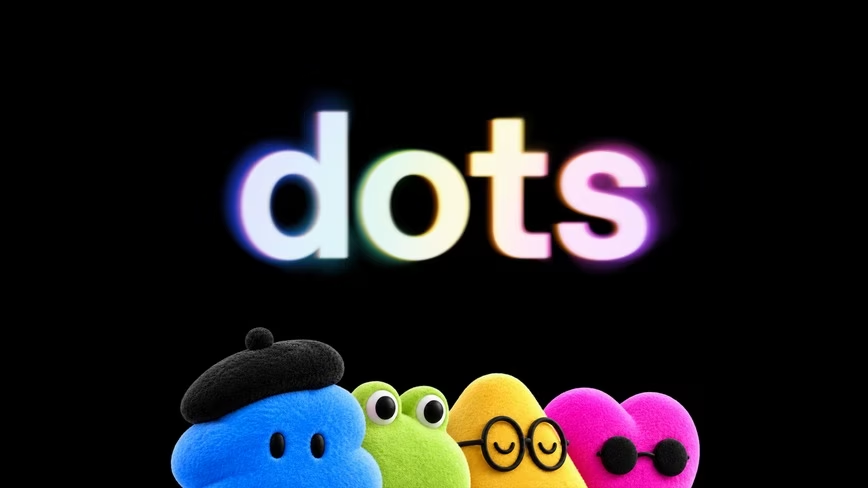
OpenAI has launched dots, AI agents that run all the time on their own cloud computers and work on a user’s behalf. The company announced dots at its DevDay 2026 event in San Francisco on Tuesday. They run on GPT-6 Astra and are rolling out in ChatGPT to Pro and Business Premium users in eligible markets.
Business Premium users get dots in all supported ChatGPT regions, OpenAI said in a statement sent to press. For Pro users, the eligible markets do not currently include the European Economic Area, Switzerland or the UK.
Each dot has its own cloud computer and browser, OpenAI wrote in a blog post. It can connect to more than 4,000 apps through plugins and work on several projects at once. Users can message or call their dot in ChatGPT on desktop, web and mobile, or message it in Slack and Teams. Texting is coming soon.
“Over time, we envision teams of dots working together on your behalf,” OpenAI wrote.
What a dot can do
A dot learns a user’s preferences from feedback and can work towards their goals around the clock, according to OpenAI. When the user is not working with it, it looks for ways to help in the background. OpenAI calls this “proactive research”. For that work, a dot can only use connected apps in read-only mode, so it cannot send messages or change content.
Users can open a dot’s computer at any time to check its work. They can also let it connect to their own laptop. OpenAI gave one example from an early tester, developer Dan McAteer. His dot noticed an invoice he had forgotten to send.
“My dot proactively picked up on an invoice I needed to send for my freelance writing, pulled the relevant details from the email thread and drafted the invoice. After I approved it, dot sent the invoice as a PDF,” McAteer said in a statement shared by OpenAI.
Safeguards and approvals
A dot’s computer is kept separate from the user’s own unless they choose to connect it, OpenAI said. Dots can sign in to supported websites with saved passwords without exposing them to the model. A monitoring system can pause or stop a dot if it detects a safety concern.
Dots start with built-in rules on when to act alone and when to ask for approval. Users can set Custom Rules to allow, block or require approval for specific actions. An auto-review step checks actions that could affect accounts or share information. Some sensitive tasks, such as changing a password, always stay with the user. OpenAI has published a separate safety post on dots.
“Dots can still make mistakes, so always review consequential work,” the company wrote.
On Monday, OpenAI said its agents had posted users’ images online, affecting 53 ChatGPT users.
Plans, pricing and specialist dots
The first dot is included in Pro and Business Premium plans at no extra cost. Enterprise, Edu and Healthcare users can try a beta once their workspace admin turns it on. Conversations with a dot do not count toward ChatGPT usage limits. Tasks it starts in Codex or ChatGPT Work do.
OpenAI is also previewing specialist dots for companies. These get their own identity, credentials and access to company systems to take on set roles. OpenAI said it tested them internally across procurement, invoice processing, email marketing, customer support and commercial contracting. It is starting with enterprise pilots and is working with Microsoft to bring specialist dots to Agent 365.
At the same event, OpenAI announced more than 20 products, including GPT-6.1 Sol. It said Sol offers “near-Astra intelligence” at a fifth of Astra’s standard token prices. OpenAI released GPT-6 Astra on 3 September. It has cancelled the October launch of GPT-6.1 Astra after failed safety tests. Meta launched its Muse AI agent for small businesses on the same day.
Get the TNW newsletter
Get the most important tech news in your inbox each week.


