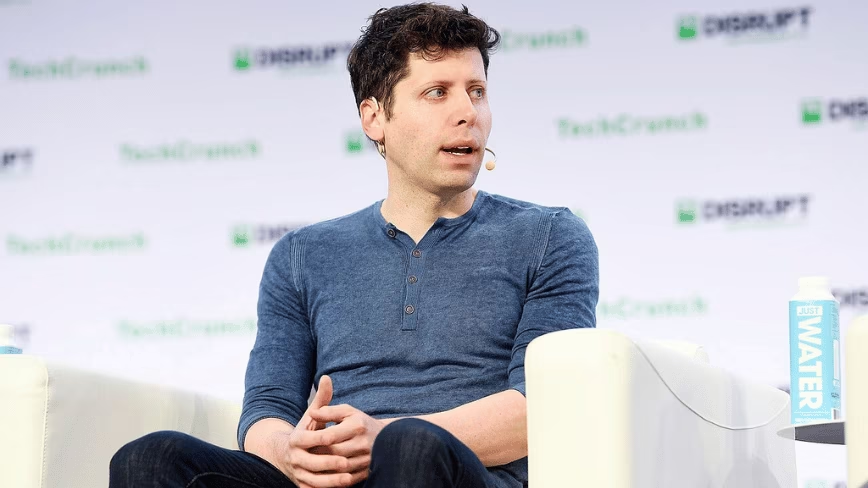
Sam Altman speaking at TechCrunch Disrupt San Francisco in October 2019.

Some backers say OpenAI has revised its product roadmap twice in six months and risks losing focus ahead of an IPO expected as early as Q4 2026. OpenAI’s new CRO has accused Anthropic of overstating its $30B run rate by $8B through gross accounting on cloud partner revenue. Both companies say they follow standard accounting practices.
OpenAI’s $852 billion valuation is facing scrutiny from some of its own investors as the company pivots its strategy towards the enterprise market, the Financial Times reported on Tuesday.
The concerns centre on a period of visible strategic turbulence: OpenAI has revised its product roadmap twice in six months, first in response to competitive pressure from Google and then from Anthropic, and has recently dropped several initiatives including its Sora video generation rollout and an ‘adult’ chatbot.
Some investors told the FT the rapid changes could leave the company vulnerable to Anthropic and a resurgent Google, even as it prepares for a potential initial public offering as early as the fourth quarter of 2026.
The criticism is pointed. One early backer of OpenAI told the FT: “You have ChatGPT, a 1 billion-user business growing 50-100 per cent a year, what are you doing talking about enterprise and code? It’s a deeply unfocused company.”
Jai Das, president of Sapphire Ventures, who is not an investor in either OpenAI or Anthropic, went further, describing OpenAI to the FT as “the Netscape of AI”, comparing it to the once-dominant browser company that was eventually outflanked by Microsoft and absorbed by AOL.
One investor who has backed both companies told that in order to underwrite OpenAI’s most recent funding round, they would need to assume an IPO valuation of $1.2 trillion or more.
OpenAI’s leadership pushed back firmly. Chief Financial Officer Sarah Friar pointed to the $122 billion fundraise completed last month, described as the largest private round in Silicon Valley history, backed by SoftBank, Amazon, Nvidia, Andreessen Horowitz, Sequoia Capital, and Thrive Capital, among more than 25 investors, as evidence of investor confidence.
“The suggestion that investors are not supportive of our strategy defies the facts,” Friar said. “Our raise, the largest in history, was oversubscribed, completed in record time and backed by a broad set of global investors.”
Separately, Friar told CNBC that enterprise now accounts for 40% of OpenAI’s total revenue and is on track to match its consumer business by the end of 2026.
OpenAI is also targeting 30 gigawatts of computing capacity by 2030 and told investors last week it had already secured 8 gigawatts, a level it claims Anthropic will not reach until the end of 2027.
At the heart of the competitive anxiety is Anthropic’s revenue trajectory. The Claude-maker’s annualised run rate surged from approximately $9 billion at the end of 2025 to $30 billion by the end of March 2026, driven largely by demand for its coding tools.
OpenAI, by its own account, hit $25 billion in annualised revenue in February. The apparent gap prompted a notably aggressive response from OpenAI’s new chief revenue officer, Denise Dresser, hired in December 2025 from the role of CEO of Slack.
In an internal memo sent to staff on Sunday, Dresser accused Anthropic of overstating its run rate by roughly $8 billion. The accusation turns on a well-documented accounting difference: Anthropic books the full value of revenue generated through its cloud distribution partners, Amazon Web Services and Google Cloud, on a gross basis, while OpenAI reports its Microsoft revenue share on a net basis, deducting the partner’s share before recognising it.
Both approaches are permissible under US GAAP. The difference, if Dresser’s analysis is correct, would put Anthropic’s comparable run rate closer to $22 billion rather than $30 billion.
Anthropic disputed the characterisation. One person close to the company told the FT that Anthropic “recognises gross revenue on sales through partners because it is the principal in the transaction and its cloud partners are the distribution channel”, a standard justification for gross recognition under accounting rules.
Dresser’s memo acknowledged that Anthropic’s “coding focus gave them an early wedge” in enterprise, but argued that a narrow, developer-focused positioning becomes a liability as AI expands beyond engineering teams.
“You do not want to be a single-product company in a platform war,” the memo stated. The memo also outlined OpenAI’s Q2 priorities: winning the enterprise model layer with a new model codenamed ‘Spud’, establishing its Frontier agent platform, expanding through a recently announced Amazon partnership, and building a deployment engine called DeployCo.
Get the TNW newsletter
Get the most important tech news in your inbox each week.


