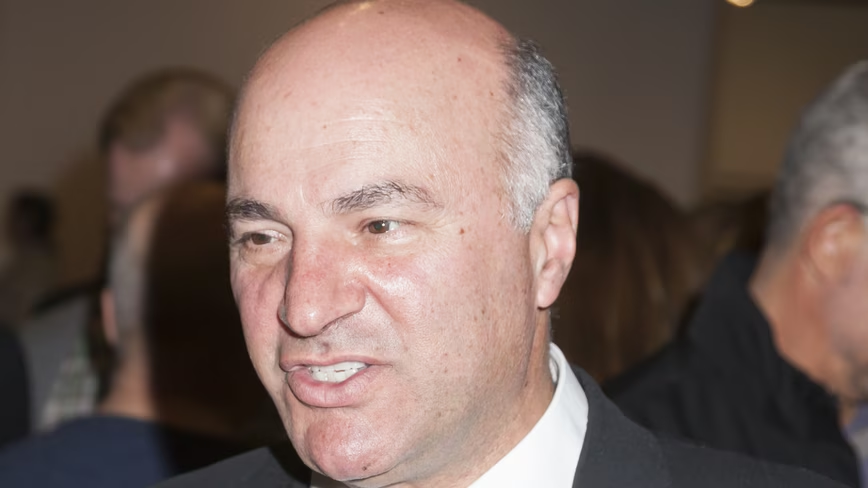
 Credit: Sam Aronov / Shutterstock.com
Kevin O’Leary has done something unusual for a man who built a brand on being blunt: he has admitted he got it wrong. The investor now says he badly mishandled the messaging around his enormous Utah AI data centre, and he is scaling the project back to calm the uproar it caused.
The concession is striking given the scale of the original plan. His Stratos project in Box Elder County was pitched as a sprawling site of some 40,000 acres drawing up to nine gigawatts of power, a footprint large enough to alarm almost any community it landed in.
Alarm it duly caused. Residents pushed back hard over water use, power demand, noise, heat and the sheer amount of land involved, and the opposition grew loud enough that the state’s political leadership took notice.
That pressure produced a dramatic climbdown. Utah’s Senate president, J. Stuart Adams, demanded a 75% cut to the project in June, and O’Leary has now agreed to shrink it to a single gigawatt, a fraction of the original ambition.
His mea culpa was unusually direct. O’Leary said he had “really screwed this up,” pledging more transparency about construction plans and insisting he has no interest in causing an environmental disaster that would tarnish his legacy.
The apology tour is partly damage control, of course. O’Leary remains committed to building in Utah and is keen to recast himself as a good-faith partner who wants to be a major contributor to the local economy rather than an outsider imposing an industrial megaproject.
His earlier handling, though, went beyond clumsy phrasing. O’Leary had claimed, without offering evidence, that opposition to the project was fuelled by Chinese money, a charge that has since drawn a defamation lawsuit naming both him and Fox News.
Whatever the motive, the retreat is real, and it fits a pattern playing out across the country. Data-centre opposition has gone national, with communities in dozens of states pushing back against the land, water and power that the AI build-out demands.
Water tends to be the flashpoint, and O’Leary knows it. He has previously argued that data centres use less water than golf courses, a comparison that sounds reassuring until the actual figures for a hyperscale site are laid out.
Some governments have stopped waiting for developers to volunteer restraint. New York became the first state to freeze new data centres for a year, a sign that the permitting free-for-all is beginning to tighten as public patience wears thin.
The underlying tension is not going away. These projects promise jobs, tax revenue and a foothold in the AI economy, yet they carry real environmental costs, and communities are increasingly unwilling to take the trade on faith.
O’Leary’s stumble is a lesson in how not to broach that bargain. Arriving with a nine-gigawatt plan and combative rhetoric all but guaranteed the fight he then had to climb down from, an own goal for a project that might have won a warmer welcome at a humbler scale.
The shrunk project still has to prove itself, mind you. A one-gigawatt facility is far more palatable than a nine-gigawatt one, but it will draw the same scrutiny over water and power, and O’Leary will have to show the transparency he has now promised rather than merely pledge it.
For the wider industry, the episode is instructive. As developers chase ever-larger sites, the communities that host them are finding their voice, and even a seasoned dealmaker like O’Leary has learned that the messaging is not a detail but the whole game.
Get the TNW newsletter
Get the most important tech news in your inbox each week.


