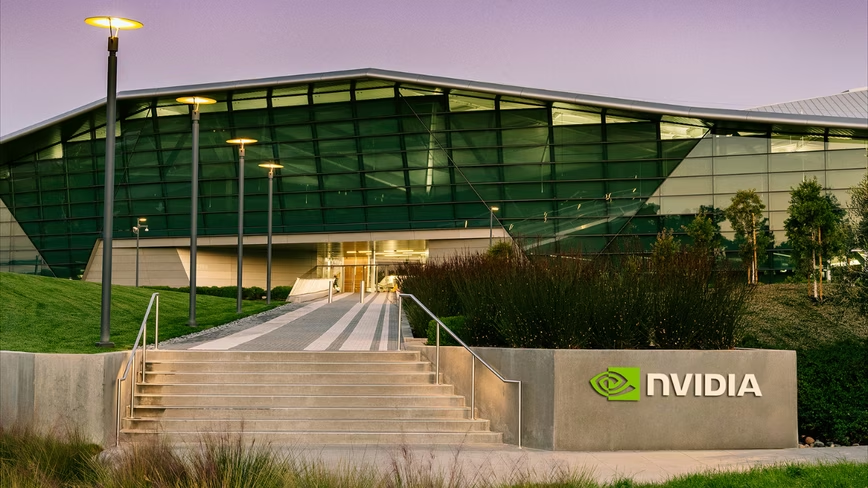
 Credit: NVIDIA
NVIDIA has agreed to invest $2 billion in Nebius Group, the Amsterdam-based AI cloud company that emerged from the wreckage of Yandex after Russia’s invasion of Ukraine, in a deal that pairs a substantial capital injection with a deep technical partnership aimed at deploying more than 5 gigawatts of NVIDIA-powered compute capacity by the end of 2030.
The investment was structured as a private placement: NVIDIA purchased pre-funded warrants exercisable into 21,065,936 Nebius Class A ordinary shares at a near-nominal exercise price of $0.0001 per share, for gross proceeds of approximately $2 billion.
NVIDIA has agreed to a six-month lockup on both the warrant and any shares acquired through its exercise. The transaction was completed as an exempt offering under US securities law, meaning the new shares were not registered with the SEC.
The capital structure matters because it is not a straightforward equity purchase. NVIDIA is effectively becoming a major Nebius shareholder, the 21 million-plus shares would represent a significant stake in a company that closed yesterday with a market capitalisation of roughly $24 billion before the announcement drove shares up around 16%, but through a warrant mechanism that gives Nebius the cash upfront while deferring formal share issuance until NVIDIA chooses to exercise.
Alongside the investment, the two companies announced a strategic partnership spanning four areas: AI factory design and support (including early access to hardware samples, design review processes, and bring-up support); inference and agentic AI stack development using NVIDIA’s latest software, optimised models and libraries; multi-generation infrastructure deployment including early access to the forthcoming NVIDIA Rubin platform, NVIDIA Vera CPUs, and NVIDIA BlueField storage systems; and fleet management, using NVIDIA’s GPU health monitoring tools to optimise Nebius’s cluster operations at scale.
Nebius said it will use the $2 billion to develop its full-stack AI cloud platform and build new greenfield data centres. The company already operates multiple gigawatt-scale AI factories in the US, including a facility in Kansas City, Missouri, and recently secured approval to begin construction of a 1.2-gigawatt AI factory on a 400-acre site near Independence, Missouri, with power delivery expected in the second half of 2026.
Jensen Huang, NVIDIA’s founder and CEO, framed the deal around agentic AI and the compute demands it creates. Arkady Volozh, Nebius CEO, positioned his company as cloud infrastructure built for AI from the ground up, rather than adapted from general-purpose cloud architecture, a dig at the hyperscalers that is becoming a recurring theme in Nebius’s market positioning.
Nebius’s origins are unusual. The company is the successor entity to Yandex N.V., the Dutch holding company of Russia’s dominant internet group.
After Russia’s February 2022 invasion of Ukraine triggered EU sanctions on co-founder Arkady Volozh and suspended Nasdaq trading in Yandex’s shares, the company spent two years restructuring.
In July 2024, Yandex N.V. sold its entire Russian business to a consortium of local investors for $5.2 billion — one of the largest corporate exits from Russia on record, and retained its international AI-focused assets: cloud infrastructure, the Avride autonomous vehicles unit, the TripleTen edtech platform, and stakes in Toloka and ClickHouse.
Volozh’s EU sanctions were lifted in March 2024, and trading in the renamed Nebius Group resumed on Nasdaq in October 2024.
NVIDIA’s relationship with Nebius pre-dates this deal. In December 2024, Nebius closed a $700 million funding round that included NVIDIA as an investor, giving the chipmaker a small equity stake of approximately 0.5%, worth around $33 million at the time according to Bloomberg.
Wednesday’s $2 billion investment is an order of magnitude larger and elevates the relationship to a formal strategic partnership with defined technical collaboration terms.
The deal follows a pattern. In January 2026, NVIDIA made a $2 billion investment in CoreWeave under a structurally similar arrangement also tied to a multi-gigawatt deployment commitment.
Earlier in March, NVIDIA announced $2 billion investments in optical component makers Lumentum and Coherent.
NVIDIA also contributed $30 billion to OpenAI’s $110 billion funding round and has said it plans to invest up to $10 billion in Anthropic.
Critics have noted the circularity: NVIDIA is investing in companies that will use the capital to buy NVIDIA chips, a dynamic that has prompted questions about whether the investments represent genuine strategic conviction or structural demand management.
Nebius reported revenue of $227.7 million in Q4 2025, a 547% year-on-year increase, though the company recorded a net loss of $249.6 million for the quarter and spent $2.1 billion on capital expenditure to secure H200 and Blackwell GPUs.
The company exited 2025 with an annualised recurring revenue of $1.25 billion and has guided for $7 billion to $9 billion in ARR for 2026. NBIS shares were trading at around $28 billion market cap post-announcement, having risen approximately 16% on the day.
The Motley Fool noted the stock now trades at roughly 43 times sales, a high multiple for a company still reporting substantial losses.
Get the TNW newsletter
Get the most important tech news in your inbox each week.


