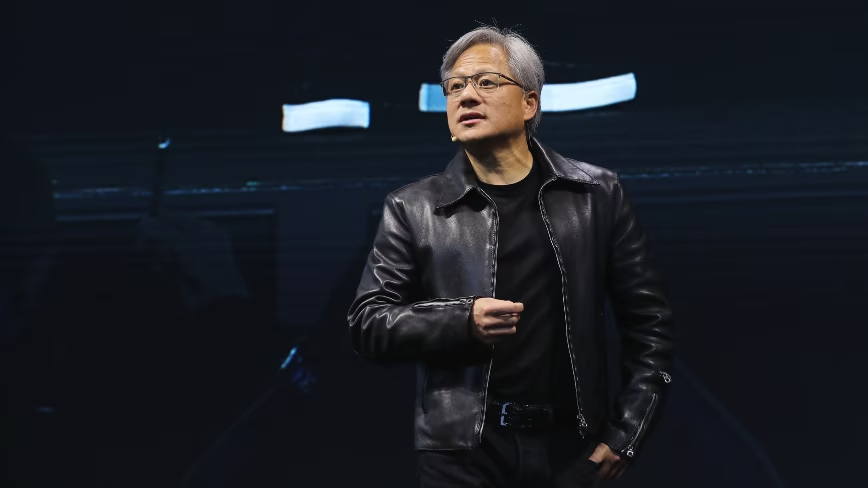
Nvidia chief executive Jensen Huang at Computex in Taipei in 2023.
 Credit: glen photo via Shutterstock
NVIDIA chief executive Jensen Huang told a Taipei audience at Computex 2026 on Wednesday that Taiwan is the “epicentre” of the AI revolution, and that the company’s annual spending on the island will reach roughly $150bn a year.
The number, the highest specific Taiwan-spend figure Huang has yet disclosed publicly, makes Nvidia’s commitment to the island arithmetically larger than the GDP of most EU member states.
The figure breaks down through the supply chain Huang spent the bulk of his keynote describing. The flagship example is Vera Rubin, Nvidia’s next-generation AI platform, which Huang called “probably the largest product launch in the history of Taiwan.”
Each Vera Rubin system contains nearly 2 million parts and is built through 150 ecosystem partners on the island, almost all in Taiwanese hands. TSMC fabricates the underlying logic. Foxconn, Quanta, Wistron and others handle assembly.
SK Hynix, listed in Seoul but with a substantial Taiwan presence, supplies the HBM4 memory the platform needs to deliver its 22 TB/s system bandwidth.
Huang’s framing matters as politics as much as engineering. The Trump administration’s second-term tariff regime has put visible pressure on Nvidia and other US chip designers to onshore more of the production stack into the United States.
The Taiwan-spend disclosure is, in part, Huang signalling to Washington how large the actual cost of that move would be, and to Taipei that Nvidia’s commitment to the island has hardened rather than softened.
It also lands within a few weeks of Huang’s remarks that DeepSeek running on Huawei chips would be a “horrible outcome” for America, which were read inside the industry as Nvidia putting itself unmistakably on the US side of the technology cold war.
What Huang did not say is also informative. He did not announce specific new fabs, packaging facilities or sovereign supply commitments. The $150bn is an aggregate figure flowing through the existing Taiwanese ecosystem, not a discrete capital plan.
The Rubin ramp is straining that ecosystem already, with TSMC reportedly working overtime to meet Nvidia’s Rubin order book. The $150bn-a-year posture amplifies that strain rather than relieving it.
For Taiwan, the politics are genuinely useful. The Lai Ching-te administration has spent the past year arguing in Washington that the island’s indispensability to the US AI build-out is a strategic asset, not a liability. Huang “epicentre” framing reinforces that argument.
For Beijing, which has spent 2026 progressively tightening its own AI policy, the keynote is an additional data point in the case that the global AI stack is concentrating geographically, not diffusing.
Computex 2026, themed “AI Together,” runs through this week. Huang’s keynote was the headline event; AMD’s Lisa Su delivers a counterpart later in the week. Both are expected to use the Taipei stage to clarify their respective roadmaps through 2027, when Nvidia’s Rubin Ultra and AMD’s MI400-series are due to ship at scale.
Get the TNW newsletter
Get the most important tech news in your inbox each week.


