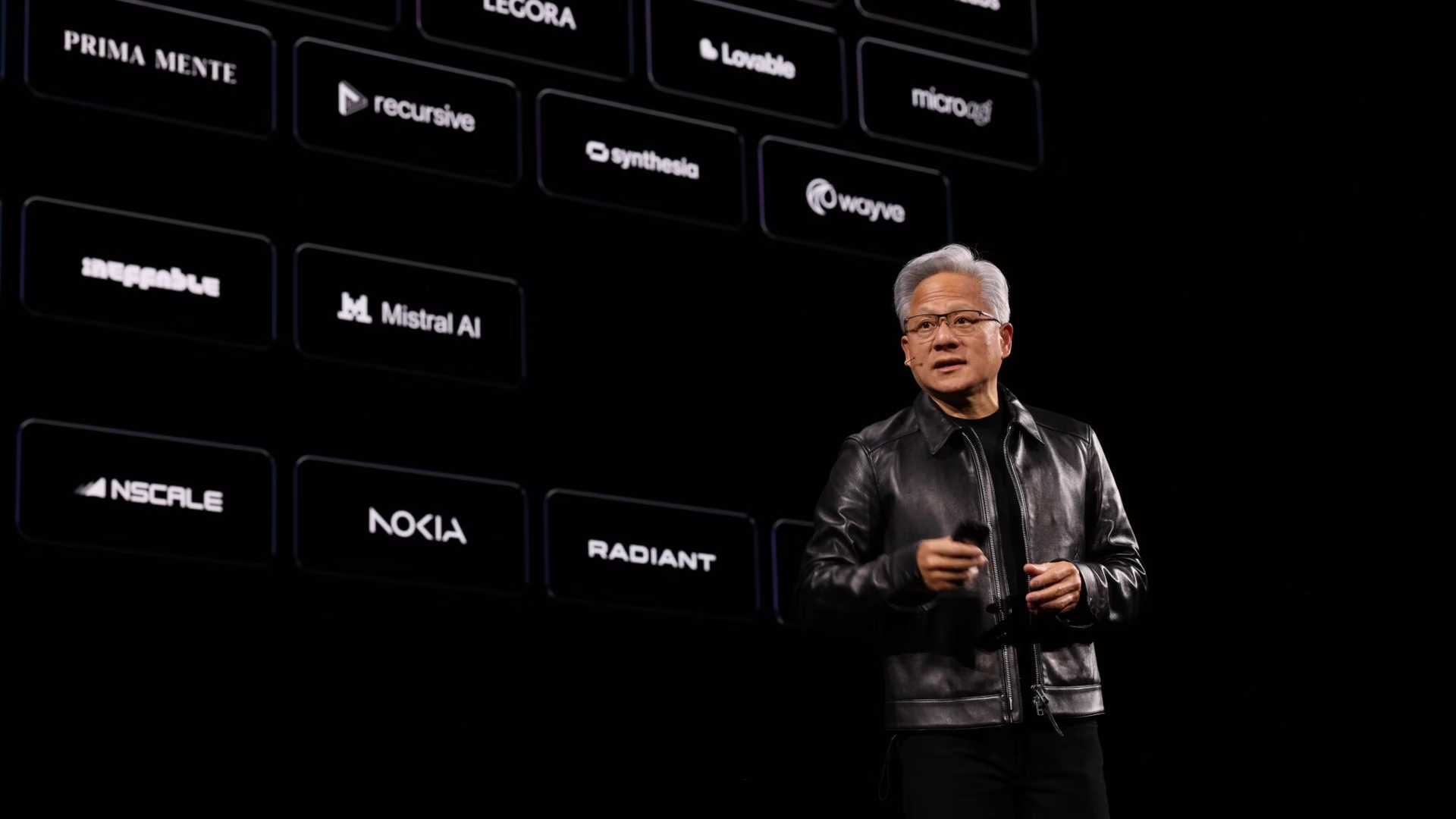
Jensen Huang at Nvidia’s GTC Berlin keynote, 21 October 2026.

Nvidia’s board met late on Wednesday to consider whether Jensen Huang should remain chief executive, a source familiar with the matter told Reuters. Yet, no decision had been announced by the end of the night.
The meeting followed a Wall Street Journal report that Nvidia was preparing to remove its co-founder. The company’s shares fell more than 8% in after-hours trading. If the decline holds, Nvidia will have lost roughly $600 billion in market value since its board began investigating Huang’s conduct.
The investigation began on Sunday, after reports that US intelligence agencies believe Alice Huang, a Megaspeed executive with whom the CEO had a relationship, is a Chinese spy who helped arrange shipments of Nvidia chips to Chinese companies. In a memo to employees, Huang acknowledged that he had been unfaithful to his wife and said he took full responsibility.
At the time, Nvidia’s board publicly expressed confidence in him, but that position came under further pressure on Wednesday, when The New York Times reported that Huang had also had a relationship with Kimberly Powell, Nvidia’s vice president of healthcare, who reported directly to him. The newspaper cited five people who had worked at the company.
When asked about Powell by phone, Huang told the Times, “I don’t think you should be talking to me directly,” before hanging up. Nvidia and Powell did not respond to requests for comment.
Removing Huang would be straightforward under Nvidia’s corporate rules, but difficult in practice. The company’s bylaws allow a majority of its 11 directors to dismiss the CEO, with or without cause. All the directors other than Huang are considered independent. But Huang, 63, owns around 3.6% of Nvidia, has dozens of direct reports, and has built the roughly $4 trillion company without putting a succession plan in place.
Bloomberg reported that the board is working with an external firm to identify potential replacements, and some analysts have pointed to CFO Colette Kress as a possible interim CEO.
“The market is starting to price Nvidia without its founder as the likely outcome, not a tail risk,” Armina Rosenberg of Nvidia shareholder Minotaur Capital told Reuters.
By late Wednesday, prediction market Polymarket put the probability of Huang resigning or being removed by the end of the year at 88%.
The uncertainty has already affected other technology stocks, as Nasdaq futures fell 1%, CoreWeave lost 6%, and South Korea’s SK Hynix also declined. AMD and Broadcom, which could benefit from any disruption at Nvidia, gained 4% and 3%, respectively.
Nvidia is due to report its quarterly results on November 17, leaving the company with little time to resolve the leadership uncertainty before one of its most closely watched financial announcements.
The controversy has also drawn attention in Washington, as Huang told Donald Trump on Monday that he had not known the woman was allegedly a spy, according to the president’s account.
Lawmakers are threatening to subpoena Huang if he refuses to attend a closed-door briefing, while Axios reported that Commerce Secretary Howard Lutnick had delayed a planned crackdown on companies suspected of diverting Nvidia chips to China.
The board faces a difficult decision, as Jensen Huang may be at the centre of the allegations, but he is also the executive most closely associated with Nvidia’s strategy, technology and growth.
As of this morning, the company had yet to say whether its directors were prepared to separate the two.
Get the TNW newsletter
Get the most important tech news in your inbox each week.


