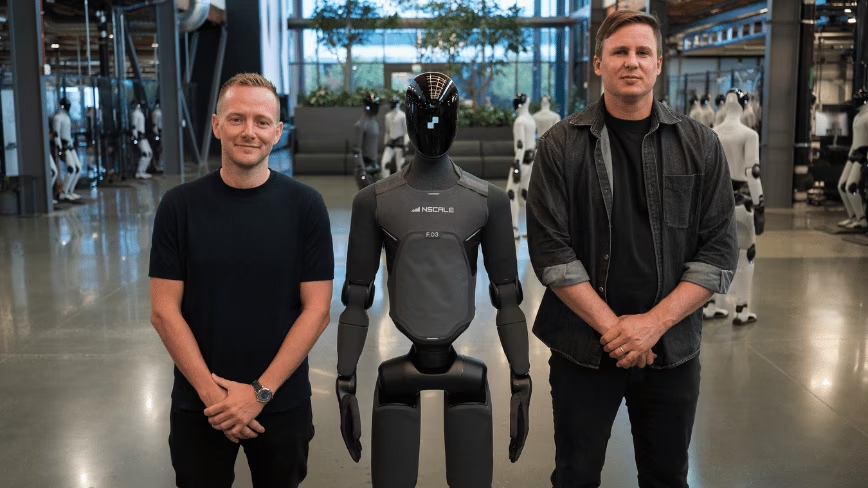
Nscale chief executive Josh Payne, left, and Figure chief executive Brett Adcock, with a Figure 03 robot in Nscale livery.
 Credit: Nscale
Nscale has agreed to sell Figure at least $3.5bn of computing power. It has also bought a stake in Figure, which is the part worth looking at.
The London company announced the partnership on 3 September in a statement also carried on PR Newswire. The deal covers up to 100,000 Nvidia GPUs running the Vera Rubin platform. The first systems arrive in the second half of 2027, at Nscale’s site in Barstow, Texas. The initial commitment is $3.5bn of compute, with what the companies call an intent to scale past $6bn.
Josh Payne, Nscale’s founder and chief executive, framed it as a move into a new category. Physical intelligence is AI’s next frontier, he said, and Figure is pushing the boundaries further than inference and agentic work have.
Alongside it, Nscale is making an undisclosed strategic investment in Figure. It becomes a shareholder and Figure’s preferred compute provider, powering the humanoid maker’s Helix models.
A cloud provider buying into its own customer
Bloomberg’s Lynn Doan put the structure plainly. By investing in a key customer, Nscale is running the playbook Nvidia has run for two years. Some on Wall Street have flagged these circular arrangements as a way to make demand look larger than it is.
The comparison is exact. Nvidia has built a $99bn equity portfolio largely by taking positions in the labs and clouds that buy its chips. Nscale is doing the same thing one layer down, with a robotics company rather than a model lab.
There is a detail that makes it tighter still. Nvidia is an investor in Nscale and an investor in Figure. So the chipmaker sits on both sides of a contract for its own hardware, and the cloud provider in the middle now owns equity in the customer at the end.
Nvidia calls it a flywheel
Jensen Huang described the arrangement as the robotics flywheel. Figure’s models train on Vera Rubin through Nscale’s cloud. Nvidia’s Isaac Sim validates them. Then they deploy on Nvidia GPUs inside Figure’s robots. Nvidia silicon at every stage.
That is an accurate description rather than a slogan. It is also a closed loop, and the same word Nvidia’s finance chief used to defend its own investments in frontier labs. The Nscale Figure deal makes the loop tighter by adding equity to it.
One line in the release goes further than the coverage has. The two companies say they will explore scaling Nscale’s supply chain with humanoids. Read plainly, that means Figure robots working in the data centres that train Figure robots.
Nobody has put a number or a date on that part, and it may stay an ambition. But it describes the end state both companies are arguing for. Nscale needs staff for sites in the Californian desert and the Norwegian Arctic. Figure needs somewhere its robots can do repetitive physical work at scale, in a building its own customer controls.
Why Figure needs the compute
Brett Adcock, Figure’s founder and chief executive, framed the constraint as data and compute rather than money. Helix improves the way any learned system does, he said, with more of both.
Figure has the data problem partly solved. Its Index programme now takes in thirty minutes of human training video every second, contributed by paid creators through a phone app. What it has lacked is somewhere to run the training. Turning that footage into a robot that can work a full shift takes sustained runs at a scale Figure says it could not reach.
Money has not been the constraint either. Figure closed a round above $1bn at a $39bn valuation in September 2025. Parkway Venture Capital led it, with Nvidia, Intel Capital, Salesforce and Qualcomm Ventures alongside. A $675m Series B in 2024 had already brought in Microsoft, Amazon’s Industrial Innovation Fund and Jeff Bezos.
Adcock is also running a second company. His AI hardware startup Hark raised $700m at a $6bn valuation in May.
Nscale is spending ahead of a listing
Nscale is committing this while preparing to go public. It closed a $2bn Series C at a $14.6bn valuation in March, then roughly $3bn of debt financing for campuses in Texas and North Carolina. Bloomberg reported last month that it is seeking up to $3bn in a US IPO, possibly as soon as September. It has told prospective investors it holds around $51bn in contracted revenue.
The company runs sites in Narvik and Glomfjord in Norway, Loughton in Essex, and Texas, with partner capacity in Portugal, Iceland and North Carolina. Barstow is where the Figure work lands.
Some of that backlog now points at a customer Nscale part-owns. We covered the pre-IPO financing two days before this deal, with Nvidia among the investors in that round too.
The sector is raising faster than it is shipping
Humanoid startups have raised $8.6bn so far in 2026, about 1.8 times the total for all of 2025. Skild AI took $1.4bn in January at more than $14bn, led by SoftBank with Nvidia and Jeff Bezos investing. Apptronik pushed a Series A past $935m in February. Physical Intelligence was reported in March to be in talks for roughly $1bn at above $11bn. Months later, nobody had confirmed it closed.
The demand case is not imaginary. Barclays has estimated that humanoids could offset 60% of China’s shortfall of 37 million workers by 2035. Nvidia has been courting other makers for the same reason.
What none of it settles is whether these robots can earn back the compute they consume. Figure has a $39bn valuation, a $3.5bn compute bill and a supplier that now profits either way, because Nscale books the revenue and holds the equity. The test is not the next funding round. It is the first customer who buys the robots rather than the story.
Get the TNW newsletter
Get the most important tech news in your inbox each week.


