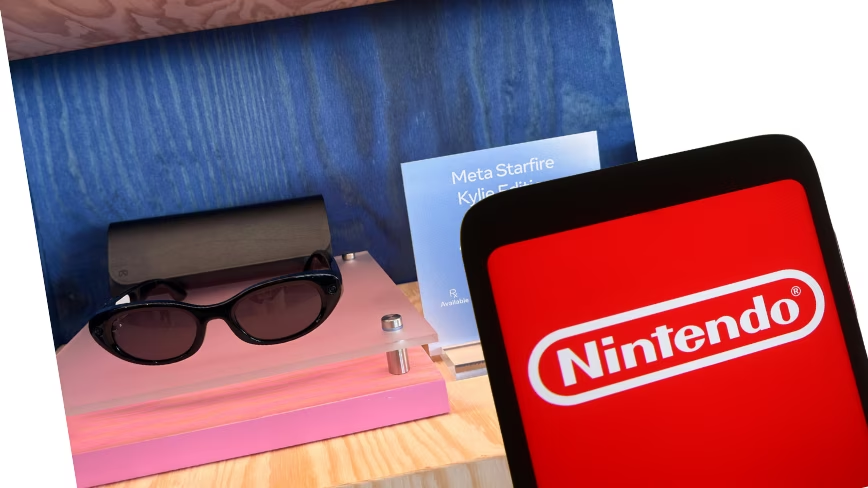
Meta Glasses and Nintendo logo
 Credit: TNW( Meta glases) & Shutterstock
The European Commission has exempted wearable technology from rules requiring batteries that users can remove and replace. The change clears the biggest obstacle to Meta’s latest smart glasses reaching the EU, Politico reports.
The delegated act, adopted on Tuesday, adds six product categories to the exemption list. It covers wearable devices such as smartwatches and fitness trackers, electric toys, and equipment used in explosive atmospheres.
Parliament and national governments have 20 days to object. If they do not, it enters into force.
The contrast is hard to miss
These are not obscure rules. Under the Batteries Regulation, portable batteries in products sold in the EU must generally be removable and replaceable by consumers, to extend product life and improve recycling.
The law has real teeth. Nintendo is discontinuing the original Switch in Europe rather than comply, and portable devices must let owners swap batteries from February 2027.
So a games console has to meet the standard, and a camera worn on your face now does not. The regulation was designed to force manufacturers to rethink product design, and lifting out a whole category is a retreat from that.
What Washington said
The lobbying was not subtle. In March, US Ambassador to the EU Andrew Puzder said the rules were so broad and restrictive that they prevented the sale of a wonderful, jointly developed US-European product.
He called the glasses very stylish, and told Europe it had to focus on letting businesses grow and innovate. That is an ambassador arguing for a single American company’s product line.
The Commission rejects the implication flatly, saying it has not given in to anyone’s pressure. On the evidence, that denial holds up better than the framing around it.
The inconvenient timeline
The Commission’s own account is checkable, and it checks out. It launched the call for applications for new exemptions in 2025, a year before Puzder said a word.
External experts then assessed the technical merits of the applications received, alongside consultation with consumer groups, industry, and member states. This was a process already in motion, not one conjured up in response to an ambassador.
The exemption is also narrower than “exempted” implies. Under the Commission’s text, these batteries must still be removable and replaceable by independent professionals, so it is end-user removal that has been waived, not repairability.
There is precedent, too. Medical devices and wet appliances like electric toothbrushes already sit in exactly this category, exempted on safety grounds and repairable by professionals.
The criticism that survives all that
BEUC, Europe’s largest consumer organisation, still calls it a dangerous precedent. Exemptions should be genuine exceptions based on technical and safety evidence, not industry pressure, its digital policy chief Cláudio Texeira said.
That objection does not depend on the timeline. Even a properly run process can reach an outcome that hollows out a flagship green law one category at a time.
The Commission itself concedes the stakes. Its release notes that small lithium-ion batteries thrown away incorrectly are causing a rising number of fires at waste treatment plants, which is precisely what removability was meant to reduce.
And the mood music matters, given that Europe has been dismantling its own rulebook to compete with America. A defensible decision can still arrive inside an indefensible trend.
The rule Brussels is not relaxing
None of this touches the harder problem. Smart glasses remain under serious privacy scrutiny, and a battery decision does nothing to resolve it.
The European Data Protection Board has commissioned a report on the category, due this summer, after which it will consider action. Irish and Italian regulators raised concerns as far back as 2021 about whether bystanders can tell they are being filmed.
The most damaging episode had nothing to do with batteries. Meta ended a contract with Sama after Kenyan workers said they were reviewing intimate footage captured through the glasses while annotating data to train AI models.
Meta points to its safeguards, including an LED that lights when recording and tamper detection to stop people covering it. It has since pushed an update disabling the camera if that light is destroyed, which is a real fix to a real exploit.
Who actually wins
Commercially, this is a significant unlock. More than 7 million pairs of Meta smart glasses sold worldwide in 2025, and EssilorLuxottica says US sales are ramping exponentially while European distribution lags, with over half of sales points still unserved.
Samsung, Google, and Apple all have smart glasses plans, and all of them benefit. The category is being made easier to sell at the same moment it is under investigation over privacy.
That is not incoherent, because battery rules and privacy rules answer different questions. But Brussels has removed a hardware barrier for a device it has not yet decided is acceptable, and the burden of that sequencing is now its own.
Get the TNW newsletter
Get the most important tech news in your inbox each week.
Also tagged with


