The next great game may not come from a million-dollar studio
Credit: Canva
TL;DR
The GDC 2026 survey shows 28% of game developers were laid off in two years and 36% now use generative AI. Former Boston Dynamics engineer Robert Brownstein runs Gnarled Helix, a ~10-person indie studio that used AI-assisted development to prototype a chess-resource-management game in days after spending years on a higher-budget project. He keeps AI-generated art out of the production pipeline while using LLMs for coding and ideation, and has built Tauric Tools, a free collaborative level editor.
The economics of making a blockbuster game are starting to look as demanding as the games themselves. Development cycles stretch across years, budgets climb into extraordinary territory, and a single failed release can erase enormous amounts of investment. The industry’s latest workforce data makes the pressure difficult to ignore. 28% of respondents to the 2026 Game Developers Conference State of the Game Industry survey said they had been laid off during the previous two years, while two-thirds of AAA respondents said their companies had experienced layoffs.
The problem is not simply that games cost more to make. Bigger production commitments can also make experimentation harder. Sony’s Concord, reportedly eight years in development, was pulled from sale only two weeks after launch after failing to find an audience, illustrating how quickly an enormous production cycle can collide with player expectations. The lesson is uncomfortable for an industry built around increasingly ambitious bets; scale can magnify both the potential payoff and the consequences of being wrong.
Meanwhile, the tools available to smaller developers are changing rapidly. The 2026 GDC report found that 36% of game-industry professionals now use generative AI in their work, with code assistance and prototyping among its common applications. Yet 52% believe generative AI is having a negative impact on the industry, showing just how unsettled the technology’s place in game development remains.
This tension points toward a consequential question for gaming: if smaller teams can test ideas faster and iterate without carrying the financial weight of a major production, could originality become a more meaningful competitive advantage than production scale?
Robert Brownstein believes it can. His own experience has given him a close view of how quickly development economics are changing.
Brownstein, a full-stack developer who earned a computer science degree in 2014, most recently worked at Boston Dynamics, where he helped build software for Spot, the company’s quadruped robot. He later applied that engineering background to Gnarled Helix LLC, a roughly 10-person studio that grew from a side project he pursued while working at Boston Dynamics. Brownstein notes that moving from web development into game development also changed how he thought about building products, particularly the value of testing an idea before committing heavily to it.
Credit: Gnarled Helix LLC
“Rapid prototypes are lower risk,” Brownstein says. “You’re able to produce something that you can verify as fun and meaningful before you spend all this budget on art that maybe no one’s ever going to see.” AI has accelerated that philosophy for his team. Brownstein notes that tools such as large language models have shifted Gnarled Helix toward ideation and prototyping, allowing engineers to spend less time buried in implementation details. He sees AI as useful precisely because human developers remain responsible for understanding and evaluating its output.
“Everything we do, AI-wise, is gated by a human. The real constraint is maintaining enough technical understanding to know what the tools are producing,” he explains.
AI’s growing role in game development has also sharpened an older industry question: where does production efficiency end and creative authorship begin? As developers adopt AI for coding, prototyping and other technical work, the debate is increasingly about which parts of a game should remain distinctly human. Brownstein’s approach offers one example of that boundary. At Gnarled Helix, he says AI-generated art does not enter the production pipeline, while game design, graphics and writing remain human-led. His approach reflects a wider concern for an industry trying to absorb advancing tools rapidly without allowing efficiency to become the measure of creative value.
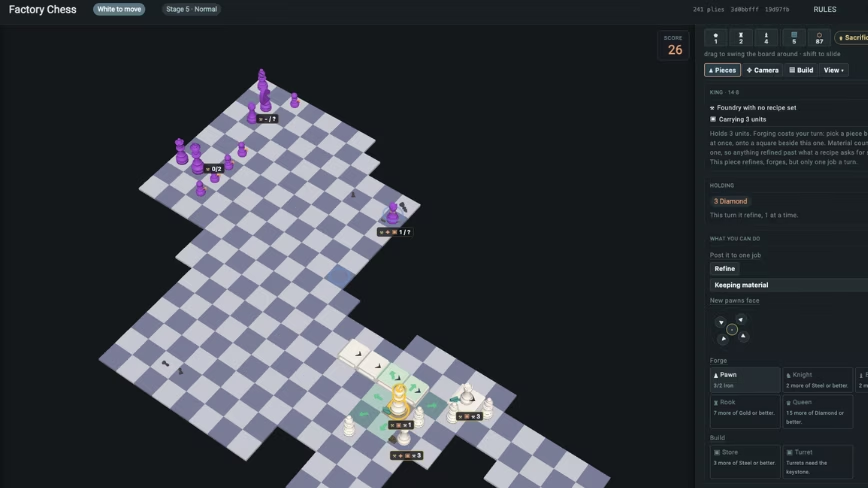
This stringency is visible in the studio’s forthcoming chess project, which emerged from Brownstein’s interest in chess and Satisfactory. The game turns captured pieces into resources that can be extracted, refined, and converted into new pieces, placing a familiar ruleset inside an unfamiliar economic system. Its single-player roguelike mode expands the board across waves while introducing different armies and economies; another mode allows players to use the mechanics in a traditional chessboard setting.
The project also reflects a shift Brownstein sees across the industry. He believes smaller teams can move through experimental ideas without exposing every prototype to the public risk that accompanies major publishers. Gnarled Helix’s own development history gave him a practical lesson in that process: the studio spent years developing a higher-budget programming-learning game, then used AI-assisted development to produce a new chess concept in days.
Game development is also creating demand for tools that can make production more efficient. Brownstein’s Tauric Tools grew from his experience building map-editing systems across several companies, translating that expertise into a free level editor with real-time collaboration and interchange support for formats including AutoCAD drawings, Tiled files, and GeoJSON, with Brownstein considering future white-label applications for other businesses.
The direction of gaming may ultimately depend on how quickly it can discover what players want. Brownstein expects more technically capable developers to move into independent gaming as AI lowers some production barriers, creating opportunities for small teams to attempt projects that would be difficult to justify at AAA scale. His goal for Gnarled Helix follows the same direction. He says, “What I really want to do with this studio is find novel mechanics that people haven’t tried before and try and make games out of them.”
If the next generation of developers can combine sophisticated tools with fast experimentation, gaming could become a market where a small team does not need to imitate the production model of a giant publisher to command attention. Success, in Brownstein’s view, increasingly hinges on finding the more interesting idea, testing it sooner, and giving players a reason to keep playing.
Get the TNW newsletter
Get the most important tech news in your inbox each week.



 Credit: Canva