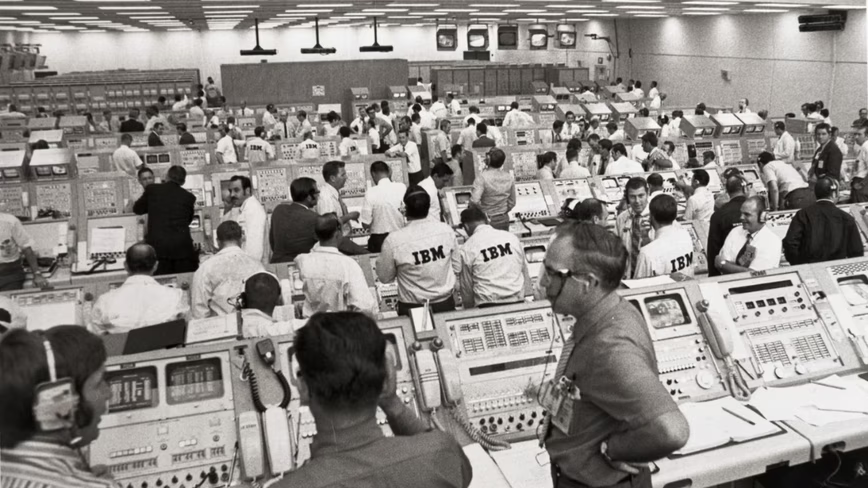
The Cape Kennedy Launch Control Center, where IBM engineers and technicians
developed test support for the guiding instrument units and produced the computer programs
for the machines supporting the launch of the 3,000-ton rocket with a 40-ton payload.
 Credit: IBM
IBM and NASA are releasing an AI model trained on decades of observations of the Moon, and making it available openly. The NASA-IBM Lunar Foundation Model is arriving on Hugging Face alongside what its creators describe as the first unified, machine-learning-ready dataset of the Moon.
The problem is not a lack of data; it is the opposite. Instruments have been observing the Moon for decades, producing petabytes of information. Scientists, however, still often work through maps and images manually or build separate models for individual tasks.
Neither approach works well at scale. Going through the data by hand takes too long, while models built for a single task are often low resolution and costly to run. Much of the lunar archive therefore remains difficult to use.
The dataset could end up being more important than the model itself. IBM and NASA scientists combined more than 30 spatially aligned layers from nine instruments across four missions, using data from NASA’s Lunar Reconnaissance Orbiter and GRAIL missions, as well as Japan’s SELENE/Kaguya mission.
There was no comparable public dataset before. Lunar observations have traditionally been stored in different formats and at different resolutions, making them difficult to combine. That has been one of the main barriers to applying machine learning to a field that has accumulated far more observations than researchers can realistically process.
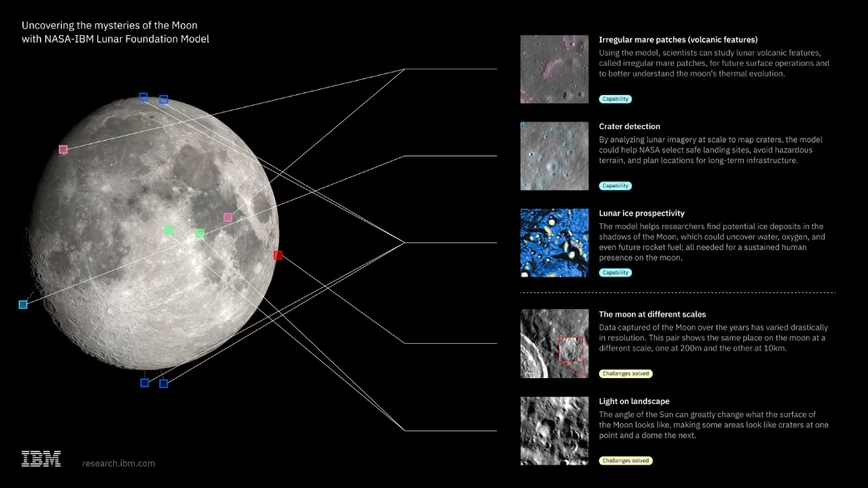
analyzing lunar imagery and data at scale. Credit: IBM — Credit: IBM
One of the clearest applications is finding ice. Permanently shadowed craters are among the most difficult places on the Moon to observe, but they are also some of the most promising locations for subsurface ice. That ice could provide water and oxygen, as well as raw material for rocket fuel.
The model estimates where ice could be found by combining observations captured at different resolutions. IBM says it reduced the error in identifying areas with high ice potential by 23% compared with SwinV2-B, a general-purpose vision model trained on ImageNet.
The other results are less dramatic. For volcanic features, the improvement is 3%, based on imperfect labels. For crater detection at metre-scale resolution, the model performs about as well as SwinV2-B rather than better, although it requires less computing power.
Efficiency is a more consistent part of the case for the model than accuracy alone. At roughly 100-metre resolution, it outperforms SwinV2-B by nearly 19% while using half as much training data. For research groups without large computing budgets, that kind of difference can matter.
Juan Bernabe-Moreno, director of IBM Research Europe, UK and Ireland, described the model in terms of access.
“The NASA-IBM Lunar Foundation Model gives scientists a foundation to explore the Moon at scale, connecting observations across instruments, revealing patterns that are difficult to see in isolation,” he said.
Crater mapping also has a practical role beyond research. NASA uses it to select landing sites, avoid steep slopes and boulders, and assess where future lunar infrastructure could be built.
The model is part of IBM’s Prithvi family, which now includes models for geospatial data, weather, heliophysics and the Moon. The same partnership previously produced a model with ESA designed to give an intuitive understanding of Earth. The idea is the same: adapt one shared model to different problems instead of building a new system for every question.
Europe is also stepping up its interest in lunar exploration. ESA has opened a call for lunar mission technology and is developing an autonomous robot to explore lunar caves. Both efforts will need detailed information about the terrain, the kind of information this model is designed to help extract.
Water remains one of the main reasons researchers are looking for lunar ice. The UK has funded a space mirror concept designed to melt lunar ice into drinking water, but such a system is only useful if there is a reliable way to identify where that ice is.
There is also an interesting detail about where the model is being published. It is going to Hugging Face, which Nvidia agreed last week to acquire for $12.93bn. The platform that has become a default home for open AI models is therefore about to have a commercial owner.
IBM and NASA have not provided a model size, parameter count, licence, or architecture description. Those are among the first things a research team would need to know before deciding whether and how to adapt the model for its own work.
Get the TNW newsletter
Get the most important tech news in your inbox each week.


