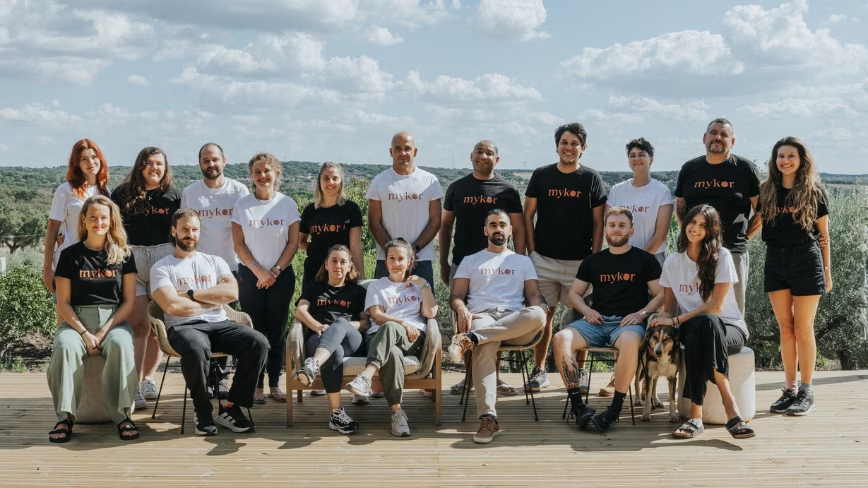
The Bristol-and-Lisbon climate-tech firm is scaling MykoFoam, a carbon-negative mycelium insulation panel grown from industrial residues at its Portuguese pilot plant.
Mykor, the Bristol-headquartered climate-tech firm growing carbon-negative building insulation from mycelium and industrial farm waste, has raised €4.6m to scale its production.
The round is roughly four times the size of the company’s previous funding total and is the largest single capital injection it has taken since founders Olivia Page and Valentina Dipietro started the business in 2021.
Mykor’s product is one of the more visually unusual things being scaled in European climate-tech right now.
MykoFoam, the company’s flagship insulation panel, is grown rather than manufactured: agricultural residues from the company’s Alentejo region in Portugal are inoculated with fungal mycelium, which threads through the waste material and bonds it into a rigid panel over roughly four weeks.
The resulting product is comparable in thermal performance to petroleum-based polyurethane and polystyrene foams.
It uses, according to the company, 90% less water, 40% less energy and 60% less CO&sub2; than conventional alternatives. The pilot facility in Montemor-o-Novo, Portugal, runs on over 75% solar energy.
The market it is entering matters. Construction is responsible for roughly 37% of global CO&sub2; emissions when materials, operations and end-of-life are tallied together, and insulation is one of the harder sub-categories to decarbonise.
Most existing low-carbon insulation alternatives, cellulose, wood fibre, hemp, sheep’s wool, occupy small premium niches and have struggled to break into the mainstream construction-procurement chain on price and consistency.
Mykor’s claim is that MykoFoam is up to 35% cheaper than other environmentally friendly insulation products while offering better fire resistance, the regulatory pinch-point that has historically kept bio-based panels out of multi-storey applications.
The competitive set is real and growing. UK-based BIOHM and Dutch GROWN.bio are running similar mycelium-construction businesses on smaller scales.
Italy’s Mogu sells acoustic wall panels rather than thermal insulation. US firm Ecovative has been the category pioneer for 15 years; MycoWorks is the most visible name on the high-end mycelium leather side.
The most-funded European mycelium company, Forêt, raised a $58m round in early 2024. Mykor’s €4.6m sits firmly in the early-scale band of that competitive landscape but with the advantage of having an operating pilot facility and a finished product already in regulatory review.
The founder story is its own asset on the cap-table side. Dipietro was named a UN Young Champion of the Earth and appears on Forbes 30 Under 30. Page brings the operating-engineer half of the partnership.
The team has worked through a sequence of pre-seed, seed and now scale-up rounds with European climate-focused investors including Sustainable Ventures, Green Angel Ventures, Rumbo Ventures and the Pera Innovation fund.
The company has also received Innovate UK grants and was a 2024 Green Tech Fund winner, which gives it the regulatory bona fides European construction buyers want to see before committing to specifying a novel material in their projects.
The harder commercial question is the gap between pilot-scale production and the volumes a mainstream-construction insulation business needs. A 100-square-metre detached house typically uses around 500 to 800 square metres of insulation board.
The European insulation market shipped roughly 600 million cubic metres of equivalent product in 2024. Mykor’s Portuguese plant is a meaningful pilot but not yet a fraction of one percent of that demand.
The €4.6m round is therefore best read as a Series A intended to fund the next plant, the certifications stack needed for multi-storey use, and the early commercial partnerships with construction firms willing to specify MykoFoam in real builds.
The round’s specific lead investor was not separately disclosed. Mykor’s prior backers have visibly leaned into follow-on participation through earlier rounds, and several are expected to be in this one as well.
The company says deliveries from its Portuguese plant will scale meaningfully through the second half of 2026.
Get the TNW newsletter
Get the most important tech news in your inbox each week.


