TL;DR
Opening arguments in Musk v. Altman began Tuesday in Oakland. Musk’s lawyer Steven Molo told the jury “the defendants stole a charity” and used a museum/Picasso analogy. OpenAI’s William Savitt countered that Musk “didn’t get his way” and wanted to merge OpenAI into Tesla. Key exhibit: a Shivon Zilis email showing Musk was presented with for-profit options. Musk took the stand as the first witness, renouncing personal damages and pledging any award to OpenAI’s nonprofit. The judge warned Musk about his “Scam Altman” social media posts.
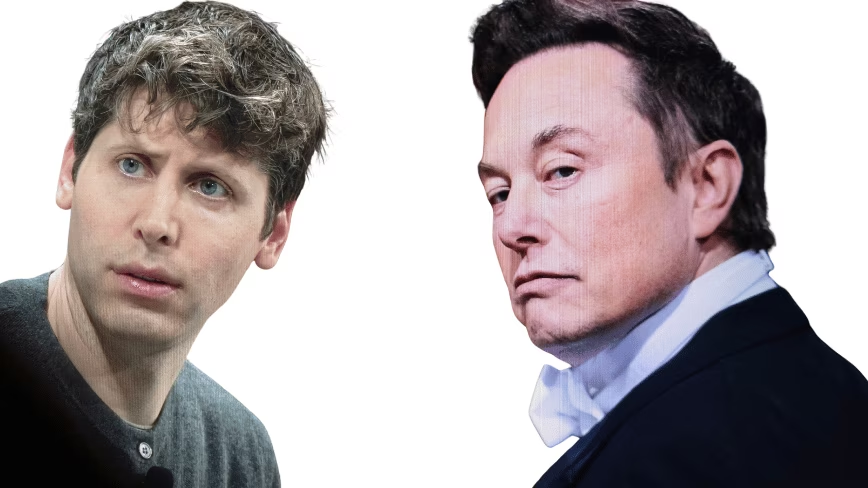
“Ladies and gentlemen, we are here today because the defendants in this case stole a charity.” That was how Steven Molo, Elon Musk’s lead trial lawyer, opened the most consequential technology trial in a generation on Tuesday morning in an Oakland federal courtroom. Molo told the nine-person advisory jury that without Musk, “there would be no OpenAI, pure and simple,” and that Sam Altman and Greg Brockman betrayed their co-founder and the public by turning a nonprofit dedicated to the safe development of artificial intelligence into what Molo called a “wealth machine.” William Savitt, representing OpenAI, Altman, and Brockman, offered a blunter counter-narrative: “We are here because Mr. Musk didn’t get his way at OpenAI. That’s what happened. He quit, saying they would fail for sure. But my clients had the nerve to go on and succeed without him. Mr. Musk may not like that, but it’s no basis for a lawsuit.” Musk then took the stand as the trial’s first witness. Both men were in the courtroom, in suits and ties, sitting at separate tables, in a trial that will last approximately four weeks and could result in remedies worth up to $134 billion flowing back into OpenAI’s nonprofit foundation, the removal of Altman and Brockman from their roles, or the forced reversion of OpenAI to a nonprofit structure.
The arguments
Molo’s strategy was to make the case simple. He avoided technical AI language and told a moral story about charity theft. His central analogy: a nonprofit museum can open a gift shop, but “the museum store can’t loot the museum and sell the Picassos.” The turning point in Molo’s narrative was Microsoft’s $10 billion investment in January 2023, which valued OpenAI at $20 billion. “This was not consistent with the nonprofit’s mission,” Molo told the jury. “It violated every commitment the defendants made, not just to Elon, but to the world.” He framed Musk’s roughly $38 million in donations as forming a charitable trust that required the company to remain a nonprofit in perpetuity, and the for-profit conversion as a breach of that trust. Molo asked Musk to stand during the opening. Musk stood and waved to the courtroom. Molo urged jurors to set aside any preconceived opinions about the Tesla and SpaceX chief executive.
Savitt’s counter-argument was that Musk wanted control, not charity. He told the jury that in 2017, Musk tried to take over OpenAI and merge it with Tesla, and that the other founders refused. “The other founders refused to turn the keys of artificial intelligence over to one person. One person having control wasn’t consistent with OpenAI’s mission.” Savitt then showed the jury an email from Shivon Zilis, a former OpenAI board member, to Sam Teller, who worked for Musk, describing two restructuring options: rolling everything into a B corporation, or creating a separate OpenAI C Corp alongside the nonprofit. Savitt’s point was that Musk was presented with for-profit options and supported them. “He supported a for-profit, so long as he was in control,” Savitt said. He claimed Musk “never expressed the view that OpenAI had to remain purely nonprofit, or even that he thought it should be.” In a 2023 email entered as an exhibit, Altman told Musk he was his “hero” but that he was hurt by Musk’s attacks on OpenAI. The exhibit record includes hundreds of pages of emails, texts, and call logs.
The witness
Musk took the stand after a 20-minute recess following opening statements, making him the trial’s first witness. “If we make it okay to loot a charity, the entire foundation of charitable giving in America will be destroyed. That’s my concern,” he told the jury. He described his life history, including his roles at Tesla, SpaceX, and Neuralink, establishing his longstanding interest in safe AI development. Musk is no longer seeking damages for himself personally. He has renounced any personal financial benefit from the case and pledged to redirect any award to OpenAI’s nonprofit foundation. The two remaining claims, unjust enrichment and breach of charitable trust, seek up to $134 billion in wrongful gains returned to the charity, the removal of Altman from the board and from his role as chief executive, the removal of Brockman as president, and the reversion of OpenAI to its original nonprofit structure. The trial that began with jury selection on Monday is now in its liability phase, with the jury’s verdict serving as advisory guidance for Judge Yvonne Gonzalez Rogers, who will make the final determination. A remedies phase, if Musk establishes liability, is expected to begin on May 18.
The trial is scheduled for approximately four weeks, with testimony allocations that reflect each witness’s significance. Musk and Altman are each expected on the stand for more than two hours. Brockman is scheduled for two and a half hours. Satya Nadella, Microsoft’s chief executive, will testify for approximately one hour. Ilya Sutskever, OpenAI’s co-founder, will appear for 30 minutes. Mira Murati, OpenAI’s former chief technology officer, will appear via videotaped deposition rather than in person, for roughly one hour. Stuart Russell, the UC Berkeley AI safety researcher and co-author of the foundational textbook “Artificial Intelligence: A Modern Approach,” will serve as one of Musk’s expert witnesses, likely testifying on whether OpenAI’s mission shift endangered safe AI development. David Schizer, Columbia Law’s dean emeritus and author of “How to Save the World in Six (Not So Easy) Steps,” will testify on charitable trust law.
The subtext
Before the jury was seated on Tuesday morning, OpenAI’s lawyers raised concerns about Musk’s social media posts from Monday, in which he called Altman “Scam Altman” and accused him of stealing a charity. Judge Gonzalez Rogers told Musk to “try to control your propensity to use social media to make things worse outside this courtroom,” adding: “Perhaps you’ve never done that before.” She said she was loath to issue a formal gag order but encouraged both sides to minimise their public commentary. Both Musk and Altman agreed. The exchange captured the trial’s fundamental tension: Musk is simultaneously the plaintiff arguing that OpenAI’s leadership cannot be trusted with the world’s most powerful technology and the man who posts “Scam Altman” on the social media platform he owns while the jury is being selected. All 11 of xAI’s co-founders have departed the AI company Musk launched in 2023, and Musk is tearing xAI down to rebuild it weeks after folding it into the SpaceX IPO filing that would create a $1.75 trillion conglomerate with Musk holding 79 per cent of voting power. He is suing Altman for concentrating control of AI while building the most concentrated corporate structure in technology history.
OpenAI’s defence will lean heavily on the argument that Musk’s lawsuit is competitive, not charitable. Savitt told the jury that Musk “quit, saying they would fail for sure” and then launched xAI to compete directly with the company he is now suing. The Zilis email is designed to undermine the core of Musk’s case: if he was presented with for-profit restructuring options and supported them, his claim that the nonprofit conversion was an unauthorised betrayal becomes harder to sustain. But the email is a double-edged exhibit. It shows Musk engaging with restructuring options, which weakens his claim of surprise. It also shows Musk insisting on personal control as a condition, which supports OpenAI’s narrative that the lawsuit is about power, not principle. Fortune has called this “a trial almost no one thinks Musk can win.” Legal experts have noted the case may be analysed under the wrong body of law. Anthropic’s valuation has surged past $800 billion, co-founded by former OpenAI executives who left over the same safety concerns Musk is now litigating, a reminder that the question of whether OpenAI abandoned its mission is not Musk’s invention. It is a question that the people who built OpenAI’s most important safety research answered by leaving. The trial will determine whether the legal system agrees with them, or whether Musk’s own credibility is too compromised to be the vehicle for that argument.


 Credit: Shutterstock