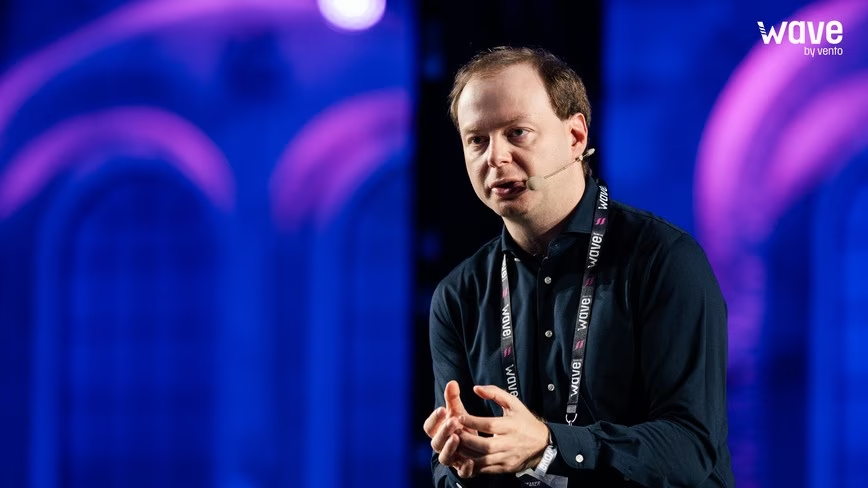
Miro co-founder and CEO Andrey Khusid speaking at Wave by Vento in Turin
 Credit: Wave by Vento
Miro co-founder and chief executive Andrey Khusid says adding AI to existing teams and processes will not deliver its full productivity gains. Companies need to redesign how work happens from the ground up, he said. He spoke at Wave by Vento in Turin on Wednesday.
“One of the big challenges is how not to put AI on top of the existing teams or operational systems, but actually, from first principles, design the workflow and then only add humans to add value on top of that workflow,” Khusid said.
The session was titled “Thinking Together in the Age of AI”. Charlie Perreau, who heads the tech, media and startups section at Les Echos, moderated it.
Khusid’s appearance in Italy came a month after Milan-based Bending Spoons agreed to buy Miro for $1.355bn. Bending Spoons expects the deal to close in the fourth quarter, subject to approvals. Miro has about $600m in annual recurring revenue, according to Bending Spoons. It was valued at $17.5bn in January 2022, when it raised $400m. Khusid said he could not talk about it yet. He was happy to be in Italy, “maybe a new home for Miro”, he said.
Why personal gains do not add up
Most people now use AI tools such as Claude or ChatGPT every day, Khusid said. The hard part is changing how whole companies operate.
Companies run on complex workflows, he said, in which work passes from one person to the next. Each person holds a different piece of the context, and it is rarely in one place. The first job is to bring that context together, so teams can work from it.
Spreading AI across an existing operating model will not give the gains people expect, he said. In some areas, Miro set up parallel teams that did the same work with AI. It built the process around them, then scaled it to the rest of the company.
More voices, more noise
AI gives quieter people a better way to share their ideas, Khusid said. They can quickly turn a prompt into a prototype that others can see.
But it also creates far more content, he said. If everyone throws AI output at their team, he said, it overwhelms the team and slows everyone down. In June, the Harvard Business Review warned about AI ‘workslop’ in companies. Khusid’s answer is accountability: each person has to own every piece of what they bring.
Intelligence at the centre
Organisations were built around people and hierarchy, with knowledge held by individuals, Khusid said. In new companies, a central intelligence knows almost everything that happens. People tap into it to decide and move fast.
Established companies have to rebuild their own intelligence infrastructure and rethink which roles they need, he said. Startups built this way move faster and decide better, which creates urgency for everyone else. In July, UK figures showed businesses had tripled their AI adoption, though most still used it only lightly.
Miro is 15 years old. Much of its code is already written with AI help, Khusid said, and the company has merged systems to give AI better context. He said there has been little disruptive change in models lately. It is already clear what they can do over the next three years. So Miro builds around that rather than chasing every release.
Humans and AI agents already work side by side in startups and large companies, he said, but people stay accountable. Miro is building a system where people and agents work on the same canvas. Within three years, he expects Miro to rely more on voice and conversation, with visual decision-making as the main way teams decide.
Khusid said Miro started in 2011 but only saw meaningful traction in 2016. His advice to founders is to work on something they love and to listen to their own intuition.
Get the TNW newsletter
Get the most important tech news in your inbox each week.


