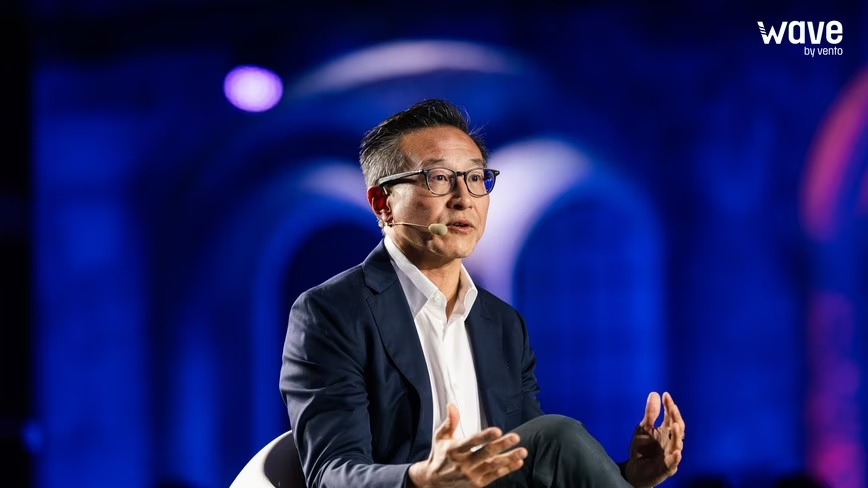
Alibaba co-founder and chairman Joe Tsai speaking at Wave by Vento in Turin
 Credit: Wave by Vento
Alibaba co-founder and chairman Joe Tsai says open-source AI is the only way for Europe to become independent in the technology. He spoke to founders and investors on Wednesday at Wave by Vento in Turin, in a session titled “The Other Side of the Story”.
“Open source is the opportunity for Europe… That’s the approach Europe can take to truly be independent. We talk about technology independence, we talk about AI sovereignty in Europe. I think the open source approach is the only way to go,” Tsai said.
James Anderson, managing partner and chief investment officer of Lingotto Innovation, led the interview. Exor owns Lingotto. Anderson spent more than three decades at Baillie Gifford, where he ran the Scottish Mortgage investment trust.
Alibaba’s two businesses
Tsai said Alibaba, founded in 1999, grew very big and lost focus over its first two decades. In 2023 it narrowed itself to two businesses: e-commerce and what he called “full-stack” AI. That runs from computing infrastructure to models to applications.
He said Alibaba uses about $25bn a year of free cash flow from e-commerce to fund the AI push. It has doubled its capital spending on computing infrastructure every year for the past three years, he said. In August, TNW reported that Alibaba’s AI spending had cut its quarterly profit by 75%.
By Tsai’s estimate, the US hyperscalers together will invest around $1tn this year, a scale China does not match. He said AI is already very good at saving people time. He put the market for knowledge-worker productivity at about $50tn.
Scarcity and open models
Anderson asked whether limits on China, including US curbs on chip supplies, had pushed its companies to innovate. Tsai said they had, and compared it to growing up without rich parents.
“If you are scraping all along, that drives you,” he said.
He said Chinese companies open-source their work on model design and inference efficiency, and still publish papers. The closed US labs no longer publish, he said, because they do not want to share.
Tsai said China accounts for about 30% of global industrial production, and its factories hold valuable data for training models. Its complete supply chains for electric vehicles, batteries and robots give it a further edge, he added.
What Europe should do
Asked how Europe can compete with the US and China, Tsai said the talent is already there. Europeans make up 20% to 30% of the staff at some US frontier labs, he said.
“It is not a talent problem,” Tsai said.
Instead, he said, Europe should look at demand. Its industrial companies, including those around Turin, hold factory data they would not want to send to a closed model. They could take open models, train them further on that data and run them themselves.
No country should fully trust another country’s technology, Tsai said. A change of government or circumstances could see it switched off. That applies to American and Chinese technology alike, he said, so having several choices matters. In September, the ECB’s Christine Lagarde warned that Europe risks being cut off without its own AI.
Tsai compared open-weight models to a recipe that anyone can take and improve. A company can run one in its own data centre and train it on its own data. It then no longer depends on the original developer, he said. It also avoids paying for access to closed models. On Tuesday, Paris-based Mistral released its Large 4 model, which has open weights.
The missing piece, Tsai said, is computing power. Europe needs to “get serious” about building data centres, he said, to train and run models on its own infrastructure. In June, Alibaba Cloud opened data centres in France.
The second generation
Anderson said part of the problem lies with his own industry. He recalled Spotify co-founder Daniel Ek telling him that Europe’s real trouble starts when it misses a second generation of technology. Europe has no companies that spend their cash flows the way US hyperscalers, Tencent or ByteDance do, Anderson said. Finance is not filling that gap.
Asked whether they would have the same conversation in five years, Tsai said AI would by then be part of every business, the way the internet is today.
“We’re not going to say AI anymore,” he said.
Get the TNW newsletter
Get the most important tech news in your inbox each week.
Also tagged with


