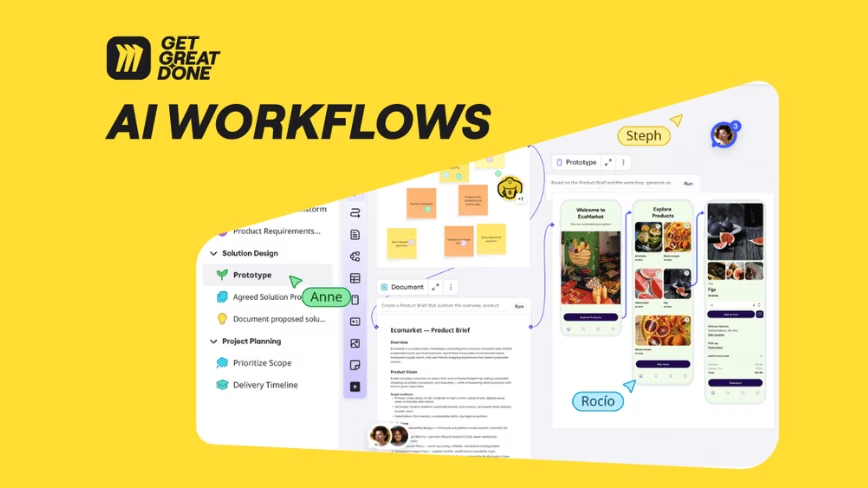
There is a particular kind of frustration that comes from feeding an AI tool the same context your team spent three days assembling on a whiteboard. You copy the sticky notes into a prompt, paste the diagram description, try to explain the relationships between ideas that were obvious when they were spatially arranged on a canvas, and watch the nuance collapse into a flat paragraph. The visual thinking that made the brainstorm productive in the first place gets lost the moment you leave the board.
Paid content by Miro. This article was commissioned and paid for by Miro and produced by TNW’s commercial team, not the newsroom. It contains affiliate links.
Miro, the visual collaboration platform used by more than 100 million people across 250,000 organisations, has been building toward a solution to this problem at considerable speed. In January 2026, it launched AI Workflows: a system of AI agents that work directly on the canvas where teams already collaborate, using everything on the board as context. No copying, no prompting from scratch, no switching between tools. The AI sees what your team sees. And in March 2026, Miro acquired Reforge, the product strategy and growth education company, signalling that it intends to pair AI collaboration tools with the frameworks teams need to use them well.
Why most AI tools fail teams
The gap between individual AI productivity and team AI productivity has become one of the more interesting tensions in enterprise software. According to Miro’s own research, three-quarters of global business leaders believe most AI tools focus too much on individual work, and 82 per cent want solutions that drive team productivity instead. That tracks with what most knowledge workers experience daily: an AI assistant that helps you draft a document is useful, but it cannot replace the collaborative process of aligning a cross-functional team around what the document should say in the first place.
Most AI tools operate in isolation. You prompt them individually, receive outputs individually, and then spend additional time synchronising those outputs with your team. The canvas, the place where ideas take shape visually and collaboratively, has historically been AI-free. Miro’s bet is that putting AI directly into that shared space changes the dynamic entirely.
Sidekicks and Flows: AI that works on the board
The two core components of Miro’s AI Workflows are Sidekicks and Flows.
Sidekicks are conversational AI agents that live on the canvas. They do not require carefully engineered prompts because they already understand the multimodal context around them: sticky notes, diagrams, documents, images, tables, and the spatial relationships between all of it. Think of them as collaborators who show up having already read every wall in the room. You can customise Sidekicks with specific skills and knowledge bases, meaning a product team’s Sidekick understands its domain differently from a marketing team’s.
Flows are multi-step visual workflows that chain AI actions together while keeping humans in the loop at every stage. A product team might build a Flow that takes a collection of user research notes, clusters them by theme, generates insight summaries, and produces a draft product brief, all on the same canvas where the original research lives. The team can intervene, redirect, or refine at any step. Early adopters report shrinking their innovation cycles from weeks to hours, with total delivery cost reductions exceeding 50 per cent.
The combination matters more than either feature alone. Sidekicks handle the conversational, contextual work. Flows handle the repeatable, multi-step processes. Together, they turn a collaborative whiteboard into something closer to an AI-augmented operating system for team thinking.
What teams are actually building with it
The use cases that have gained traction fastest tend to follow a pattern: messy collaborative input transformed into structured, shareable output.
Product teams use Flows to convert brainstorm sessions into prioritised roadmaps. Design teams connect Miro’s canvas to Figma through the new prototype export feature, so architecture diagrams and wireframes translate directly into design files. Engineering teams are using Miro’s MCP server (currently in beta, built in collaboration with Anthropic, AWS, GitHub, Google, and Windsurf) to connect boards to AI coding tools like Cursor, Claude Code, and GitHub Copilot. The result: system architecture diagrams on the canvas become the basis for AI-generated code that actually reflects the intended design, because the coding agent can see the board.
Workshop facilitators are gravitating toward Miro Engage, a beta tool for turning passive attendees into active participants during meetings, all-hands events, and training sessions. And the new AI Slides feature lets anyone generate a presentation deck using board content as source material, which means the output of a working session can become a stakeholder presentation without the usual hours of reformatting.
These are not theoretical possibilities. They reflect how teams at companies like PepsiCo, ASOS, and Deloitte are already using the platform.
The pricing question
Miro’s free plan still exists and remains genuinely useful: unlimited team members, three editable boards, and access to core canvas features. For individuals or small teams testing the waters, it is a reasonable starting point.
The Starter plan at $8 per member per month (annual billing) opens up unlimited boards and basic integrations. But the interesting shift is the Business + AI Workflows plan at $20 per member per month (annual), which is now Miro’s default Business tier for new subscribers. It includes 50 AI credits per member per month, full access to Sidekicks and Flows, SSO, guest editing, and advanced admin controls. For context, that puts it in the same bracket as a standard Notion or Figma team seat, but with a fundamentally different value proposition: collaborative AI on a visual canvas rather than in documents or design files.
Enterprise plans (custom pricing, 30-member minimum) raise the AI credit allocation to 100 per member per month and add data residency, SCIM provisioning, and SIEM integration. Miro holds ISO 27001 certification, ISO 42001 (AI management) readiness, SOC 2 compliance, and GDPR compliance, which matters for regulated industries evaluating the platform.
Where it fits and where it does not
Miro is at its strongest when teams need to think visually and collaboratively before producing structured output. Product development, strategic planning, service design, workshop facilitation, and cross-functional alignment are its natural territory. If your team’s workflow involves whiteboards, sticky notes, or diagrams at any stage, Miro’s AI layer now makes that stage dramatically more productive.
It is less suited to teams whose work is primarily text-based or individually authored. Writers, analysts working in spreadsheets, and developers who live in their IDE will find less immediate value in a visual canvas, even one with AI agents on it. Miro knows this, which is why its integrations list runs to 250+ apps: the platform works best as the collaboration hub that connects to wherever the execution happens.
The broader trend here is worth watching. The first wave of enterprise AI tools focused on individual productivity: write faster, summarise quicker, generate code. The second wave, which Miro is positioning itself at the front of, focuses on team intelligence: aligning groups of people around shared context and turning collective thinking into collective output. The Reforge acquisition reinforces that bet. Reforge built its reputation on teaching product and growth teams how to think strategically; combining that expertise with Miro’s AI canvas suggests the company is not just building tools, but trying to shape how organisations learn to work with AI in the first place. Add the new Singapore hub (announced March 2026) to accelerate growth across Asia, and the picture is of a company that believes the market for collaborative AI is global and largely untapped.
For companies where innovation depends on cross-functional collaboration (which is most of them), the question is no longer whether AI belongs on the whiteboard. It is whether your team can afford to keep it off.
Pricing is subject to change. Visit Miro’s website for the most current plans and details.
Get the TNW newsletter
Get the most important tech news in your inbox each week.
Paid content. This article was commissioned and paid for by Miro. It was produced by TNW's commercial team and the TNW newsroom was not involved in its creation. Links may be affiliate links, meaning TNW may also receive a commission on purchases. This does not affect the price you pay.


