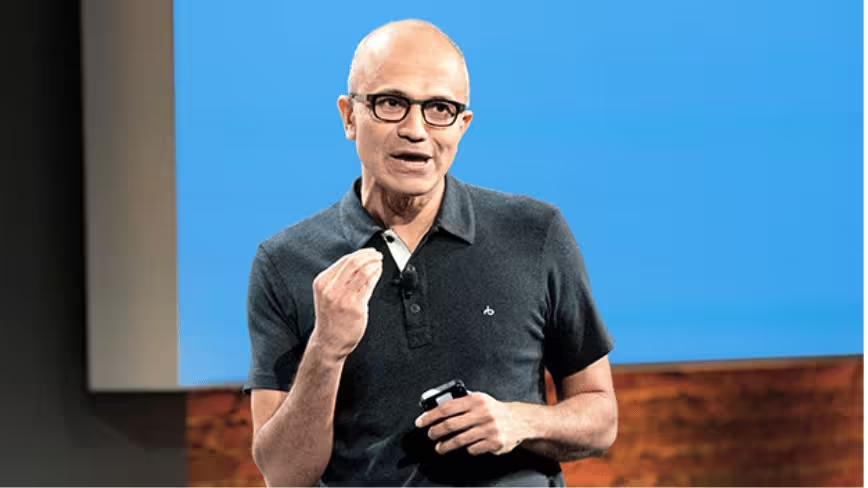
Satya Nadella, CEO, Microsoft
 Credit: Microsoft
Summary: Microsoft is offering voluntary retirement to approximately 7% of its US workforce (~8,750 of 125,000 employees) in the first such programme in its 51-year history, using a “Rule of 70” formula (age + years of service). The offer, disclosed by CPO Amy Coleman, targets senior director level and below, with details arriving 7 May and a 30-day window. It follows 15,000+ layoffs in 2025, a March 2026 hiring freeze (AI teams exempt), and comes as Microsoft spends $80B+ on AI infrastructure while reporting $81.3B quarterly revenue.
Microsoft is offering voluntary retirement to approximately 7% of its US workforce, roughly 8,750 employees out of 125,000, in the first programme of its kind in the company’s 51-year history. The offer, announced in an internal memo on Wednesday by Amy Coleman, the company’s chief people officer, uses what Microsoft calls the “Rule of 70“: employees at the senior director level and below whose age plus years of service equal 70 or more are eligible. Workers on sales incentive plans are excluded. Eligible employees will receive details on 7 May and have 30 days to decide. The package includes a financial payout and extended healthcare. Coleman wrote that “our hope is that this program gives those eligible the choice to take that next step on their own terms, with generous company support.”
The word “voluntary” is doing considerable work in that sentence. Microsoft eliminated more than 15,000 positions in 2025, including roughly 9,000 in a single round in July and 6,000 in May. In March 2026, it froze hiring in its Azure cloud and North American sales divisions while explicitly exempting AI and Copilot teams from the freeze. The voluntary retirement programme is a softer instrument than a layoff notice, but it arrives in the same sequence and serves the same strategic purpose: making the company smaller in the places where it does not need to be large, and redirecting the savings toward the places where it does.
The financial context
Microsoft is not struggling. Its most recent quarter, the second of fiscal year 2026, reported $81.3 billion in revenue, up 17% year over year, with operating income of $38.3 billion, up 21%. Net income rose 60% to $38.5 billion. Microsoft Cloud revenue passed $51.5 billion, with Azure growing 39% in constant currency. The company returned $12.7 billion to shareholders through dividends and buybacks in the quarter alone, a 32% increase. Third-quarter results are due on 29 April, with revenue guidance of $80.65 billion to $81.75 billion.
The number that sits alongside those profits is $37.5 billion in capital expenditure in a single quarter, up 66% year over year, nearly all of it directed at AI infrastructure. Microsoft has committed more than $80 billion to AI data centres and compute capacity. Satya Nadella has described the company’s 220,000-plus headcount as a “massive disadvantage” in the AI race, a remarkable statement from the chief executive of one of the world’s most valuable companies. The voluntary retirement programme is one answer to that diagnosis: reduce the denominator without the headlines that come with mass layoffs.
The pattern across Big Tech
Microsoft is not doing this alone. Oracle eliminated up to 30,000 employees in March to fund AI data centres, delivering the news via 6 a.m. emails with no warning. Meta plans to cut 8,000 jobs on 20 May as part of its AI restructuring, while simultaneously doubling its AI infrastructure spending to between $115 billion and $135 billion. Atlassian cut 1,600 jobs and replaced its chief technology officer with two AI-focused executives. Amazon signalled roughly 30,000 cuts in the first half of 2026 across Alexa, AWS, and Prime Video. By April, more than 95,000 tech workers had lost their positions across 249 companies in 2026, with an estimated 44% of those reductions directly or indirectly linked to AI automation. In the first quarter alone, 78,557 jobs were eliminated.
The mechanics differ. Oracle’s approach was blunt and immediate. Meta’s is phased, with a second wave planned for the second half of the year. Microsoft’s is the most unusual: genuinely voluntary, targeted by tenure and age rather than division or performance, and accompanied by a 30-day decision window rather than a walk-to-the-door escort. The Rule of 70 formula means the programme disproportionately affects long-tenured employees in their fifties and sixties, the people who built the pre-AI Microsoft and whose institutional knowledge is hardest to replace but whose roles are, in the company’s calculus, most susceptible to automation or elimination.
The AI trade-off
The hiring freeze exempts AI teams. AI and machine learning engineering roles carry a 56% wage premium over comparable non-AI positions. The company is spending $80 billion on infrastructure while offering buyouts to the people who maintain the systems that infrastructure is designed to replace. The trade-off is explicit and, within Microsoft’s strategic logic, internally consistent: every dollar saved on headcount in enterprise sales, middle management, and legacy engineering is a dollar available for GPU clusters, model training, and Copilot development.
Whether the logic holds depends on a question that AI is not eliminating roles so much as the organisational structures that justified them. A senior programme manager with 20 years of experience and a salary of $250,000 is expensive. If AI tools can automate 40% of the coordination, documentation, and status-reporting that programme management entails, the company does not need fewer programme managers; it needs different ones, or fewer layers of them. The voluntary retirement programme offers the most expensive employees a dignified exit. What it does not offer is a plan for what happens when the institutional memory walks out the door with them.
The “AI-washing” of layoff announcements has become a pattern across the industry: companies invoke AI transformation as the rationale for workforce reductions that are, in many cases, driven by margin pressure, organisational bloat, or Wall Street expectations. Microsoft’s case is harder to dismiss as pretextual than most. The company is genuinely spending at a scale that requires trade-offs. It reported $37.5 billion in capex in a single quarter. That money has to come from somewhere, and headcount is the largest controllable expense in a software company. But the fact that Microsoft is profitable, growing, and returning billions to shareholders makes the “we must cut to invest” argument less about necessity and more about allocation. The company can afford both. It is choosing not to.
What comes next
The programme’s uptake will depend on the specific terms disclosed on 7 May and on the alternative: what staying at Microsoft looks like for a 55-year-old senior director in a company that has told its workforce, through every structural signal available, that the future belongs to AI engineers in their thirties. Coleman’s memo also announced changes to stock compensation, giving managers more flexibility to reward high performers through adjusted stock awards decoupled from cash bonuses. The combination of a voluntary exit ramp for tenured employees and performance-linked equity for those who remain is a coherent, if cold, personnel strategy. It says: we will pay you to leave, and we will pay the people who stay to work harder.
Guggenheim reaffirmed its buy rating on Microsoft on Wednesday. Citi lowered its price target from $635 to $600 but maintained its buy recommendation, viewing fundamentals as “improving.” The market’s judgment, for now, is that a leaner Microsoft is a better Microsoft. The 8,750 employees eligible for voluntary retirement may reach the same conclusion, or they may decide that 51 years of precedent was broken for a reason, and that the next round will not be voluntary.
Get the TNW newsletter
Get the most important tech news in your inbox each week.
Also tagged with


