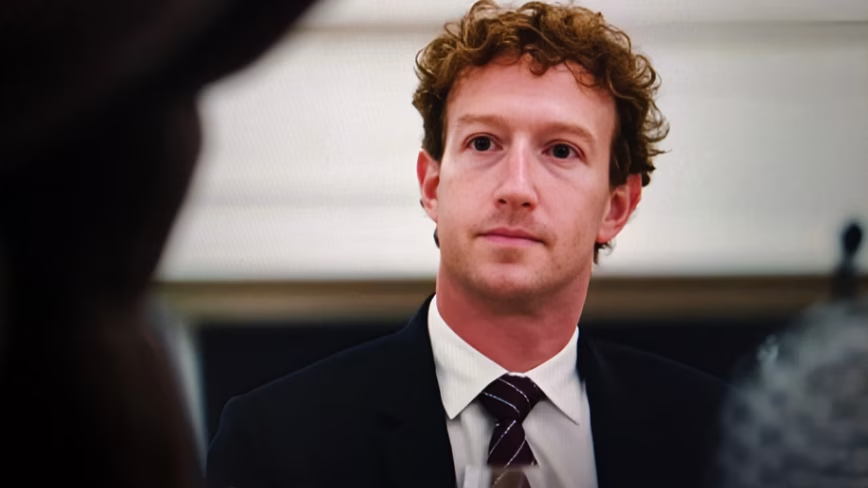
Meta CEO Mark Zuckerberg at a dinner with tech leaders in the State Dining Room of the White House in Washington, Sept. 4, 2025.
 Credit: FotoField / Shutterstock.com
A 2016 internal email stating that Instagram’s overall company goal was “teen time spent” is now an exhibit in an Oakland courtroom. It is one of several internal documents the states put before a federal judge this week, in the first case to reach trial out of a litigation covering 3,000 claims.
The trial opened on Tuesday before Judge Yvonne Gonzalez Rogers in the Northern District of California, six weeks after she declined to dismiss the case.
Four states, California, Colorado, Kentucky, and New Jersey, are trying consumer-protection and COPPA claims as the spearhead of a 29-state coalition.
Eight jurors are hearing it, five women and three men, but their verdict is advisory. Gonzalez Rogers decides liability and any remedy herself, a point most coverage has skated over.
Megan O’Neill, a California deputy attorney general, opened for the states with a four-word summary of the business model: hook the users, hold them, harvest their data, hide the truth.
“Meta said it prioritized safety over profits,” she said, “but it hid the reality that when it came time to make a decision, time and again profits won.”
She showed the court an internal study titled “Long Term Retention: The Young Ones Are The Best Ones”, examining usage among tweens roughly aged 10 to 12. “Meta found the younger a kid is when they start using the app, the better,” O’Neill said.
The hardest numbers came from a 2021 internal survey asking 13- to 15-year-olds about a single week on the platform. Of those asked, 27% had witnessed bullying, 21% had experienced negative social comparison, 13% had received unwanted sexual advances, 12.8% had seen violent content, and 8.4% had seen content about self-harm.
Both sides then claimed the same sentiment survey. The states highlighted the one in five teenagers who said they felt worse after using the apps; Meta pointed to the 41% in the same document who felt positively.
Paul Schmidt of Covington & Burling opened for Meta by conceding there is “no dispute” that some users struggle, while arguing the research shows no clear link between adolescent use and diminished wellbeing.
He took the jury through time-management tools introduced in 2018 and Teen Accounts launched in 2024. Meta shares closed down 4.4% that day.
Arturo Bejar took the stand on Tuesday afternoon as the states’ first witness. A Facebook engineering director from 2009 to 2015 and an Instagram wellbeing consultant from 2019 to 2021, he has now testified against the company in three trials, including the New Mexico case that ended in $942m of damages and the Los Angeles one where a jury found Meta and YouTube liable in March.
“Instagram changed from a product that you can use into a product that uses you,” he told the court. On what the company was capable of when it chose to be: “This is a company that is incredible at taking a metric and reducing it.”
Many products, he said, “were shipped into the world … and safety was not a consideration in how it was initially deployed”, citing Reels. On why he escalated: “I knew that in order to have a change in how the company is dealing with harm, it had to come from Mark himself.”
He was still under direct examination on Wednesday, questioned by Jason Slothouber for the states. The day’s new exhibit was his email to Chris Cox, Meta’s chief product officer, setting out a gap between the prevalence Meta reported and the harm users described in his own research.
Young people, the email said, “were experiencing harm at extraordinarily high rates”, and Arturo Bejar testified that a parent “would have wanted to have known”.
Gonzalez Rogers had already refused Meta’s attempt to bar him over deleted Signal messages, calling the motion a “Hail Mary”; its cross-examination had not begun by the close of Wednesday.
Mark Zuckerberg, Adam Mosseri, and Antigone Davis, Meta’s vice-president of public policy, are all expected to testify, in a trial listed for about six weeks with a ruling anticipated in early October. Brussels is examining the same design features under the Digital Services Act.
On the money, the states put realistic exposure at around $200bn. The $1.4 trillion figure in wide circulation is Meta’s own arithmetic ceiling, produced in a filing.
Get the TNW newsletter
Get the most important tech news in your inbox each week.


