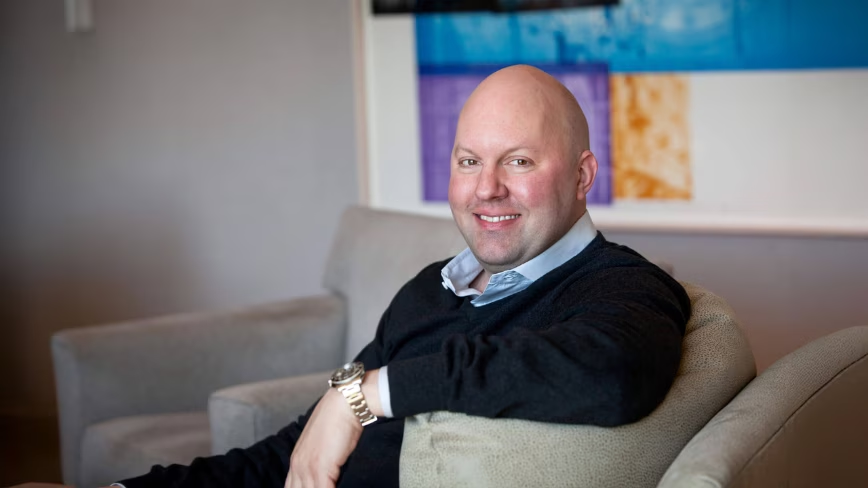

Andreessen now advises the Pentagon’s leadership on the very decisions his firm has invested billions around. It is legal, and it raises a question the rules were built to answer.
Pete Hegseth announced the membership of a freshly cleared-out Defense Policy Board, the advisory panel that counsels the Pentagon’s civilian leadership on force structure, modernisation, and the shape of American military strategy.
Thirteen names were on the list.
The chair went to Robert Lighthizer, the former trade representative. The vice chair went to Norm Coleman, a former senator.
And tucked among the appointees, between the diplomats and the defence hands, was a venture capitalist whose firm has spent the past three years assembling one of the largest private bets on the future of American warfare.
Marc Andreessen does not need an introduction in this publication, but the position does. The Defense Policy Board is not a ceremonial body.
It advises the defence secretary and the Pentagon’s policy chief on the questions that shape which technologies the military buys, which doctrines it adopts, and which companies it commits to for the next decade of procurement.
It is, in other words, one of the rooms where the direction gets set. And Andreessen arrives in that room with a great deal already invested in where it points.
The positions are not small. Andreessen Horowitz, the firm he co-founded, holds stakes in Anduril, Skydio, Shield AI, Saronic, and Flock Safety, a roster of companies whose fortunes track closely with the regulatory and procurement choices the Pentagon makes.
The best-known of them is Anduril, which a16z helped take to a $61bn valuation in a $5bn round, after the US Army handed the company a $20bn enterprise agreement in March.
This is not a portfolio that happens to sit near defence policy, it overlaps with it almost completely.
That overlap is worth sitting with, because of how the disclosure works. Board members who do not otherwise work for the government are appointed as special government employees, and special government employees file their financial disclosures on an OGE Form 450.
Unlike the public filings required of senior officials, the 450 is confidential and is not released to the public. So at the moment an investor with specific, named stakes in defence procurement joins the body that advises on that procurement, the document that would let the rest of us weigh the overlap for ourselves is the one we cannot see.
That is not a flaw anyone designed on purpose. It is just how the categories happen to line up, and it leaves a question sitting in the open.
The rules are real, and they are meant for exactly this. Federal law bars an official from participating personally and substantially in any particular matter that touches their financial interests, and an adviser who runs into one is expected to step back.
In practice it asks a person to notice, in the moment, when the advice they are about to give would benefit the companies they have invested in, and then to hold their tongue.
For most board members that is a light burden. For someone whose defence portfolio reads a lot like a list of Pentagon priorities, the recusals could end up so frequent that it is fair to wonder what is left to advise on.
None of which means Andreessen will handle it badly. It means the system is leaning hard on his judgement, and asking us to take the result on trust.
It is worth saying plainly that there is no suggestion Andreessen has done anything improper. He has not, as far as the public record shows, and the appointment is entirely above board.
The more interesting point is that this is not really about him. He is the most visible figure in a wider shift, a steady migration from Sand Hill Road into the federal government.
More than three dozen employees, allies, and investors connected to Elon Musk, Peter Thiel, Andreessen, and Palmer Luckey have taken roles across federal agencies since the administration took office, according to reporting compiled by ProPublica, in positions that touch billions in contracts.
Andreessen already sits on the President’s Council of Advisors on Science and Technology, and the Washington Post has described him as a talent networker for the cost-cutting effort known as DOGE.
What sets the defence seat apart is simply the scale of what is being decided. Venture capital poured a record $49bn into defence-tech startups in 2025, nearly double the year before, on a bet that the Pentagon is about to change how it buys, moving away from the legacy primes and toward the software-first, autonomy-heavy companies a16z has spent years backing.
A seat on the board that helps shape that shift is not a favour handed out. It is a place close to a decision that is worth an enormous amount of money, held by someone with a direct interest in how it goes.
The defenders of this arrangement make a real argument, and it deserves to be heard rather than dismissed.
The Pentagon, they say, has spent decades buying overpriced hardware on twenty-year timelines from a shrinking handful of contractors, while the actual technological frontier, in drones, autonomy, and AI, moved to startups the procurement system was structurally incapable of reaching.
Bring in the people who funded that frontier, the argument runs, and you finally get a defence establishment that moves at the speed of the threat. There is truth in it. The case for tapping operators who understand autonomous systems is not nothing.
The difficulty is that the same argument is the one an interested party would naturally make.
The investor who funded the disruptors believes, sincerely, that the disruptors should win, and that belief can be both genuinely held and aligned with his own balance sheet at once.
Conflict-of-interest rules exist precisely so that the public does not have to sort out which it is, case by case, on faith.
When the person making the case for a procurement overhaul also stands to gain from it, a sealed form and a reasonable assurance of good character is a thinner safeguard than the situation calls for.
For a long time, Silicon Valley described itself as something apart from the state, the outsider that would route around Washington rather than join it. That framing no longer fits.
The people who built the defence-tech boom are now helping to advise the institution that will decide its future, and Andreessen’s seat is the clearest sign yet of how far the two worlds have merged.
The arrangement may well produce better, faster decisions for the military. It also asks the public to trust that the line between advising on the national interest and advancing a private one will hold, in a room we are not allowed to watch.
Get the TNW newsletter
Get the most important tech news in your inbox each week.


