TL;DR
Macron and Modi are personally courting tech CEOs to secure AI infrastructure investment. Macron texted SoftBank’s Son to land a €75 billion data centre deal, and Modi secured $48 billion from Amazon after a direct meeting with CEO Jassy.
The French president personally convinced SoftBank to invest €75 billion, and India’s prime minister secured $48 billion from Amazon. The contest for AI data centres is being decided by personal diplomacy.
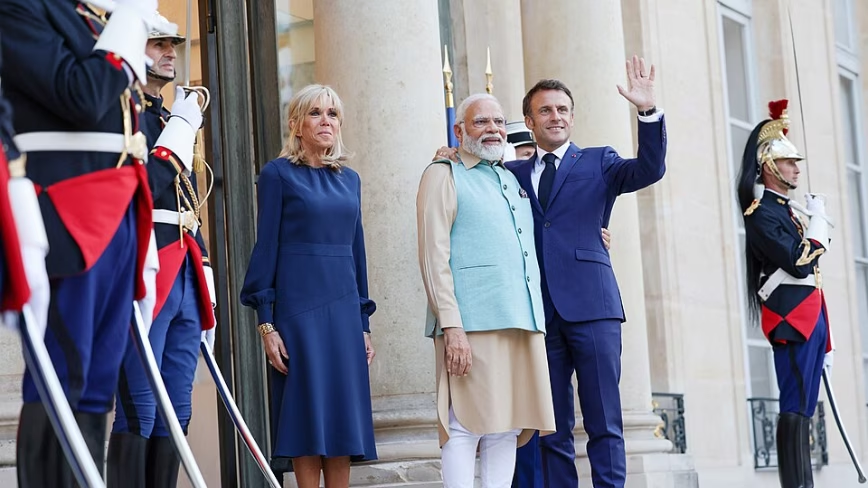
PM Modi with Pres Macron at Elysee Palace
 Credit: Press Information Bureau on behalf of Prime Minister's Office, Government of India
Macron and Modi are personally courting tech CEOs to secure AI infrastructure investment. Macron texted SoftBank’s Son to land a €75 billion data centre deal, and Modi secured $48 billion from Amazon after a direct meeting with CEO Jassy.TL;DR
The global race for AI infrastructure has become a contest of personal relationships. French President Emmanuel Macron and Indian Prime Minister Narendra Modi have emerged as its most aggressive practitioners, personally courting the heads of the world’s largest technology companies to secure data centre investments that will determine where the next generation of AI systems are trained and deployed.
Their methods differ in style but share a common principle: the people who control the capital respond to direct engagement from heads of state, not policy papers. The results, so far, have been measured in tens of billions of dollars.
Macron’s most significant win came in May, when SoftBank committed up to €75 billion to build 5 gigawatts of AI data centre capacity in France. The first phase, worth €45 billion, will deliver 3.1 gigawatts across three sites in the Hauts-de-France region by 2031, with state-owned EDF providing a former power plant in Bouchain as one of the locations.
The deal was the product of personal engagement. Macron approached SoftBank founder Masayoshi Son during a visit to Japan earlier this year, and the two exchanged text messages as they negotiated the details.
In June, Macron used France’s G7 presidency to host a working lunch that seated world leaders alongside the CEOs of OpenAI, Anthropic, Google DeepMind, and Mistral. The Choose France Summit that preceded it attracted €93 billion in total investment pledges, with AI infrastructure as the centrepiece.
Modi has pursued a parallel strategy with a different roster of partners. Amazon CEO Andy Jassy met the prime minister in New Delhi in late June and announced a $48 billion investment commitment through 2030, of which $21 billion will fund AI and cloud infrastructure expansion in Mumbai and Hyderabad.
At the India AI Impact Summit in February, Modi held bilateral meetings with 16 AI startup CEOs, including Sam Altman, Dario Amodei, and Demis Hassabis. India then served as the AI Country Partner at VivaTech 2026 in Paris, with more than 80 Indian deep-tech companies exhibiting alongside their European counterparts.
The Indian pipeline is enormous. Reliance Industries committed $110 billion to AI infrastructure over seven years, Google pledged $15 billion for what it calls India’s first gigawatt-scale AI hub, and OpenAI is partnering with Tata Group to build 100 megawatts of capacity with plans to scale to one gigawatt.
The UK offers a cautionary tale. OpenAI paused its Stargate UK data centre project in April, citing electricity prices roughly four times higher than in the United States and unresolved regulatory questions around AI copyright.
China is pursuing a different model entirely, offering AI capabilities to developing nations as a geopolitical tool while the G7 debates export controls. The competition Macron and Modi face is not just with each other but with a rival approach that treats AI distribution as diplomacy by other means.
The sums involved carry a familiar caveat. SoftBank’s €75 billion is an “up to” commitment, Amazon’s $48 billion is cumulative from 2026 through 2030, and the £31 billion in UK tech investment pledges that accompanied Stargate UK have largely failed to materialise.
The difference, so far, is that France has construction underway at identified sites with EDF as energy partner, and India has signed contracts with specific timelines and corporate entities whose reputations are attached to delivery. Whether the personal relationships that generated these commitments can sustain them through years of construction, permitting, and energy procurement is the question that neither charm nor text messages can answer.
Get the most important tech news in your inbox each week.


