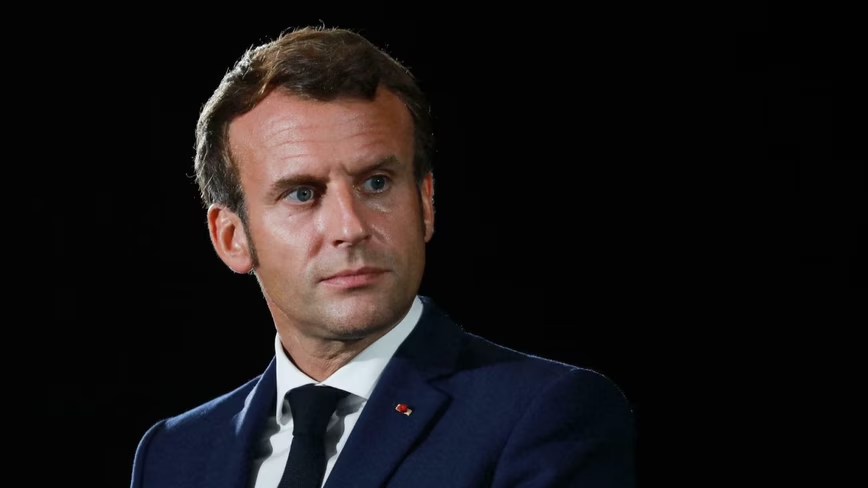
Portrait of French president Emmanuel Macron.

France took over the G7 this week with Emmanuel Macron pressing artificial intelligence to the front of the agenda and, with it, a good deal of his own standing. The summit runs from 15 to 17 June, and the pitch is straightforward: position France as Europe’s AI powerhouse, running on the country’s plentiful nuclear electricity.
The catch, as Bloomberg framed it, is that much of what would make the case rests on money and infrastructure Macron does not himself command.
The headline number arrived ahead of the summit. SoftBank committed to develop and operate 5GW of AI data-centre capacity in France, an investment of up to €75bn, with a first phase of roughly €45bn delivering 3.1GW in the Hauts-de-France region.
It was the centrepiece of the Choose France summit, where companies pledged some €93bn across 71 projects, with the government putting the job figure above 15,600.
SoftBank is not alone. Brookfield, the Canadian asset manager, is adding to its French data-centre spending, and Gulf money has been circling the same sector. Macron’s line, that the projects would make France “by far the leading country hosting data centres” and computing capacity in Europe, is the claim the pledges are meant to underwrite.
The vulnerability is in the verbs. These are commitments and plans, multi-year and conditional, and the gap between an announced €75bn and a built and running 5GW is where AI infrastructure promises tend to thin out.
Power connections, planning, and the shifting economics of the AI build-out can all slow a pledge or shrink it, which is the sense in which the legacy hangs on funding that is, in the framing of the reporting, fickle.
The nuclear argument is the part Macron can make on his own terms. France generates the bulk of its electricity from nuclear reactors, which gives it both abundant power and a low-carbon story to tell data-centre operators weighing where to build, at a moment when grid capacity is the binding constraint on the industry. It is the one structural advantage in the pitch that does not depend on a foreign balance sheet.
The convening power, at least, is real. Sam Altman is attending at Macron’s invitation, a sign of the access France can offer even where the capital is someone else’s.
Hosting the G7 hands him a stage, and the AI agenda lets him use it, but a summit communiqué and a built gigawatt are different things, and only one of them is in his gift.
Whether the summit converts attention into the built capacity Macron has promised is the thing the next few years, not the next few days, will decide. For now he has the pledges, the venue, and the electricity. The construction is what is still to come.
Get the TNW newsletter
Get the most important tech news in your inbox each week.


