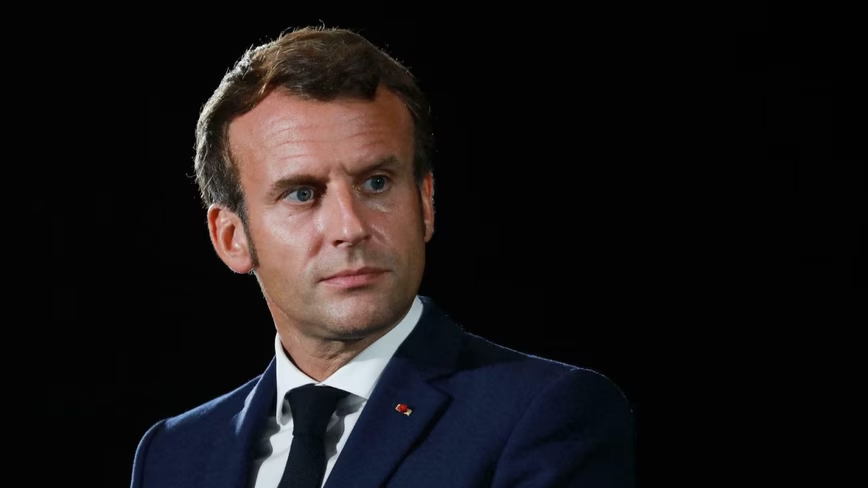
Portrait of French president Emmanuel Macron.

Emmanuel Macron has asked the European Commission to ban children under 15 from social media across the bloc, three weeks after France’s highest constitutional authority struck down his government’s attempt to do the same thing nationally.
The request came in a letter to Commission president Ursula von der Leyen dated 29 August, reported by Reuters on Tuesday.
Macron writes that it has become essential to go further through “a new European legislative text”, framing the aim as protecting all children in the Union rather than leaving the question to member states one at a time.
On 14 August the Conseil constitutionnel struck down the central article of the French ban, which would have blocked under-15s from TikTok, Snapchat, X, Instagram, YouTube’s social features, WhatsApp, Messenger and some online games from 1 September.
The Council called it an infringement that was not suited, necessary or proportionate to the objective pursued. The separate ban on smartphones in lycées survived.
Two things sank it, and only one of them is fixed by moving to Brussels. The Council found the scope too broad, sweeping in services whose risk to minors had not been established, which is a drafting problem a European text could in principle solve with more careful definitions.
The other objection was that the age verification the ban required did not come with adequate protection for users’ privacy.
That one travels. Checking that every user is over 15 means checking every user, and the identity data that makes verification work is exactly the data European privacy law is built to restrict.
We have written before about how Europe’s child safety proposals keep requiring the collection its privacy rules forbid. A French court found the collision unconstitutional. Nothing about relocating the law to the EU dissolves it.
Macron is not abandoning the domestic route either. AFP reported that he intends to bring forward revised national legislation designed to comply with both EU law and the French constitution, which means the Élysée is running the two tracks at once and hoping one of them clears.
He is also picking his moment. Von der Leyen delivers her State of the Union address on 16 September, and Macron has been lobbying other governments before it.
She has already moved in this direction on her own, pushing EU-wide age protections for children and floating the idea of a digital age of majority. A letter from the French president arriving a fortnight before the speech is less a request than a bid to set its contents.
The precedent everyone in this argument reaches for is Australia, which put an under-16 ban into force and has since kept legislating around it, most recently with a duty of care and an algorithm opt-out for users.
European politicians cite it as proof that a ban is enforceable. The complication is that Australia is one jurisdiction with one privacy regime, and the EU is 27 with a shared one, which is the reason Macron wants a European text rather than 27 national ones, and also the reason a European text is harder to write.
The bloc is not unanimous. Estonia has been the rare member state arguing against bans of this kind, and the Commission has spent the past year building the technical groundwork instead, including an age verification app it says is ready.
That sequencing matters: the tooling is being built to make verification possible without a single ban having survived a court.
What Macron is asking for, in effect, is that the EU take on a legal fight France has already lost once, on the theory that a European law drafted with the French ruling in hand would be harder to overturn.
It might be. It would still have to explain how a continent verifies the age of 450 million people without building the identity infrastructure its own laws were written to prevent.
Get the TNW newsletter
Get the most important tech news in your inbox each week.


