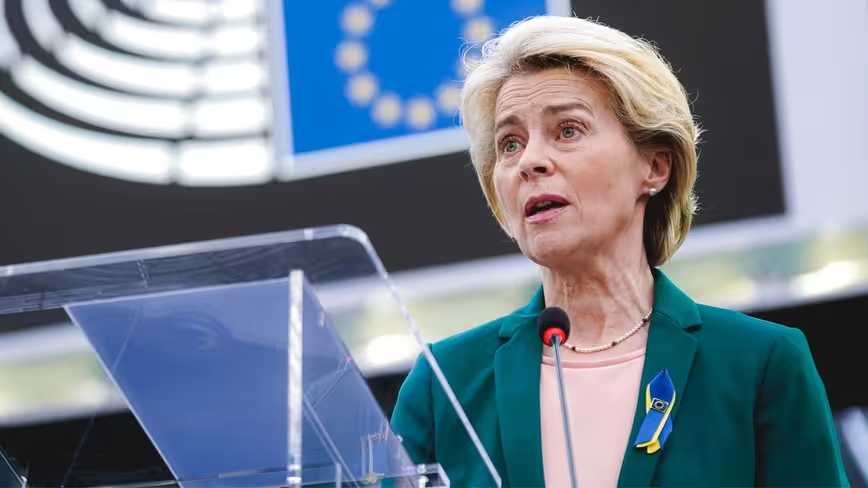
European Commission President Ursula von der Leyen
The European Commission president said an EU age-verification app is technically complete and that bloc-level rules on minimum social-media ages are next. France, Spain, and several others are already moving alone.
European Commission President Ursula von der Leyen on Tuesday set out the EU’s plan to extend protections for children online, telling MEPs the bloc’s age-verification app is technically ready for citizen use and that a Commission-led approach to minimum social-media ages is in development.
The intervention follows a wave of national legislation by EU member states moving ahead of any bloc-wide rule. France approved a bill in January 2026 to ban under-15s from social-media platforms, citing a public-health emergency.
Spain has tabled plans for an under-16 ban; Austria, Denmark, and Slovenia are drafting rules at ages 14, 15, and 15, respectively. Italy and Ireland are exploring restrictions at the under-15 and under-16.
The Commission’s preferred approach has not yet been finalised. The European Parliament has called for a uniform 16-year minimum, but von der Leyen said the Commission first wants to consult experts on the appropriate threshold.
The Digital Services Act already requires very large online platforms to assess and mitigate risks to children, and a series of enforcement actions and risk-assessment audits is underway against named platforms.
The age-verification system Ursula on der Leyen referenced was developed by the Commission’s digital-identity team and uses zero-knowledge cryptographic techniques to confirm whether a user is above a defined threshold without disclosing their actual age, identity or other personal data.
The Commission says the app is ready for member-state implementation; rollout timing is at the discretion of each member state.
The push lands inside a broader DSA enforcement cycle. Meta, TikTok, X and Snap are all under active Commission investigation for aspects of their handling of minors; some of those investigations may produce findings within the next twelve months.
The Commission has also instructed Apple and Google to integrate the age-verification system at the operating-system level.
Industry response has been guarded. Platform operators have argued that hard age thresholds will push minors towards unmoderated or non-EU services, and that the technical lift required to implement age verification at scale is significant.
Child-safety groups have urged the Commission to move faster, citing rising rates of self-reported harm and the consistent association of high social-media use with worsening mental-health metrics in adolescents.
Von der Leyen said the Commission would prefer a single EU rule rather than 27 separate national laws. “This is a question for Europe to answer together,” she said in remarks to MEPs in Strasbourg.
“Children should be protected in the same way wherever they live in our Union.”
A formal Commission proposal is expected before the autumn break. National laws already enacted will remain in force in the interim. Member-state regulators continue to enforce existing DSA obligations regardless of the timing of any new age-related framework.
Privacy advocates have raised concerns about the broader deployment of age-verification infrastructure, arguing that even zero-knowledge systems can drift toward identity-verification over time.
The Commission has said the system is designed specifically to prevent that drift; details on governance and audit have not yet been published in full.
Get the TNW newsletter
Get the most important tech news in your inbox each week.


