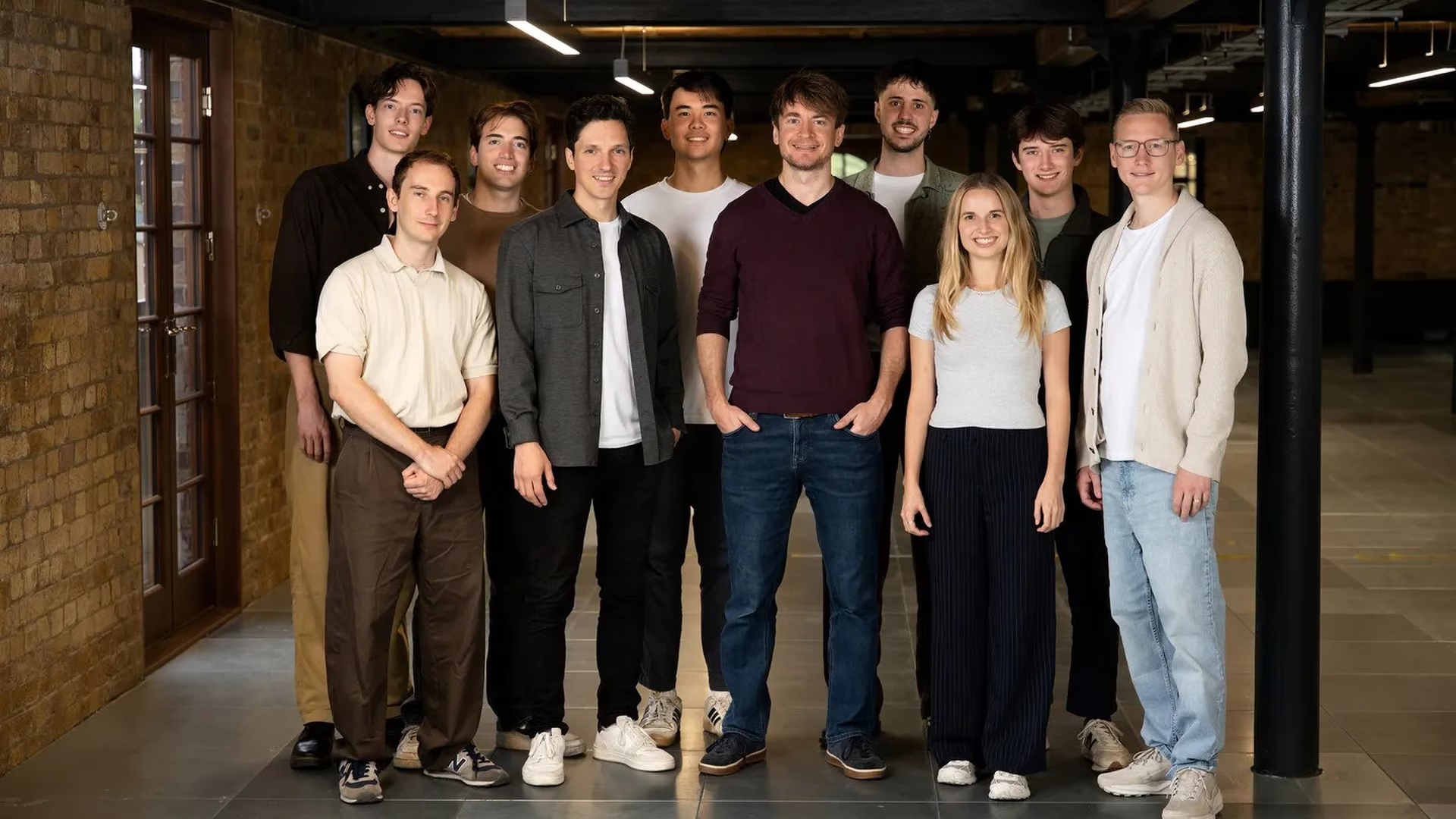
Machenta’s team, including co-founders Edward Johns and Vitalis Vosylius.
 Credit: Oscar May / Machenta
Machenta, a London robotics startup spun out of Imperial College London, has raised a $40M seed round. It is building an AI model that teaches robots a new task from a single demonstration. Creandum and Union Square Ventures co-led the round, Imperial said on 27 October. The university calls it the largest seed round ever raised by a UK robotics startup.
Machenta trains its model entirely on simulated data, in computer-generated environments, rather than on footage of people at work. Edward Johns is Machenta’s CEO and co-founder, and a professor of robot learning at Imperial. He told Rya Jetha of Business Insider that the model uses no “single pixel of real-world data”. Machenta declined to disclose its valuation, BI reported.
“Intelligence is not so much about what you can already do, it’s about how quickly you can learn to do something new. Humans don’t need to see the same thing over and over before they can do it,” Johns said in Imperial’s announcement.
One demonstration
Once trained, the model can direct a robot to do a new task, such as packing a box or tidying a table, Johns told BI. It needs to see the task done only once, with no further training. Imperial says one model has learned packing and tidying across different robots, including humanoids.
The work began six years ago in Johns’s Robot Learning Lab at Imperial. In early experiments, a robot guided through a task then needed about 30 minutes of extra data collection, BI reported. Only after that could it do the task alone. Johns and his former PhD student Vitalis Vosylius founded Machenta late last year to remove that step.
Much of the industry is going the other way and collecting real-world data. Last week, Maxinsights raised $30M to pay contractors to film their work for robot training.
Investors and rivals
“Very few teams in robotics can point to a body of work like this, which has repeatedly changed what people thought was possible,” said Kathi Wilhelm, a partner at Creandum.
USV managing partner Rebecca Kaden wrote in a blog post that the team calls its approach “physical vibe coding”.
“With Machenta, when robots are fast and easy to train, imagination instead of capability becomes the constraint,” Kaden wrote.
Machenta has 11 employees and remains focused on research, according to BI. It has no near-term plans to sell its technology. More precise tasks and complex movements remain difficult for its model.
Its rivals are far larger. Physical Intelligence is valued at about $11B, and FieldAI is raising money at a $10B valuation, BI reported. Skild AI, valued at over $14B, already sells similar technology. In August, Skild said its new model could do unseen tasks lasting up to 10 minutes after one video demonstration. It said last month that it had reached $100M annual recurring revenue.
Machenta will use the money to grow its team and to train its model with more computing power and simulated data. It is also moving into a new office and lab in King’s Cross, London.
Get the TNW newsletter
Get the most important tech news in your inbox each week.


