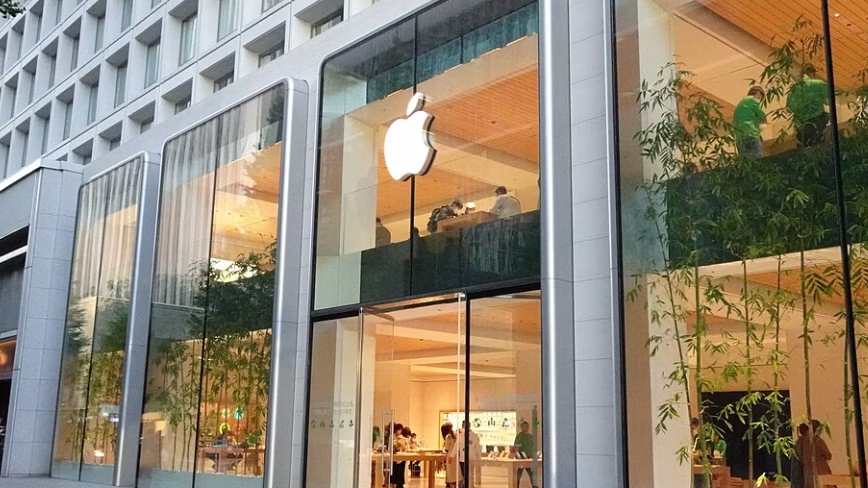
The exterior of Apple Marunouchi, located in Marunouchi, Chiyoda-ku, Tokyo
 Credit: RuinDig/Yuki Uchida, CC BY 4.0, via Wikimedia Commons
The commerce secretary made the comments to The Wall Street Journal on 14 August, in a piece by Rolfe Winkler, Raffaele Huang and Amrith Ramkumar. “The Trump administration is not in favor of that,” Lutnick said. There have to be “other solutions to the memory issue, but it’s not great American companies using Chinese memory”. Asked whether he had put that to Apple directly, he answered in one word. “Plainly.”
The Journal’s second sentence is the one worth keeping, though. Apple may do so anyway.
The objection is political rather than legal
Two Chinese manufacturers are involved, and their positions are not identical. Yangtze Memory Technologies sits on the Commerce Department’s Entity List, and CXMT does not. The Pentagon has designated both as Chinese military companies, but that designation signals concern rather than banning commercial purchases.
What the rules actually require is a licence before an American company shares product information with either firm. A chipmaker needs that information to build a customised part. Apple, though, can buy off-the-shelf memory from both and negotiate the price, because nothing currently stops it.
Apple’s own executive closed the gap
Sabih Khan, Apple’s chief operating officer, declined to confirm the testing when the Journal asked. He said only that the scale of the shortage means “we have to look at all options”, including pushing existing suppliers to raise US production. Then he said the thing that matters. Apple customises many components inside an iPhone, but “there isn’t a lot of customization” for memory.
Read those two facts together and the export-control lever quietly disappears. Commodity parts need no shared design information, so no licence is required, and no moment arrives where Commerce could step in. What Lutnick has is a strong opinion and a podium. What he does not have, on the rules as they stand, is a mechanism.
This desk asked the question back in June
Apple went to the Commerce Department early in the summer looking for a guarantee on CXMT. What it wanted was an assurance that the company would not be added to the Entity List. That request has now been answered in public, and the answer is no. It has arrived as a preference rather than a rule, though, which is precisely the point.
Apple has been testing chips from CXMT and YMTC, as a prelude to using them in devices sold in China. Two rivals have gone further already. HP and Acer now ship CXMT memory in products sold outside the US, the Journal reported previously, and nobody stopped them.
A deadline nobody is talking about
The Senate got here before the cabinet did. Jim Banks and Chuck Schumer led a bipartisan letter to Tim Cook in late July, which this desk covered as a warning to Apple, and it carried a date. The senators asked Apple to commit by 21 August to excluding these components entirely. That deadline is six days away, Lutnick has landed in the middle of it, and Apple has still not said what it will do.
Their argument was about dependency rather than price. Apple would be relying on critical supplies from a firm the US government has formally designated a Chinese military company. That is a different order of risk from an expensive quarter.
The other American company in this fight
Micron has been lobbying in the opposite direction. It has asked the administration not to let Apple buy Chinese memory, arguing that the move would damage domestic production and undercut the reshoring effort. Its leverage is its own chequebook, since Micron has committed roughly $250bn across New York, Idaho and Virginia. The senators who signed that letter represent two of those three states.
The shortage has been very good to it. Micron briefly overtook Meta and Tesla by market value in June, reaching $1.27trn on profits of $28.2bn. So the president is refereeing between two of the largest companies in the country. One wants cheaper memory, and the other would rather the memory market stayed expensive and American.
The shortage is not an Apple problem
Demand from AI data centres has drained the supply of computer memory and driven prices sharply higher. Consumer electronics makers have been raising their own prices to cover it, and Apple added $200 or more to some Macs and iPads. It is neither the first to do that nor likely to be the last.
Firms in medical devices and carmaking have asked for help too, and there is very little the administration can do quickly. New capacity takes more than a year to build. That is the hard fact underneath every position in this argument, including Lutnick’s.
Where the comments were made
Lutnick said all this after touring Apple’s new Advanced Manufacturing Center in Houston. He had cut the ribbon there the day before, alongside Cook and Senator Ted Cruz. Apple says it has spent hundreds of millions on the site, which already assembles AI servers and will build Mac Minis later this year. Cook used the occasion to note that Apple sourced more than 20 billion chips in the US last year.
The choice of product carries a small joke for anyone following this beat. The Mac Mini sold out across US stores this spring, because AI enthusiasts found it ideal for running agents through OpenClaw. Lutnick told a version of that story himself. He had thought of the machine as the computer on your desk, until Cook explained you could run advanced AI models on it.
What the administration has actually won
The pressure has produced results, and they are worth naming. Intel will make some of Apple’s chips, and Apple has committed to making all the cover glass for iPhones and Apple Watches in the US.
Lutnick described his approach in a phrase. “Relentlessly, more and more and more.” He framed the challenge in terms of labour, saying Apple built its supply chains on low-cost labour and now needs one built on advanced manufacturing. He thinks it can. Step by step and piece by piece, he predicted, Apple will bring significant portions of its business home.
The White House framed the same effort through security. Reshoring semiconductor manufacturing is a top priority for the president, spokesman Kush Desai said, and the administration is focused on investment and jobs while safeguarding national security.
What would settle it
Three things, and the first is 21 August. Either Apple gives the senators the commitment they asked for, or it declines and the argument moves somewhere with teeth.
The second is the Entity List. Adding CXMT to it would convert Lutnick’s preference into a rule, and nothing short of that would. The third is who is running Apple by then, because Cook becomes executive chairman on 1 September with policymaker relationships explicitly in his remit. That leaves John Ternus to inherit the decision.
Get the TNW newsletter
Get the most important tech news in your inbox each week.
Also tagged with


