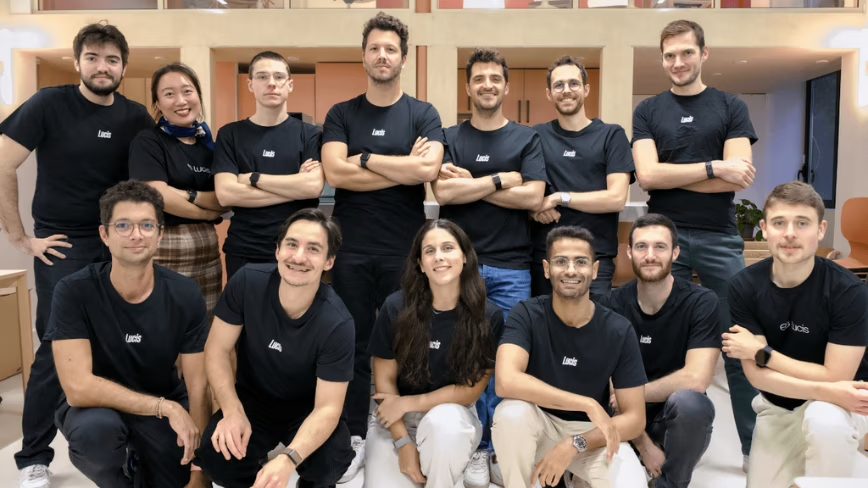
Paris-based Lucis, a preventive-health platform that pairs blood biomarker testing with an AI-driven companion app, has raised a $20m Series A led by Singular, with participation from General Catalyst, Y Combinator and angel investors including Céline Lazorthes of Resilience, Manu Lecomte, and backers of the running-coach app Runna.
The round arrives four months after the company’s $8.5m seed in December 2025, bringing total funding to roughly $28m. Lucis says the capital will fund expansion into Spain, Germany and Italy by the end of 2026 and continued development of the AI layer that turns biomarker data into ongoing health guidance. The company will not disclose its valuation.
Lucis was founded in 2025 by Maxime Berthelot, Baptiste Debever and Max Guérois, and went through Y Combinator’s 2025 batch. Its model is simple to describe and increasingly familiar: members get a blood draw at a partner laboratory, the platform analyses what the company says is more than 110 biomarkers across metabolic, hormonal, cardiovascular, inflammatory and nutritional systems.
Then the results feed an AI companion that recommends nutrition, supplementation, lifestyle and follow-up testing changes, with physician oversight. Recommendations refine as new data arrives. Lab partners include Eurofins and Randox.
The pitch lands on familiar ground. A growing cohort of US and European startups, including Function Health, Superpower, Forward and Berlin’s HealthCaters, are all betting that consumers will pay out of pocket to monitor their own biomarkers ahead of any clinical reason to do so.
Lucis is differentiated less by the underlying tests, which are commodity work performed by certified labs, than by the AI layer and the longitudinal-tracking promise: it claims that among users who completed a six-month follow-up, 75% improved at least three biomarkers without medication, and that more than 80% chose to retest.
Those numbers are company-supplied and have not been independently audited. So is the more striking figure Lucis foregrounds: that 99.9% of users had at least one biomarker outside optimal ranges at first test.
The implied claim, that almost everyone has something subclinical happening, is also exactly what a company selling subclinical testing would say.
The Series A pitch rests in part on whether sustained engagement and measurable biomarker improvement translate into the kind of long-term retention preventive-health platforms have historically struggled to demonstrate.
The macroeconomic case is sturdier. The World Health Organisation’s June 2025 European report attributes 1.8 million avoidable deaths a year across the WHO European Region to non-communicable diseases, at an economic cost of $514bn, with the agency arguing that 60% of those deaths could be prevented through risk-factor reduction. Lucis cites that figure as the gap its product is built to address.
“Europe’s preventive health category will be won by platforms that unite clinical credibility with AI at scale,” said Jeremy Uzan, co-founder and general partner at Singular, in a statement. He pointed to Lucis’s pace of user growth to 10,000 in under a year as evidence the category is ready to consolidate.
The Series A puts Lucis at a similar scale to other recent European AI-health raises, including the $20m round closed by Blossom Health for AI copilots in psychiatry. Whether preventive testing is a durable consumer category or a wellness adjacent to one is the open question. Lucis says expansion across the rest of the EU will follow over the next 12 months.
Get the TNW newsletter
Get the most important tech news in your inbox each week.


