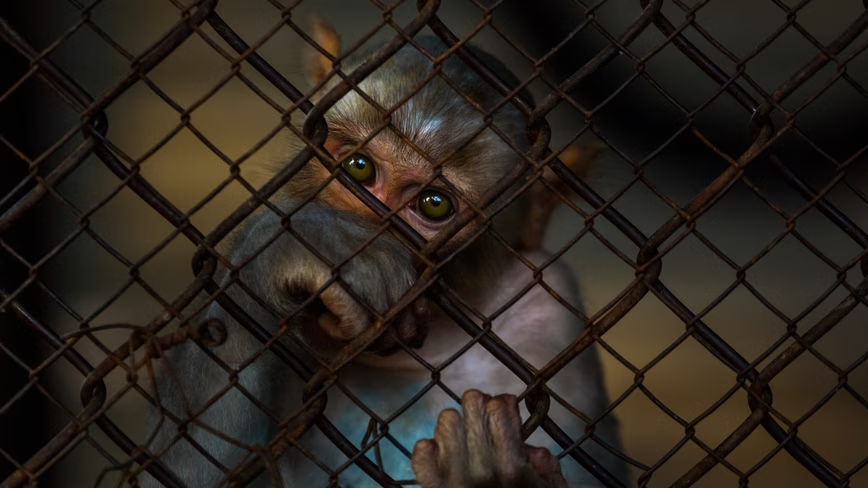
The clearest sign of China’s drug-development surge is not a molecule but a monkey. The price of a research primate there has climbed toward 150,000 yuan, roughly $26,000, and it keeps rising.
That is a steep jump in a short time. The figure is up from an average of about 103,000 yuan in 2025, though still below the extraordinary highs of the pandemic years, when prices briefly ran past 200,000 yuan.
The cause is a boom in demand. Chinese biotech has enjoyed a record run of dealmaking, public listings and venture funding, and all that money has pushed a wave of new drug candidates into the stage of testing that requires animals.
Primates are central to that stage. Before a treatment reaches humans, regulators typically demand safety data from monkeys, whose biology is close enough to ours to reveal problems earlier species cannot.
The trouble is that supply cannot move at the speed of capital. Cynomolgus monkeys, the workhorse of drug testing, take around four years to reach a usable age, so a sudden surge in demand cannot be met for years.
That mismatch is now biting. Contract research labs report delays and rescheduled programmes because animals are scarce, and some reuse monkeys after mandatory rest periods, which yields data considered weaker than a fresh study.
The scarcity is a symptom of ambition. China’s pharmaceutical sector has been signing licensing deals with global drugmakers at a rapid clip, evidence that its pipeline is being taken seriously in a field the US has long dominated.
The rise is real across the board. Chinese biotechs are producing results that command attention, including an Akeso lung-cancer drug that cut the risk of death in a closely watched trial, the kind of data that reshapes global competition.
Technology is accelerating the pace further. Even TikTok’s parent has moved in, with ByteDance-linked researchers designing drugs for targets long deemed undruggable, a sign of how much computing power is flooding into the field.
The monkey squeeze is not confined to China. American prices have stayed elevated too, with long-tailed macaques now fetching anywhere from $11,000 to $35,000, well above the few thousand dollars they cost before the pandemic.
The US is exposed by its reliance on imports. It brings in around 30,000 monkeys a year, mostly from Southeast Asia, a dependence that crackdowns on smuggling and shifting export rules can disrupt at short notice.
China’s position is more self-contained. It has built substantial domestic breeding capacity over the years, which gives its laboratories a steadier supply even as prices climb, and spares them the import risks that dog American rivals.
That contrast feeds a larger anxiety in Washington. Biotech has joined chips and AI on the list of fields where officials worry about losing ground to China, and control of basic research inputs is part of that unease.
That fragility matters for the wider race. A country that cannot secure test animals cannot move drugs through trials, so control of the primate supply chain has quietly become a strategic advantage in biotech.
The shortage is also reviving old debates. Pressure on primate supply has renewed interest in alternatives to animal testing, from lab-grown tissue to computer models, though regulators still treat monkey data as the gold standard for safety.
It also tempers the hype around faster science. However much AI promises to speed drug discovery, the physical bottlenecks of testing remain, and a shortage of monkeys is a stubborn reminder that biology sets its own pace.
For now, the price tag tells the story. When a research animal costs as much as a car, it is a measure of how much money and ambition are pouring into an industry determined to catch the leader.
Get the TNW newsletter
Get the most important tech news in your inbox each week.


