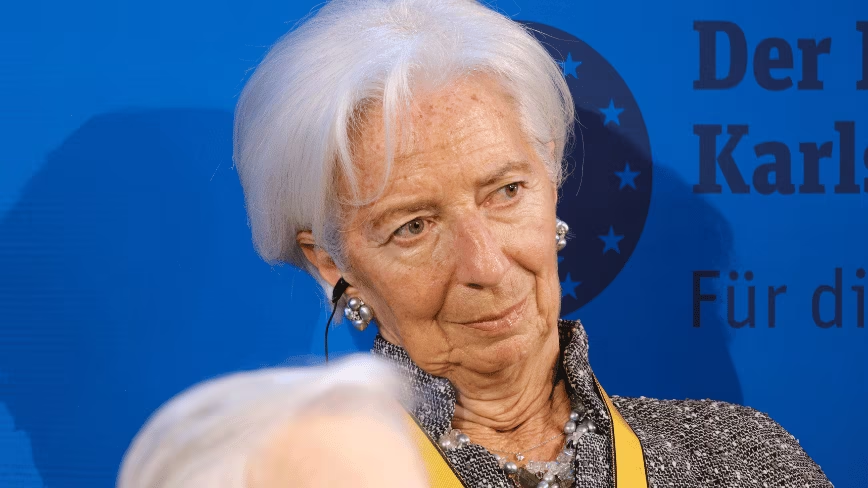
Christine Lagarde at the Karlspreis (Charlemagne Prize) ceremony in Aachen, May 2026

Europe must produce its own AI or risk being cut off from it, says Christine Lagarde, president of the European Central Bank. She warned that a trade partner could use Europe’s reliance on foreign AI as leverage in negotiations.
She made the case in a speech in Vienna on 14 September. Its title was “A new age of capital: growth, sovereignty and AI”. She spoke at the Hofburg im Dialog event.
“A withdrawal of access, or a change in its terms, would then reach every sector at once. That is leverage of a kind no trade partner has ever held over Europe, and it could be used in any negotiation, on tariffs or on digital taxes, for example.”
Within a few years, she said, AI will be screening goods at borders and picking tax returns for audit. It will also dispatch trains, watch patients on wards, and clear bank payments.
Europe’s share of models and compute
Lagarde said AI is mostly being built outside Europe. Last year the US produced 59 notable AI models and China produced 35, she said. France and the UK produced one each.
The US hosts three-quarters of the world’s AI computing capacity, according to the speech. Europe hosts 5%.
Europe already lacks enough data centre capacity to meet its own demand, Lagarde said. On current trends, she added, that gap will grow more than sixfold within a decade. She put Europe’s data centre gap over the next ten years at as much as €600bn.
An “awkward choice”
Lagarde described the options facing Europe as “an awkward choice”. It could hold back on AI because it cannot protect its data, and give up the growth. Or it could adopt AI quickly and become highly dependent. That, she said, risks losing the freedom to run its economy by its own values.
ECB estimates suggest that fast adoption could lift productivity by up to 4% over a decade, she said. She called that transformative for public finances.
Lagarde said Europe is already paying for the technology. Euro area companies will put around 10% of their total investment into AI in 2026, according to the speech. More than half of euro area workers now use AI at work. That share has doubled in two years.
Three things Europe needs
Lagarde set out three steps. The first is more European computing capacity. The second is AI models that are “good enough” for most tasks and run on European infrastructure. With those, “the threat of being cut off loses its force”, she said. The third is access to frontier models, so that Europe stays competitive.
She tied the plan to Europe’s capital markets. European households save around €1.4tn a year, Lagarde said. She argued that building sovereign AI needs capital markets that send more of those savings to European projects. That is the job she set for the planned savings and investments union.
On 14 September, a Nobel laureate and a former EU commissioner said Europe had one year to act. A recent Capgemini survey found that most large organisations think full digital sovereignty is unrealistic.
How AI spending reaches Europe’s markets
Lagarde also described how the AI boom is already affecting European finance. In the first quarter, she said, AI-related borrowing made up about a quarter of the growth in credit to firms.
The big US cloud providers issued more than $100bn in bonds last year, according to the speech. Some of that borrowing is taking place in Europe, which pushes up costs for other borrowers, Reuters reported. Euro area households hold about €440bn in US technology firms, Lagarde said, so any market correction would hit European savings.
She made a related point four days earlier, at the ECB’s press conference in Berlin on 10 September. The ECB raised its three key interest rates by 25 basis points that day. Lagarde said increased AI-related activity was visible in digital services, business investment, and exports.
Asked about rising bond yields around the world, she named financing demand from AI-related activity as a key driver. She said that demand, once mostly met through equity, is now moving into bonds and private credit.
The transatlantic backdrop
The EU and the US remain key allies, but trust between them has been shaken, the Guardian and Reuters noted. Both outlets cited US tariffs, US demands to take over Greenland, and US troop withdrawals from Europe.
Recent data centre announcements in Europe include Google’s €13bn plan for Finland and a UAE investment in Germany that includes 1GW of data centres.
Get the TNW newsletter
Get the most important tech news in your inbox each week.


