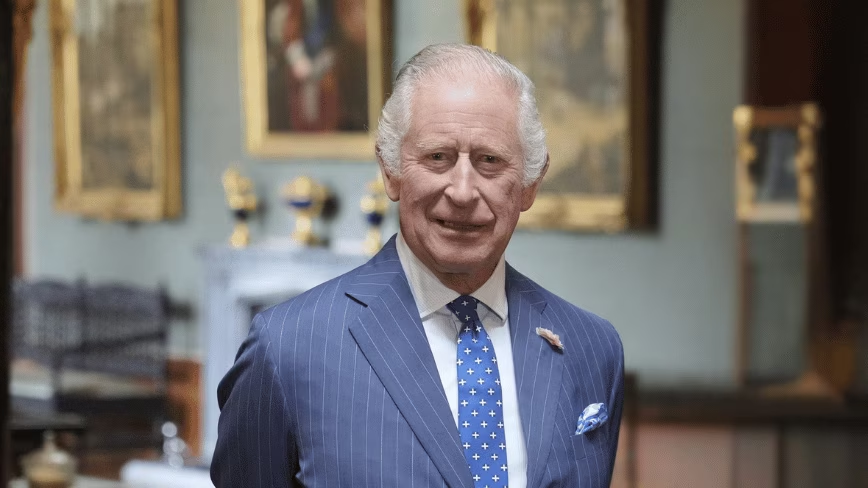
King Charles III at Windsor Castle in July 2023. Cropped from a White House photograph.

“Those in our world who value deeply our humanity and its vital moral component are anxiously seeking your reassurance that we will not lose control of our destiny, or our souls,” King Charles III told AI leaders on 17 September.
The King spoke at a summit he convened at Dumfries House in East Ayrshire, Scotland, the Royal Family said in a statement. It published the full text of his speech. Representatives of Nvidia, Google DeepMind, OpenAI and Anthropic attended, and the Ditchley Foundation facilitated the talks.
Delegates considered whether a shared set of principles could guide the future use of AI, according to the statement. About 30 executives, policymakers and researchers took part, Bloomberg reported. The executives did not publicly commit to any changes.
“Sufficient means of control”
The King said the development of AI, its substance and its pace, was “both intriguing and deeply concerning in equal measure”.
He said AI was already showing its “immense capacity to improve and save life”, for example in life sciences and medicine. Yet those who created the technologies are “now increasingly warning” that it risks “developing darker capacities”, he said, and “perhaps even to take life”.
The King said there “seems urgency in adequately considering the existential dangers of such technologies falling into the wrong hands”. He asked: “Surely, we need sufficient means of control before it is all too late?”
He put two questions to the room, building on the message he sent to the UK’s AI Safety Summit at Bletchley in 2023. The first was how to harness the benefits of AI “with safety at its heart”. The second was how to build international cooperation and consensus “so no Nation is left behind”, and “the human race is left in place”.
“The task before you is not merely to advance technology, but to ensure that it remains firmly in the service of humanity, community and the natural world,” he said. “Our humanity must remain sacred.”
Who was there
Nvidia chief executive Jensen Huang, Google DeepMind co-founder Demis Hassabis and OpenAI chief financial officer Sarah Friar attended. So did Tino Cuéllar, Anthropic’s chief global affairs officer, and UK AI minister Kanishka Narayan. TNW reported the plans on 8 September.
The King also met Huang, Hassabis, Cuéllar, Friar and five other guests in private. Bloomberg saw the itinerary. The group included Vatican AI adviser Paolo Benanti, Berkeley computer scientist Stuart Russell and Cabinet Secretary Antonia Romeo.
Bloomberg’s guest list also named MI6 chief Blaise Metreweli, author Yuval Noah Harari and Xue Lan of Beijing’s Tsinghua University.
What the executives said
Hassabis told the summit that artificial general intelligence was “probably only a few short years away”, the BBC reported. He put its possible impact at ten times that of the Industrial Revolution. He also called the chance of something going wrong “definitely non-zero”.
“The future is not yet written,” Hassabis told the delegates. He launched the DeepMind Institute a day earlier to debate AGI. On 15 September, a former DeepMind safety researcher posted a warning about AI.
Friar said AI’s growing capabilities raised questions about safety and “how we ensure it always serves people”. “No one company or government can do that alone,” she said, according to the BBC. OpenAI disclosed six model incidents on 16 September.
“When a product is not safe enough, we should hold it back and keep engineering,” Huang said. Earlier, he told reporters to regulate AI products rather than the technology. He also argued for open models, the BBC reported. They let “researchers, universities, start-ups and countries” build on them, he said.
Get the TNW newsletter
Get the most important tech news in your inbox each week.


