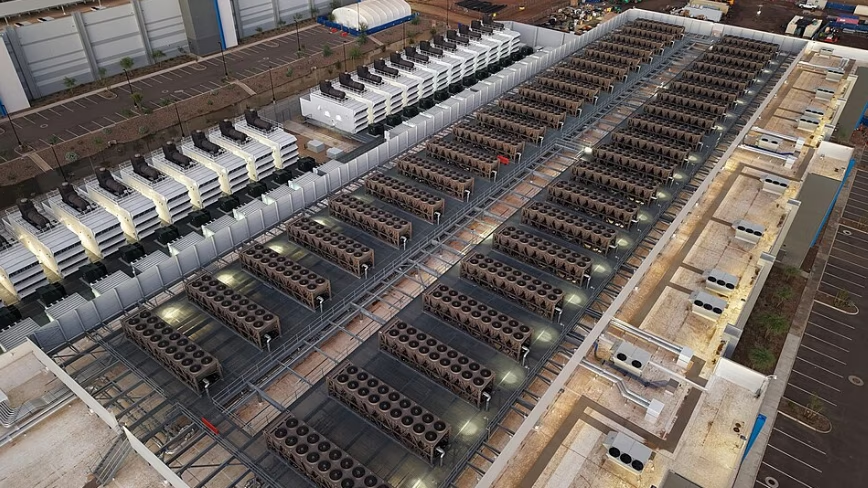
Roof of a data center featuring cooling towers and backup generators
 Credit: Rsparks3
Investment firm Kimmeridge says as many as half of the data centres proposed in the United States are at risk of delay or cancellation because of political backlash and the difficulty of building physical infrastructure. It expects that to cut forecasts for US gas demand, most of which Europe now buys.
As many as half of the data centres proposed in the United States are at risk of delay or cancellation, according to Kimmeridge Energy Management. The investment firm blames political backlash and the ordinary difficulty of building physical infrastructure.
“The sort of Silicon Valley model is running into a real-world infrastructure constraint,” said Ben Dell, the firm’s managing partner and co-founder, speaking at Bloomberg’s New York headquarters.
Where the estimate comes from is worth noting. Kimmeridge holds stakes in gas producers and in a Louisiana export terminal, and Dell says delays would force cuts to US gas demand forecasts, which makes this a warning against his own book.
He put figures on it. Of roughly 30 billion cubic feet a day of expected US gas demand growth, most of it from LNG exports, Dell said data centres might account for 5 billion to 10 billion, with delays pushing that towards the lower end.
The backlash he describes is now measurable. TNW reported this month that more than 500 US jurisdictions restrict data centres, with New York freezing environmental permits and Texas halting approvals pending audits.
Dell says the opposition has turned bipartisan. Pennsylvania, Texas and Ohio, once considered friendlier to these projects, are producing pushback and litigation, and the issue is heading into the midterm elections.
Europe has the same problem for a different reason. The obstacle here is rarely the neighbours and usually the grid, as Nscale found when National Grid could not connect its £2B Essex site in time to open next year.
The two continents are joined by the fuel. Kimmeridge’s Commonwealth LNG took a final investment decision in May on a $13B terminal in Cameron Parish, Louisiana, shipping 9.5 million tonnes a year from around 2030.
Europe is the customer for that gas. IEEFA expects the United States to supply two-thirds of European LNG imports this year, rising towards 80% by 2028, into terminals it projects will be three times larger than European demand by 2030.
So an American delay becomes a European supply question. Gas that does not burn in Ohio can be liquefied and sold to a continent that keeps telling Big Tech to align its data centres with climate targets.
Dell’s ideal proposal, he said, would be “zero impact,” with no net effect on water use, land, emissions or power prices. Nobody has built one of those yet, on either continent.
Get the TNW newsletter
Get the most important tech news in your inbox each week.


