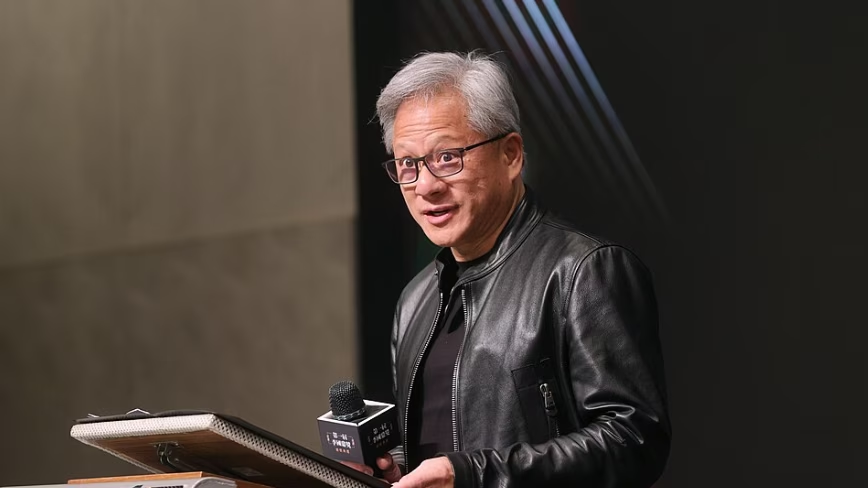
Huang
 Credit: 總統府
Jensen Huang has heard the warnings. He is not buying them. The Nvidia chief runs the world’s most valuable company on the back of the AI boom. So when he calls the darkest predictions about that boom “complete nonsense,” it is worth asking whether he is right, or just talking his book.
In a wide-ranging Axios interview with Mike Allen, Huang took on two claims at once. That AI will end humanity, and that it will wipe out half of American jobs. Both are “complete nonsense,” he said, and “all of the evidence points exactly to the opposite.”
His real argument is subtler than the soundbite. It is not that no jobs change. It is that people keep confusing a task with a job.
Don’t mistake your task for your job
The line is one Huang says he gives to young people.
“Don’t mistake your task for the job.” A radiologist’s task is reading scans, and AI can do much of that. But the job, he argues, is ending suffering and guiding patients. That does not vanish when the scan-reading is automated. Some roles will still go.
Call-centre work, he granted, is “very likely to be highly automated.” The judgement around it, he thinks, stays human.
He came with numbers. The number of radiologists is rising, by about 20%, he said, because AI lets each one see more patients, a claim others have backed. Paralegals are up around 10%.
Manufacturing jobs have grown some 50% in recent years, he claimed, as the industry races to build data centres. His reframe of the fear is blunt. “AI is not going to destroy all of our jobs,” he said. “Someone who uses AI is going to take your jobs.”
A jab at his own peers
The pointed part was his target.
Asked why Asia is so much sunnier about AI, Huang said the doomers “spend too much time theorizing about these science fiction outcomes,” which “makes them sound smart.” Pressed on whether he meant fellow AI bosses, he softened. The aim was clear enough.
Talk of a singularity, of a simulation, of machine consciousness, is “all made up.” “It’s fine to warn people,” he added. “It’s absolutely inappropriate to make things up.”
He took the same message to Washington. AI is not a “100-metre dash” with a single winner, he said, and policymakers risk over-correcting if they “fall for these narratives.”
His advice to the Trump administration was to talk to many scientists, not one or two. He even waved off the idea of the government taking a stake in Nvidia as “unnecessary.”
The optimist’s ledger
Huang’s brighter vision is expansive. He expects a trillion AI agents running at once. He says the “ChatGPT moment” for robots has already arrived, with useful machines perhaps three to four years away. An AI bubble “will come someday,” he allowed, “just not today,” and probably not within five years.
It is a bracing counter-story, and Huang has every reason to tell it, because more AI means more Nvidia chips. The job figures are his own framing, and rivals such as Anthropic’s Dario Amodei still forecast the opposite.
Yet his central distinction is hard to wave away. Automation has reshaped work before without ending it, and “someone who uses AI is going to take your jobs” is a more honest worry than a robot uprising.
The doom, Huang bets, is a story.
The real question is whether people believe him before they act on the other one.
Get the TNW newsletter
Get the most important tech news in your inbox each week.


