 Credit: JD.com
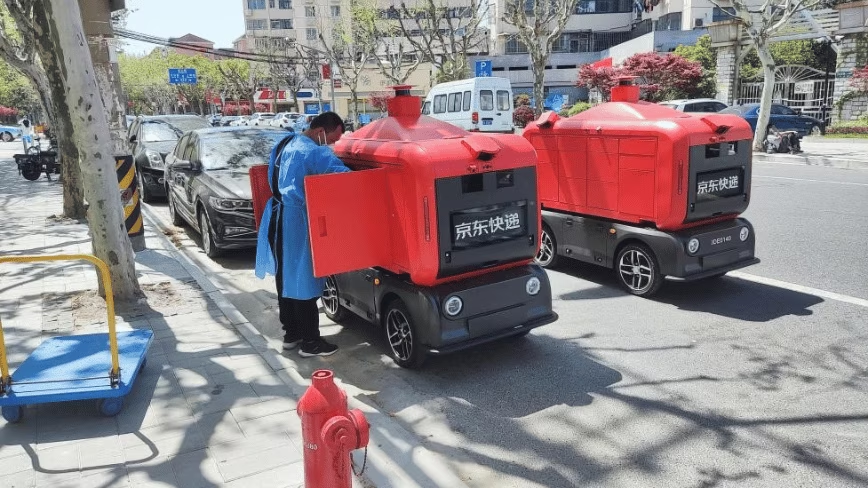
JD.com robots will eventually replace the company’s 700,000 couriers, its founder says. It is a rare admission that automation is coming for blue-collar jobs.
Most tech bosses hedge when asked whether machines will take people’s jobs. Richard Liu just said it plainly.
He chairs JD.com, one of China’s biggest e-commerce groups. At the APEC China CEO Forum in Shenzhen on Sunday, Liu said robots will take over deliveries. They will replace the firm’s 700,000 delivery workers, he said, “sooner or later”.
“In the future, when robots are delivering parcels, sooner or later, there will be a day when couriers are basically no longer needed,” Liu said, according to the Financial Times. “But I really do not want our 700,000 brothers to go without meals, without jobs.”
He did not say when robot deliveries would become widespread.
The Nirvana Plan
Liu paired the warning with a plan. JD.com has launched an internal programme, called Nirvana, to move its couriers into new work before the robots arrive.
The company has signed contracts with about 120 schools across China. They will retrain delivery staff in skills such as repairing and maintaining the machines set to replace them.
New roles include robot maintenance engineers and AI trainers. The pitch is a move from rain-soaked streets to indoor jobs servicing fleets of delivery robots.
“I don’t want our 700,000 employees to be left without jobs or income,” Liu said. Weeks earlier, he went further in an internal speech reported by Bloomberg. He pledged that JD would not fire a single front-line worker replaced by machines.
A promise that is hard to keep
The two messages sit in obvious tension. Liu is forecasting that couriers will vanish, while vowing to protect the couriers he already employs.
His answer comes down to sequencing. He is betting that retraining can outrun the pace of automation.
Whether 120 schools can reskill a workforce of 700,000 remains the open question. Robot-maintenance roles will not exist at anything close to today’s courier headcount. JD’s own labour data over the next few years will be the real test.
JD is building the robots too
This is not a company watching automation from the sidelines. JD runs one of China’s most automated logistics operations.
It already tests unmanned warehouses, drone delivery, self-driving vans and unmanned pickup stations. Pilots are live across the country. In Shenzhen, airport robots ferry meals to departure gates. Others ride commuter trains to restock convenience stores.
The automation that powers JD’s network is the same tech Liu says will hollow out its biggest job category.
A nervous moment for Chinese labour
The comments land in a tense market. Policymakers worry that China’s rush to deploy robots threatens its most vulnerable workers. Beijing has started to track AI’s hit to jobs as a national priority.
The numbers explain the nerves. China will count around 320 million gig workers this year, up from 200 million five years ago, according to the China New Employment Forms Research Center. That is roughly 40 per cent of all urban employment.
Youth unemployment, meanwhile, ran at 16.3 per cent in April. A wave of courier layoffs would hit an already strained jobs market hard.
The honest CEO
Liu’s candour stands out against a noisy global debate. Western tech leaders have flip-flopped on whether AI will take jobs, often softening the message as the politics turn.
The machines, though, keep improving. Researchers are giving robots longer memories. Players from autonomous-vehicle firms to carmakers buying up robotics labs are racing to put them to work.
For JD’s 700,000 couriers, the question is no longer whether the robots are coming. It is whether the retraining arrives first.
Get the TNW newsletter
Get the most important tech news in your inbox each week.


