TL;DR
Infineon is opening a €5 billion power chip factory in Dresden on 2 July, backed by €1 billion in EU Chips Act subsidies. The fab is the act’s first major success after Intel’s Magdeburg project was cancelled..
The power semiconductor fab, backed by €1 billion in EU subsidies, will produce chips for AI data centres that Infineon says will consume as much electricity as all of Germany by 2030.
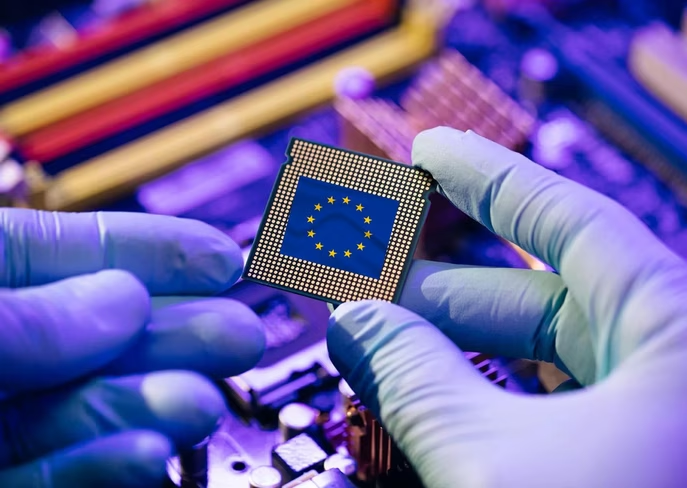
EU-chips-act-europe-semiconductors
 Credit: Canva
Infineon is opening a €5 billion power chip factory in Dresden on 2 July, backed by €1 billion in EU Chips Act subsidies. The fab is the act’s first major success after Intel’s Magdeburg project was cancelled..TL;DR
Infineon Technologies is preparing to open its largest single investment, a €5 billion semiconductor factory on its Dresden campus, on 2 July. The Smart Power Fab, which received approximately €1 billion in EU Chips Act subsidies, will produce power semiconductors used in AI data centres, electric vehicles, and renewable energy systems.
The opening arrives three months ahead of the original schedule. “The AI data centres currently being built and planned around the world will consume twice as much electricity in 2030 as they do today,” said chief operating officer Alexander Gorski. “That’s as much as the entire Federal Republic of Germany.”
The new plant is a conspicuous success for the EU’s semiconductor sovereignty strategy, which was drafted during Covid-era supply shortages with the goal of doubling Europe’s share of global chip production from 10% to 20% by 2030. That target is widely considered unattainable, and the act’s flagship project, a cutting-edge Intel fab in Magdeburg, was cancelled in August 2025 after Intel’s CEO cited insufficient customer commitments.
Brussels has responded with a proposed Chips Act 2.0 that would give the Commission direct funding powers for manufacturing and emergency authority to override existing semiconductor supply contracts during shortages. Infineon’s Dresden fab, which sits on the same campus as TSMC’s first European chip factory, demonstrates that Europe can still attract large-scale semiconductor investment, even if the broader strategy has underdelivered.
Infineon does not produce advanced AI processors like those designed by Nvidia. What it makes are the power semiconductors that regulate and convert electricity inside the data centres where those processors run, components that become more critical as AI workloads push energy consumption higher.
The company’s data centre revenue has grown from €250 million in fiscal 2024 to more than €700 million in 2025. Management expects it to reach €1.5 billion in fiscal 2026, roughly 10% of total sales, and €2.5 billion in 2027. Bank of America raised its AI power revenue forecast for Infineon by €500 million to €4.5 billion for 2028.
The Smart Power Fab uses 300-millimetre thin wafers and will manufacture chips in both silicon and silicon carbide, materials that improve energy efficiency in high-power applications. Infineon has invested approximately €2 billion on construction so far, with the remaining €3 billion to be spent over time adding machines as demand scales.
The silicon carbide side of the business already has a marquee customer. On 8 June, Infineon announced a partnership with Siemens to supply CoolSiC MOSFET power modules for Siemens’ SENTRON 3QD2 solid-state circuit breakers, which protect AI data centres and factories from electrical failures.
The semiconductor breakers interrupt current in microseconds, up to 1,000 times faster than conventional electromechanical systems, a capability that becomes critical as facilities shift to direct-current power grids.
“AI data centres and factories are becoming increasingly electrified and complex,” said Andreas Weisl, Infineon’s chief sales officer for industrial and infrastructure. “This increases vulnerability to electrical failures.”
At full capacity, the facility could add as much as €5 billion in annual revenue, though Gorski declined to specify when that milestone would be reached. The fab is expected to create up to 1,000 jobs in Dresden.
Infineon’s shares have more than doubled this year, recently touching a 52-week high of €89.67. Morgan Stanley raised its price target from €63 to €91, and Deutsche Bank lifted its target from €70 to €90, both maintaining buy ratings.
The rally reflects a broader shift in how investors value companies that supply infrastructure to the AI sector rather than building AI models directly. Major tech companies are investing more than $700 billion in data centre projects this year, and Infineon’s power chips sit in the critical path between electricity grids and GPU clusters.
The €5 billion revenue potential at full capacity is a long-term projection, not a near-term commitment, and depends on demand that has not yet fully materialised. Infineon’s data centre revenue, while growing rapidly, still accounts for only about 10% of total sales, meaning the company remains heavily dependent on the automotive market.
The EU’s 20% semiconductor production target by 2030 remains out of reach, and one successful fab does not reverse the structural challenges that led to Intel’s withdrawal. Whether the proposed Chips Act 2.0 can attract further investment at this scale is an open question, particularly as the United States continues to offer competing subsidies through the CHIPS and Science Act.
Get the most important tech news in your inbox each week.


