 Credit: Hydra Host
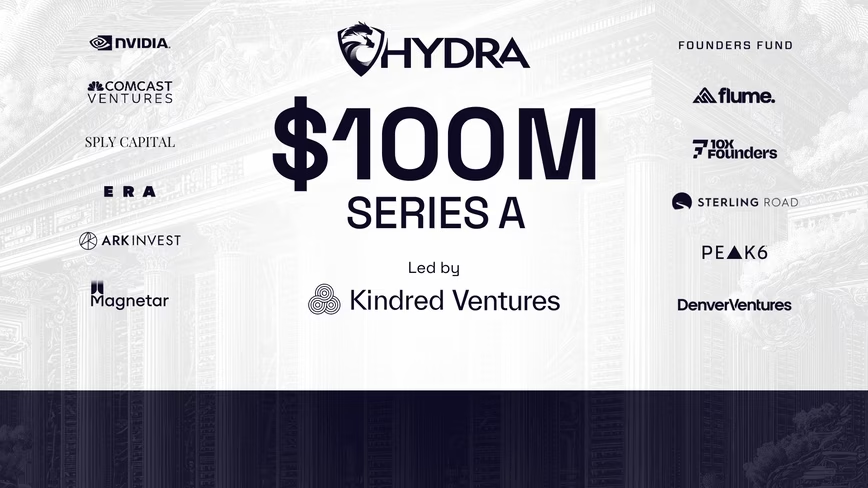
Hydra Host has raised $100m to build the plumbing of the AI boom, and one of its new backers is the company whose chips it is trying to turn into a commodity: Nvidia.
The Series A was led by Kindred Ventures, with Nvidia joining alongside ARK Invest, Comcast Ventures, Magnetar, PEAK6 and others. The Information, which first reported the deal, put the valuation at close to $800m.
Hydra sits in the middle of the market. Data-centre operators use its ‘Brokkr’ software to deploy and rent out GPU capacity, while AI firms tap that capacity for training and inference, across more than 50 sites in the Americas, Asia and Europe.
The crypto-to-AI playbook, again
The pattern is familiar. Hydra was founded in 2021 to serve crypto miners before pivoting to AI, the same arc that produced CoreWeave and Europe’s Nscale.
What sets Hydra apart is that it is asset-light. Rather than own the GPUs, it sells the operating system and the marketplace, taking a cut as it connects spare megawatts to AI workloads. Chief executive Aaron Ginn frames the job as making it easier to convert ‘megawatts into tokens’.
For Nvidia, backing a broker that standardises and resells access to its chips is of a piece with its wider strategy of seeding the companies that buy them, keeping demand flowing as capacity floods online.
A contrarian bet, and a frothy one
Hydra’s wager is that the great GPU shortage is ending, and that compute is becoming a commodity to be traded on price and availability rather than hoarded. If true, the value shifts from owning chips to routing them, exactly the layer Hydra occupies.
That logic is also fuelling a wave of debt. AI ‘factories’ are increasingly financed by asset-backed loans secured against the GPUs themselves, a model that lets operators scale fast but loads the sector with leverage, the same dynamic pushing up borrowing across the neocloud world.
The risk is the obvious one. A thin-margin marketplace is a fine business in a boom and a brutal one in a bust, and the rush of capital into anything GPU-shaped, from shoe brands turned compute sellers to crypto miners, has the unmistakable feel of a cycle near its top. Hydra is betting it owns the layer that survives whichever way the buildout breaks.
Get the TNW newsletter
Get the most important tech news in your inbox each week.


