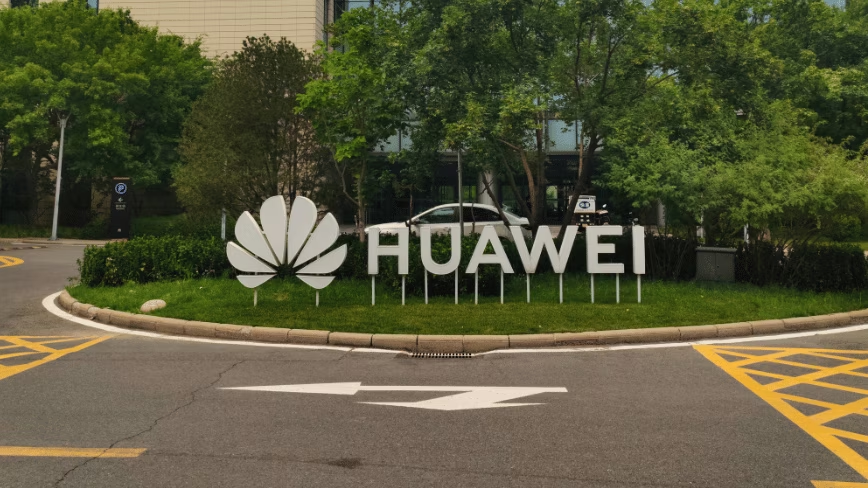
Huawei’s Beijing Research Institute, June 2024.

The United States opened its criminal case against Huawei in Brooklyn federal court on Wednesday, with a prosecutor describing two decades of conduct by the world’s largest telecoms equipment maker as theft, lies and cover-up.
“Theft, lies, cover-up. For 20 years, that’s how Huawei victimized American companies,” said Taylor Stout, a Justice Department trial attorney, according to Reuters.
Brian Heberlig, for Huawei, told the jury the case is:
“about competition, not conspiracy. Innovation, not theft. Ordinary business dealings, not criminal conduct.”
The indictment covers bank fraud, sanctions violations and racketeering, alongside allegations that Huawei stole trade secrets from five American companies including Cisco Systems and T-Mobile.
Prosecutors point to operating system source code taken from Cisco routers and a robotic phone-testing device at T-Mobile. The defence says those were the acts of individual employees and that management put things right on discovering them.
The trade secret allegations are also a reminder of how unglamorous industrial espionage usually is. The government’s exhibits are router source code and a robot that tests phone screens, not a stolen breakthrough.
The T-Mobile device, known internally as Tappy, was a machine for tapping a handset repeatedly to see what broke. It is a long way from the frontier technologies that dominate the current export control argument, and it is the sort of ordinary engineering advantage that companies actually fight over.
On the sanctions charges, the government alleges Huawei concealed its Iranian operations in order to move US dollars through the American financial system and to help the Iranian government conduct surveillance.
Huawei’s answer is narrower than a denial: it says nothing shows the company knew that clearing those dollars would breach sanctions law.
That distinction is where the trial will be won or lost. Racketeering requires the government to prove a pattern rather than a series of incidents, which is why the opening statement reached for twenty years rather than for any single episode.
The defence does not need to establish that nothing happened, yet it needs the jury to see a large company with badly behaved employees, which is a different and much more ordinary thing than an enterprise organised to steal.
We have written about jury selection last week and the original indictment when it was brought. One earlier ruling matters more than most: charges against chief financial officer Meng Wanzhou were dismissed in 2022 under a deferred prosecution agreement, but a judge has held that the admissions she made can be used against the company.
Huawei is on trial partly on the strength of statements made by an executive who is no longer a defendant.
The case is expected to run three months, which places a verdict in the middle of a US and Chinese technology relationship that has changed considerably since the charges were filed. The conduct alleged belongs to a period when Huawei was a supplier to Western carriers.
It is being tried at a point when the company has been designed out of most of those networks, and after the European Commission reissued its warning to member states about high-risk vendors.
For European operators the verdict is not really about network policy. That argument has been settled by rip-and-replace programmes and procurement rules, whatever a Brooklyn jury decides.
What a conviction would supply is the thing the security case has always been short of: a finding of fact, tested in open court and subject to cross-examination, rather than an intelligence assessment nobody outside government gets to read.
An acquittal would supply something too. Huawei has argued for years that the campaign against it is industrial policy dressed as law enforcement. Three months of evidence, examined in public, is the strongest test that claim has ever been given.
Get the TNW newsletter
Get the most important tech news in your inbox each week.
Also tagged with


