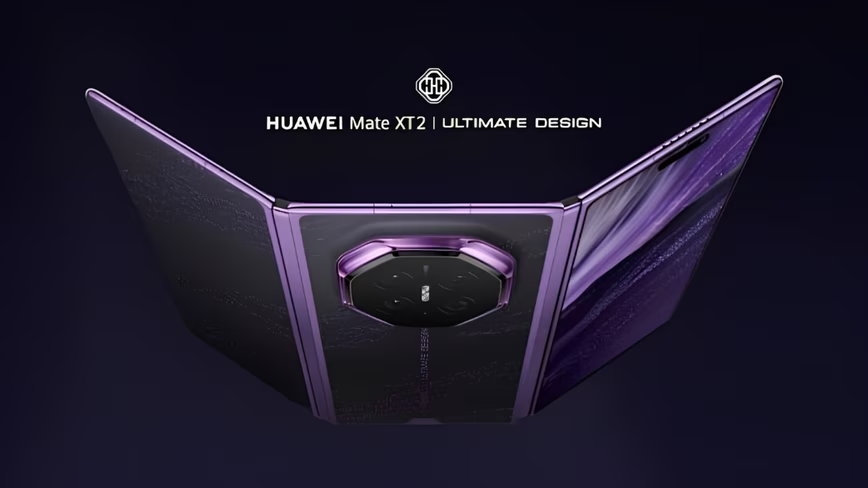
The Mate XT 2 is Huawei’s third tri-folding handset and goes on sale in China on 10 September
 Credit: Huawei
Huawei has launched a new tri-folding phone two days before Apple is expected to show its first foldable iPhone. The Mate XT 2 was unveiled on Monday and goes on sale in China on 10 September.
Apple’s event falls on 9 September, so both Huawei and Xiaomi will have shown their foldables before Apple shows its first, and Apple arrives at a market where the reference prices have already been set by somebody else. The hardware is a third-generation tri-fold rather than a first attempt.
The Mate XT 2 opens to a 10.2-inch display, carries a battery above 6,000mAh, and uses a redesigned hinge intended to soften the crease that has dogged every folding screen since the format appeared.
What is inside it matters more than the fold. The phone runs a Kirin 9050 Pro built on Huawei’s own newer process, which is a chip the company was not supposed to be able to make after Washington cut it off from advanced foundries.
Xiaomi has done something similar on its own account. The 18 Fold runs the company’s proprietary Xring O3 with LPDDR6 memory, a 7.6-inch folding display, a 200MP main camera and 67W wired charging, at around 8,999 yuan.
Two Chinese manufacturers shipping flagship foldables on domestically designed silicon is the story underneath the launch calendar. Xiaomi has been building that capability in public, including a custom 3nm chip for intelligent driving, and Huawei has kept advancing under sanctions.
The export controls were designed to prevent exactly this. They have reshaped the equipment trade and pushed Chinese design toward custom silicon on the process nodes available domestically, which has produced a slower path to competitive parts rather than no path at all.
Huawei has kept pushing on the research side too, and not quietly. Its chip lead recently set out a scaling law of her own, which is not the behaviour of a company that considers itself boxed in.
Apple’s device looks like a first-generation product by comparison. Reporting on the expected specifications describes a 7.8-inch inner screen and a 5.3-inch cover display, with no telephoto lens and Touch ID in the power button in place of Face ID.
Those omissions are the cost of thinness, and they come at a price. The foldable iPhone is expected to sell for above $2,000, roughly twice what Xiaomi is charging in China.
Apple has taken this approach before and been rewarded for it. It was late to large screens, late to 5G and late to stylus support, and in each case it arrived with a more polished implementation and took the profitable end of the market anyway.
Foldables are a harder case for that argument. The format has existed since 2019, the mechanical problems are well understood, and the companies that have been iterating for seven years have accumulated manufacturing knowledge that a first attempt cannot shortcut.
Huawei’s constraint is not engineering but distribution. Its phones ship without Google services, which keeps them out of Europe and the United States in any meaningful volume, so the Mate XT 2 competes with Apple only inside China.
That is still the market both companies care most about. China is where Apple’s share has been under sustained pressure from domestic premium phones, and where a tri-fold launched two days early is aimed squarely.
Europe gets the format without the contest. Buyers here will choose between Samsung and Apple while the most aggressive foldable engineering happens in a market they cannot buy from, which is what the phone business now looks like after five years of export controls.
The crease is the detail worth watching on Wednesday. Every folding phone has one; seven years of engineering have not removed it, and Apple has built a reputation on not shipping a compromise that visible.
Several things are still unconfirmed. Huawei has not published Mate XT 2 pricing outside its Chinese pre-order configurations, and Apple’s foldable remains unannounced, so every specification attributed to it is reporting rather than fact.
Get the TNW newsletter
Get the most important tech news in your inbox each week.
Also tagged with


