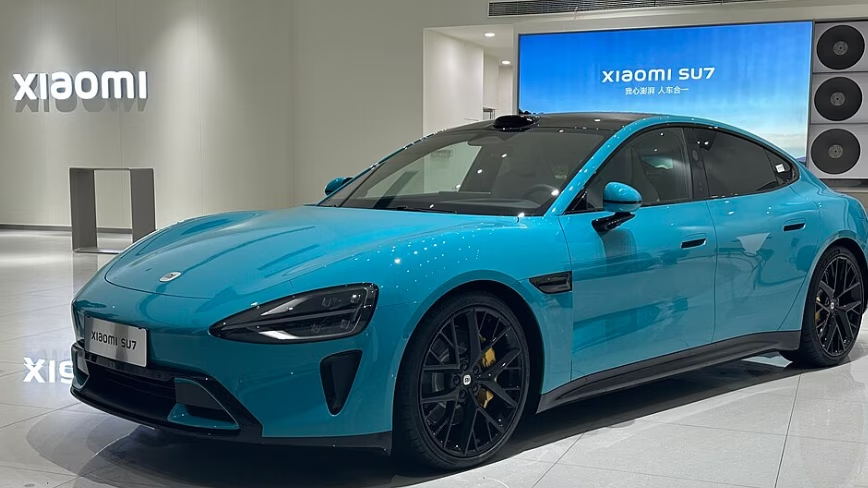
Xiaomi Su7 car
 Credit: JustAnotherCarDesigner
Xiaomi has unveiled the Xring D100, an in-house 3nm chip for intelligent driving that will replace Nvidia hardware in its cars from 2027. The company has invested more than 21bn yuan, about $3.1bn, since restarting its chip programme.
Xiaomi is designing Nvidia out of its cars. The company has unveiled the Xring D100, an in-house chip for what it calls intelligent driving, replacing the Nvidia Drive hardware that has powered the SU7 and YU7 so far.
The specification is ambitious. A 20-core CPU and 16-core NPU on a 3-nanometre process, supporting up to 160GB of unified memory, which Xiaomi says is enough to run a 200-billion-parameter model on the vehicle itself.
It is not the only Chinese company doing this. BYD, Nio and Xpeng are all working on in-house silicon, and Alibaba has built its own AI chip to reduce the same dependency.
One number is conspicuously absent. Xiaomi has not published a figure for trillions of operations per second, which is what actually determines whether all that capacity becomes performance.
The spending behind it is substantial. Xiaomi says it has invested more than 21bn yuan, about $3.1bn, since restarting its chip programme, and now employs a chip team of nearly 3,000 people.
Commercial use starts in 2027. The D100 arrives alongside the O100 accelerator and the O3 mobile processor, which debuts in a folding phone and is made by TSMC on the same 3nm node.
The cars are the more consequential half. Nvidia has supplied the brain of every Xiaomi EV so far, and from 2027 it will not.
That makes this independence from Nvidia rather than from Taiwan. Tesla, Rivian and Xiaomi have all built their own driving silicon, and every one of those chips is fabricated in the same place.
Europe could not manufacture this chip at all. Its flagship new plant, ESMC in Dresden, will run 28 and 22-nanometre planar CMOS alongside 16 and 12-nanometre FinFET, according to TSMC’s own plans.
That is not a small facility. It costs more than €10bn, carries €5bn of approved German state aid, and is jointly owned with Bosch, Infineon and NXP, three of the most important automotive chip firms in the world.
It is also several generations away from 3nm. Xiaomi’s EV arm lost 2.6bn yuan last quarter and is spending on silicon anyway, while Europe’s chip industry keeps asking for a Chips Act 2.0.
Get the TNW newsletter
Get the most important tech news in your inbox each week.
Also tagged with


