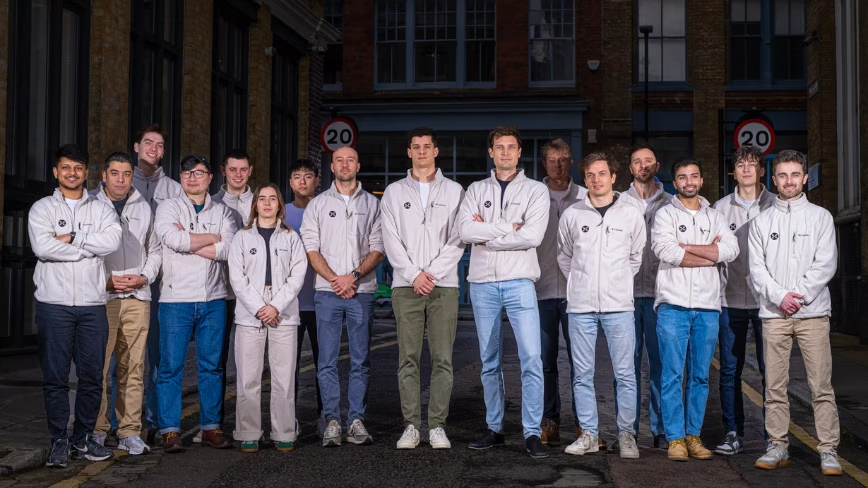
The Luxembourg-founded startup is already in production with multiple top-20 global pharma companies, including a public collaboration with Pfizer. Its $10M seed round is led by redalpine, with the CEOs of Cohere and HuggingFace among the angel investors.
Helical, a London-based pharma AI startup founded by three Luxembourgish childhood friends, has raised $10 million in a seed round led by redalpine, with participation from Gradient, BoxGroup, and Frst.
Notable angel investors include Aidan Gomez, CEO of Cohere; Clément Delangue, CEO of HuggingFace; and Mario Goetze, a professional footballer.
The funding will support expansion across more top-20 pharma programmes and growth of Helical’s deployed science and engineering team.
The company was founded by Rick Schneider, Maxime Allard, and Mathieu Klop, three school friends who took divergent paths into the same problem. Schneider built technology at Amazon before helping the German enterprise software company Celonis scale operations in France and Japan.
Allard led data science teams at IBM before pursuing a PhD focused on reinforcement learning and robotics. Klop became a cardiologist and genomics researcher. When biological foundation models began emerging, the trio identified the same gap: models capable of transforming how pharma discovers drugs were arriving faster than the application infrastructure needed to make them usable at scale.
Helical’s thesis is that bio foundation models, AI systems trained on vast genomic, transcriptomic, and proteomic datasets, have already crossed a quality threshold that makes computational hypothesis-testing meaningful in pharma research.
What has not kept pace is the layer between a model’s output and a scientific decision. In practice, this means bench scientists and ML engineers working in separate environments, teams recreating one-off notebooks for each programme, and analysis that is difficult to reproduce or transfer across disease areas.
Helical builds the infrastructure that closes that gap. Its platform has two surfaces: a Virtual Lab for biologists and translational scientists, and a Model Factory for ML engineers and data scientists, both running on shared data and models to produce consistent, auditable results.
The company is already in production with multiple top-20 global pharma companies. Its publicly disclosed collaborations include work with Pfizer on predictive blood-based safety biomarkers, and with Tanabe Pharma America on AI-driven target discovery for neurodegenerative diseases including ALS.
Across those deployments, Helical says teams have compressed discovery timelines from years to weeks. The broader industry context gives the ambition some scale: global pharma R&D spending exceeds $300 billion annually, bringing a single drug to market costs more than $2 billion on average, timelines stretch beyond a decade, and more than 90% of candidates entering clinical trials fail to reach approval.
Daniel Graf, General Partner at redalpine, described the investment as a bet on a transition “from siloed AI models to integrated virtual AI labs” as biological foundation models and general language reasoning converge. The round builds on a prior €2.2 million raise in 2024 from Frst, BoxGroup, and angels including Gomez and Delangue, who return as investors in this round as well.
Get the TNW newsletter
Get the most important tech news in your inbox each week.


