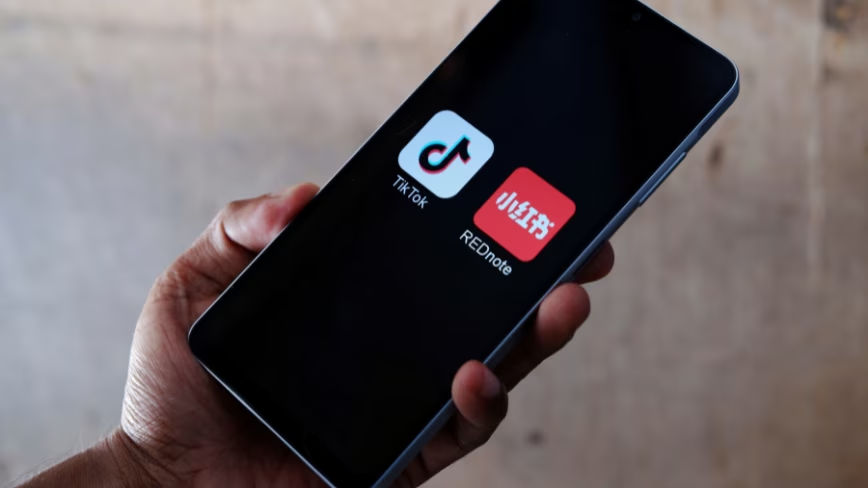
SR Ventures Management Co., one of the earliest backers of the Chinese social commerce app Xiaohongshu, is raising about $350m for a new China-focused venture fund and is using its existing stake in the app, known internationally as RedNote, as the central pitch, according to a Bloomberg report on Tuesday citing people familiar with the matter.
Investors who back the new vehicle have been told they may gain exposure to RedNote shares through GSR’s existing fund, the people told Bloomberg.
The structure would also create a possible exit route for backers of the current GSR fund, which is more than a decade old and which currently holds the firm’s RedNote position. The fund-raising plans are described as preliminary and may change. A GSR spokesperson declined to comment.
RedNote is now marked in GSR’s books at roughly $50bn, a figure that anchors the entire pitch. That is a 61% increase on the $31bn implied valuation logged in a secondary transaction inside the same GSR vehicle in the first half of 2025, when shares of the fund changed hands and the position was disclosed in portfolio documents distributed in September.
The $50bn mark is consistent with a separate late-2025 Xiaohongshu secondary share sale, reported by Chinese outlet Pandaily, which valued the company at the same level.
RedNote, co-founded in 2013 by Charlwin Mao Wenchao and Miranda Qu Fang, sits in an unusual category for Chinese consumer tech. Often described as a Pinterest-Instagram hybrid, it became a household reference point in the West last year when US users migrated from TikTok during the latter’s short-lived ban, briefly making it the most-downloaded free app on the US App Store.
The company is reported to have turned profitable in 2023 with annual net profit of about $500m on revenue of $3.7bn, and its earlier backers include Tencent, Alibaba, Hillhouse, Boyu and HongShan, the firm formerly known as Sequoia China.
Investors are still waiting for an IPO that has not yet materialised.
GSR is not alone in trying to convert a sentiment shift into committed capital. IDG Capital is targeting roughly $2bn for a new China growth fund, with a first close expected before year-end. Hillhouse, Primavera, BAI Capital and Boyu have all been visibly active in fundraising conversations over the past year, according to multiple sector reports.
Together they represent the first concentrated push by China-focused US-dollar funds in roughly five years, since Beijing’s tech crackdown and the COVID-era slowdown drained the foreign capital that had previously poured into the country’s startup ecosystem.
The investor base for these new funds looks different from the one that funded the last cycle. Many US pensions and endowments have stepped back from China entirely, citing geopolitical risk. Sovereign wealth funds and family offices from the Middle East, parts of Europe, and Southeast Asia are filling some of the gap.
Chinese government messaging has helped at the margin: a recent pledge from the market regulator to support private firms is widely cited as having improved sentiment.
For GSR specifically, the question is whether the RedNote sweetener does the work. The fund is, in effect, asking new LPs to fund a forward-looking China book on the implicit promise of access to a single trophy position whose IPO has been pending for several years.
A GSR exit route, in the form of secondary structures or eventual listing, is the variable that will define how this round actually closes. Marketing is reportedly still in the early stages.
Get the TNW newsletter
Get the most important tech news in your inbox each week.


