TL;DR
A Michigan township of 3,000 people is being sued for hundreds of millions of dollars after it killed a $2.36 billion Chinese battery plant. The Gotion case has become a test of whether America can build its way to supply-chain independence when communities keep rejecting the factories.
Less than three years ago, residents of Green Charter Township, a rural community of roughly 3,000 people in central Michigan, packed a hall to celebrate what they saw as a victory for local democracy. They had recalled every member of their town board and installed replacements who promptly killed a $2.36 billion electric vehicle battery plant proposed by Gotion, a US subsidiary of the Chinese manufacturer Gotion High-Tech.
The victory may cost them their town. Gotion is now suing Green Charter for hundreds of millions of dollars in damages, and the township has already run a budget deficit of nearly $400,000 from legal fees alone.
What the township rejected
Backed by Michigan Governor Gretchen Whitmer and nearly $175 million in state incentives, the proposed Gotion campus would have covered 109 hectares, including more than 24 hectares of protected wetlands, to produce lithium iron phosphate cells and EV components. It was projected to create roughly 2,500 jobs and support US efforts to onshore critical battery supply chains.
Residents saw something different. They viewed the project as a “Trojan horse” that could bring Chinese Communist Party influence into their community, contaminate the Muskegon River system that feeds into Lake Michigan, and irreversibly change their way of life.
In November 2023, voters recalled the five board members who had approved the plan. The new board rescinded the agreements, including a water-access permit Gotion needed to operate, and the project stalled.
The lawsuit
Gotion sued Green Charter in March 2024 and won a preliminary injunction against the township’s rescission, meaning it could have proceeded with construction. It chose not to, citing sustained local opposition and the new board’s refusal to cooperate.
By October 2025, the Michigan Strategic Fund declared the project in default and moved to recoup $50 million in subsidies. The state is also seeking $23.6 million Gotion spent on land purchases.
Gotion’s amended lawsuit, filed on 12 June, seeks at least $23 million in damages tied to the state funds it was ordered to return, plus additional claims for lost profits, legal fees, and project costs. The township argues Gotion “sat idly by, injunction in hand, while its project withered.”
A town that cannot afford to lose
“A multibillion-dollar multinational corporation is trying to sue a township of 3,000 people for hundreds of millions of dollars in damages,” said local activist Marjorie Steele, who runs the Economic Development Responsibility Alliance of Michigan. The state Treasury Department has flagged the township for three consecutive years because its expenditures have exceeded its authorised budget, with officials attributing the shortfall to legal fees.
At a town hall on 9 June, residents warned that if property taxes had to rise to cover the deficit, housing could become unaffordable and families would be forced to leave. Township supervisor Jason Kruse acknowledged the challenge, telling local outlet 13 On Your Side that a $23 million payout “would not be very easy to navigate.”
The political flashpoint
The dispute long ago outgrew Green Charter. Republican congressman John Moolenaar, who chairs the House Select Committee on China, framed Gotion’s damages claim as “further example of CCP lawfare” and reportedly secured passage of his NO GOTION Act, which would prohibit federal grants to companies with CCP ties, though the bill’s current legislative status could not be independently confirmed.
During the 2024 presidential campaign, Donald Trump opposed the project amid broader concerns about Chinese parts in American supply chains, and his running mate JD Vance held a rally near the site with Moolenaar. Gotion’s congressional critics point to federal filings in which the company admitted it is “wholly owned and controlled” by its China-based parent and subsidised by the Chinese government.
The contradiction
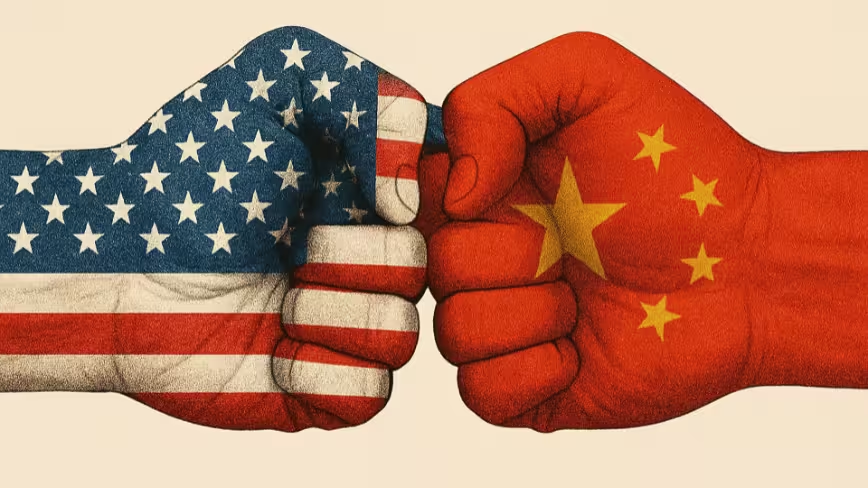
The Gotion fight exposes a tension at the heart of American industrial policy. Washington is pushing for more factories, battery plants, and semiconductor facilities on US soil, insisting that critical supply chains must be decoupled from China.
Yet the communities where those facilities need to go are increasingly saying no.
China controls 94% of global lithium iron phosphate battery production, the very chemistry Gotion planned to manufacture in Michigan. American manufacturers cannot match Chinese scale, cost structure, or speed of iteration, which is precisely why the US needs technology transfer from companies like Gotion to build a domestic supply chain.
Denis Simon of the Quincy Institute, a Washington-based think tank, said US national politics “plainly shaped the strong opposition” to the Gotion project. While residents’ concerns about water, land, and oversight were legitimate, they became “intertwined with broader political anxieties about China, EV policy, national security, and partisan politics,” making compromise impossible.
The fallout extends beyond Michigan. “Foreign investors will ask whether local approvals in the United States are durable,” Simon said, noting that if projects can be approved, funded, and reversed after an election, investors will seek stronger guarantees, demand higher risk premiums, or avoid politically sensitive jurisdictions altogether.
What comes next
The case is set to continue in federal court. Gotion’s amended claims include demands for lost profits on a facility that was never built, a legal theory the township calls “prejudicial” to a community of its size.
At least five other US battery factory projects, including plants by FREYR, KORE Power, and Natron Energy, have been cancelled or halted in recent years. The pattern suggests Green Charter is not an outlier but the leading edge of a problem that Chinese companies doing business in the US will increasingly face.
For Steele, the stakes are simple. “When you’re working in America, you cannot assume and expect to bulldoze over local residents,” she said.
Whether federal courts agree, and at what cost to Green Charter, is the question that will define the next chapter of America’s battery ambitions.


 Credit: DailyNewsBay via Shutterstock.com