TL;DR
Former Meta CTO Mike Schroepfer’s Gigascale Capital raised a $250 million fund focused on energy, grid infrastructure, and critical minerals startups. The fund bets that AI’s energy demands will make clean power startups the real winners of the AI boom.
Gigascale Capital, the venture firm led by former Meta chief technology officer Mike Schroepfer, has raised a $250 million fund to invest in energy, grid infrastructure, and critical minerals startups. The fund, announced on Monday, is Gigascale’s second and its first to include institutional investors. It arrives as most of the venture capital industry has pivoted away from climate tech and toward AI, making Schroepfer’s continued bet on the physical economy a deliberate contrarian move.
“The companies we back win because they’re cheaper, faster, and more reliable,” Schroepfer said. “Climate impact is the result of better-performing systems.” The framing is notable: Gigascale is positioning clean technology not as a values-driven investment thesis but as an economic inevitability driven by performance advantages.
AI is the catalyst, not the competitor
The irony of a former tech executive raising a climate fund during an AI boom is less contradictory than it appears. US utilities plan to spend $1.4 trillion by 2030 to meet the electricity demands of AI data centres, which could consume 9% of the country’s total electricity by the end of the decade, up from 4% in 2023. Natural gas turbines, the default backup power source, have waitlists stretching into the early 2030s.
That power crunch creates the opening Gigascale is targeting. Companies that need massive amounts of electricity, whether for AI training, manufacturing, or industrial processes, cannot wait for utility-scale infrastructure to catch up. Startups building solutions to the data centre energy problem are already attracting significant capital, and Schroepfer has argued on podcasts that “bring-your-own power is going to be a competitive advantage over time” for energy-intensive businesses.
Gigascale’s existing portfolio reflects this thesis. Commonwealth Fusion Systems, which raised $863 million from investors including Nvidia, Google, and Bill Gates, is developing commercial fusion reactors. Form Energy builds 100-hour iron-air batteries designed for grid-scale storage. Heron Power raised $140 million for grid infrastructure technology. These are not consumer apps. They are companies building the physical infrastructure that the digital economy requires.
Bucking the climate tech backlash
The $250 million raise is significant because it comes at a moment when much of the venture industry has abandoned the “climate tech” label. After a wave of high-profile climate-focused funds launched between 2020 and 2023, returns have been mixed and several prominent climate startups have struggled. European venture firms are raising large funds with broader mandates, and US investors have largely redirected capital toward AI-native companies.
Schroepfer started Gigascale after studying climate technology during the pandemic. His argument is that the sector’s problems are not technological but commercial: clean technologies need to be cheaper and faster than incumbents, not just greener. Solar energy is his reference case, a technology that won market share not because of environmental mandates but because it became the cheapest source of electricity in most of the world.
The fund will also look at critical minerals and what Schroepfer calls “physical AI,” a term that likely refers to robotics and automation applied to manufacturing, mining, and construction. Battery storage and mineral supply chains are increasingly recognised as bottlenecks in the energy transition, and startups that can address those constraints have a clearer path to revenue than companies building yet another solar panel.
The Meta connection
Schroepfer served as Meta’s CTO for more than a decade before stepping down in 2022. His tenure included oversight of the company’s infrastructure buildout, including the data centres that now consume massive amounts of electricity to run AI workloads. The experience gave him direct exposure to the energy constraints that large-scale computing faces, an understanding that informs Gigascale’s investment thesis.
Meta itself has become one of the largest corporate buyers of clean energy, with 2026 capital expenditure guidance between $125 billion and $145 billion, much of it directed toward AI infrastructure. The search for solutions to AI’s energy problem has produced ideas ranging from data centres in space to small modular nuclear reactors, but the most commercially viable answers are likely to come from startups building practical improvements to energy generation, storage, and distribution.
Gigascale’s $250 million is modest relative to the scale of the energy infrastructure challenge, but the fund’s contrarian positioning could prove well-timed. If the AI industry’s power consumption continues to accelerate and legacy energy infrastructure cannot keep up, the startups building the physical layer will capture value that no amount of software optimisation can replace.


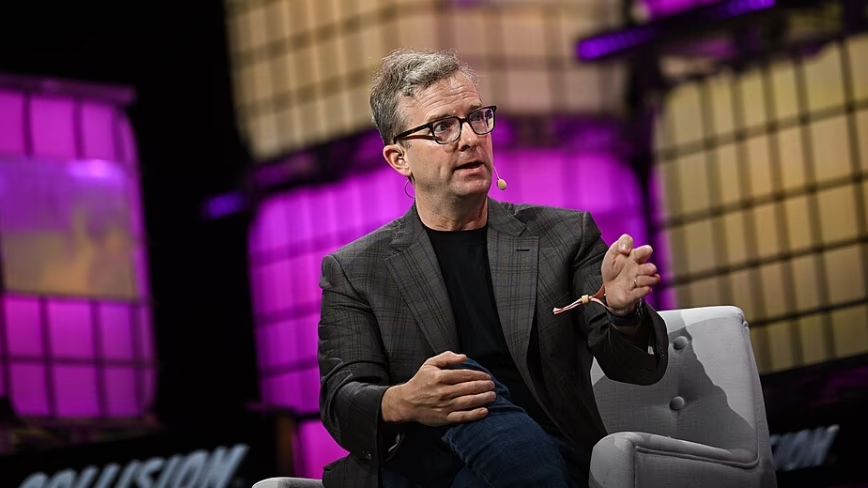
 Credit: Collision Conf