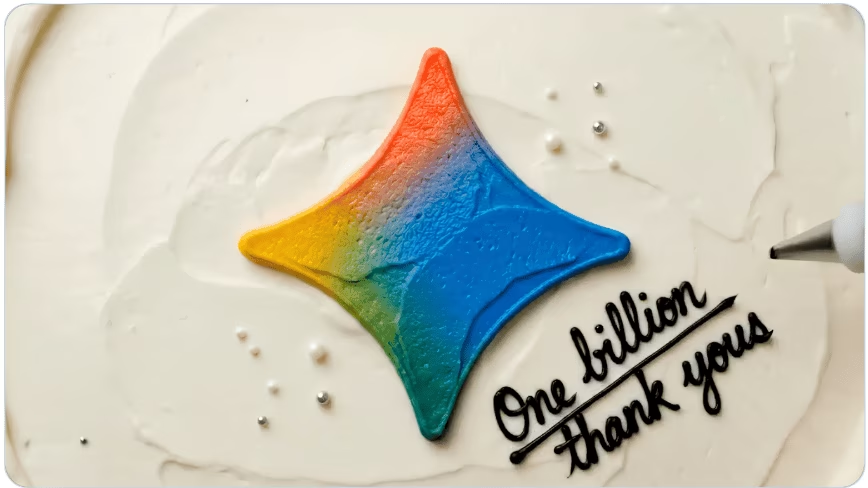

Sundar Pichai announced on Tuesday that the Gemini app had passed a billion monthly users. He called it “our fastest growing product ever” and the 14th Google product to hit the mark, alongside Search, Gmail, Android, Maps, Chrome, Play and YouTube. His post has been seen more than 1.5 million times.
Google published the engagement figures on its own blog the same day. Most coverage framed the milestone as Gemini closing the gap with ChatGPT. Check the metrics and they do not say that.
A monthly billion and a weekly billion are different animals
ChatGPT reached a billion monthly users on 3 June, which we reported as the fastest any app had got there. Gemini reached the same mark on 11 August. That is ten weeks later, on the identical measure.
OpenAI has now said so on the record. Spokesperson Lindsay McCallum told The Verge that ChatGPT “crossed 1 billion monthly users some time ago, and hit a billion a week in July”. She declined to say how many monthly users it has today.
We reported OpenAI passing a billion weekly users in late July, a target it had missed by about seven months. Weekly actives are a much harder test than monthly ones, because they count habit rather than curiosity. Gemini matched in August what ChatGPT did in June, and ChatGPT moved to a harder measure in between.
The counterweight is that ChatGPT has slowed
That reading has a hole in it and The Verge found it. ChatGPT was on 900 million weekly users in February. It took five months to add the last hundred million. Google is accelerating into the same wall that OpenAI has already hit.
The two curves matter more than either milestone. Gemini added 50 million users in a fortnight. ChatGPT added a hundred million in five months. The metrics differ, so the comparison is rough, but the direction is not really in doubt.
What a billion users actually counts
The measure is narrower than it sounds. It counts people who open the Gemini app or the web interface, and nothing else. Ars Technica noted that anyone who used Gemini “only once in the past month” sits inside the total.
The figure also excludes the places where most people meet Gemini. Google’s AI Mode in Search separately passed a billion monthly users, TechCrunch reports. The model runs inside Gmail, Docs and Android too. Tuesday’s number is the standalone app on its own.
The growth is real, and so is the distribution
None of that makes the climb unimpressive. Gemini was on 400 million monthly users in May 2025, 9to5Google notes, and Google announced 750 million in February. It reported more than 950 million on its Q2 earnings call a fortnight ago. Daily active users have tripled in a year.
The caveat is where those people came from. Gemini rides Android, Search, Chrome and Workspace, four products that already had a billion users each. ChatGPT had to be sought out. Comparing the two as though they started level flatters Google.
One figure cuts against that, and it is the strongest number Google released. Gemini has more than 100 million active users on iOS, where Google owns no distribution at all. Those people went and got it. Google adds that macOS users prompt it about twice as often as users on other surfaces.
What a billion people are actually doing
Gemini now generates more than 150 million images a day, each one watermarked with SynthID. About 63% of users talk to it rather than type. Google says parents are 43% more likely than other users to use voice for daily tasks.
One Gemini Live interaction in five now carries a live camera feed or a shared screen. Some 38% of school-related requests arrive with an attachment. On Android the app automates actions across more than 40 apps. That is an assistant rather than a chat window, and it is a different product from the one OpenAI built.
The number Google did not put in the post
A billion monthly users of a general assistant means a billion people getting answers that used to arrive as links. Google has spent a year defending AI Overviews against publishers over exactly that. Our own reporting tracked what it did to publisher traffic.
Gemini is the same trade at a larger scale and with no blue links at the bottom. Google has not published a figure for how many Gemini answers send anyone anywhere. That absence is not an oversight.
The product underneath is not settled
User numbers and model quality are separate problems, and Google is winning one of them. In July we reported that the next Gemini Pro had slipped by months after its coding fell short of internal targets. It was promised for June and has still not arrived. Google says it remains in testing.
The company has already started training Gemini 4, whose new boss was named the same week two of Gemini’s co-leads walked out. Demis Hassabis stepped back from running DeepMind on 5 August. Google hit the milestone six days after handing its AI division to someone else.
That combination is unusual and worth stating plainly. Distribution is solving the adoption problem faster than research is solving the capability one.
What to watch
The next honest comparison is a weekly figure. If Google publishes Gemini weekly actives near a billion, the parity framing everyone used this week becomes true. If Google keeps quoting monthly while OpenAI quotes weekly, that silence is the answer.
The second thing to watch is what Gemini does to the open web at this scale. A billion monthly users is roughly one in eight people alive. Google has crossed a threshold. From here it gets measured against that number rather than congratulated for it.
Get the TNW newsletter
Get the most important tech news in your inbox each week.


