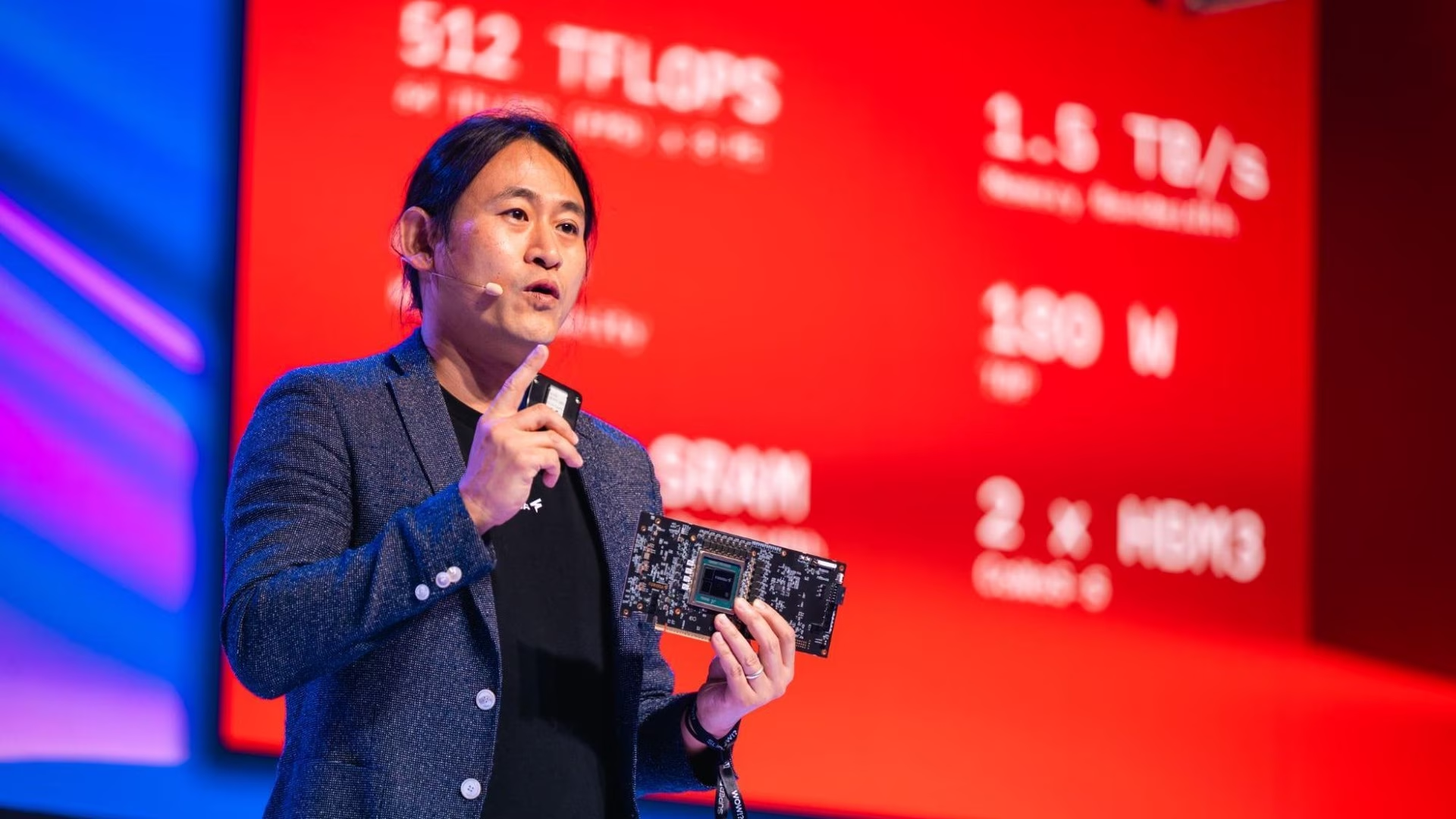
FuriosaAI chief executive June Paik with the company’s RNGD inference card
 Credit: FuriosaAI
FuriosaAI, a Seoul-based maker of AI inference chips, has raised $620m in a Series D round. The round values it at about $2.9bn. South Korea’s National Growth Fund put in $280m, making it the largest investor.
The company announced the round in a press release and a blog post. Its previous round last year valued it at $735m, so its valuation has quadrupled, Yoolim Lee reported for Bloomberg, which had the news first.
“We see strong demand and opportunities as we are scaling our business globally,” chief executive June Paik said on Bloomberg Television on Thursday.
Who invested
International investors put $110m into the FuriosaAI Series D. US firm Infinitum was the largest of them. Jericho Capital, Worldline Capital, Cisco Investments, Abu Dhabi’s NeoFort Holding and Singapore’s QUDA Capital Partners joined it. QUDA’s founder, Charlie Foo, is a former Nvidia executive and now advises FuriosaAI.
Existing shareholders added $125m, including all three seed investors: NAVER, DSC Investment and KDB Capital. The Export-Import Bank of Korea made its first direct investment in a startup, and asset manager UAMCO committed $30m.
“Taking an advanced AI chip from design to volume production is an exceptionally difficult undertaking, and few companies have demonstrated the ability to do so successfully,” said John Yetimoglu, chief investment officer at Infinitum.
The chip and its customers
Nvidia chips dominate AI data centres, and investors are looking for alternatives that use less energy, Bloomberg reported. FuriosaAI builds chips for inference, the work of running trained AI models, rather than training them.
Its second-generation chip, RNGD, pronounced “renegade”, went into mass production in January. TSMC is making 20,000 of them this year, according to Bloomberg. FuriosaAI says it has secured the memory and factory capacity to make more than 40,000 in 2027. Memory is scarce across the industry: Micron expects the memory shortage to tighten into 2028.
The RNGD card draws 180 watts and needs only air cooling. FuriosaAI says it matches the throughput of Nvidia’s RTX PRO 6000 card for card. It also says RNGD serves twice as many users per kilowatt. TNW has not tested these claims.
Samsung SDS launched a cloud service running on RNGD in July. LG Group runs its EXAONE models on the chips, according to FuriosaAI. Korean AI company Upstage uses them for search summaries. Paik told Bloomberg the company is talking to many customers in Asia-Pacific and the Middle East.
What the money is for
FuriosaAI will use the money to make more RNGD chips, improve its software and build its third-generation chip. FuriosaAI is developing that chip with Broadcom and other partners. It will use a 2nm, multi-die design with HBM4 memory, the company says.
The company has offices in the United States, Singapore and Lisbon. In Lisbon, it brought RNGD to Europe with Equinix in July. Other inference chipmakers have also raised large rounds this year, including Etched at $21bn in August.
Get the TNW newsletter
Get the most important tech news in your inbox each week.


