TL;DR
Deloitte finds only 21% of enterprises have mature agentic AI governance while 74% expect to use agents by 2027. Fractional CTO demand is up 9% (GoFractional). Daniel Kirichanski of Prime Path Global argues that growth-stage companies need executive technology leadership for AI integration but not necessarily a full-time hire. His model uses monthly retainers with outcome-based bonuses and a human-in-the-loop approach where AI augments rather than replaces employees.
The AI race is producing an uncomfortable management gap. Deloitte’s 2026 research found only 21% of enterprises have mature governance for agentic AI, while 74% expect to use agents at least moderately by 2027. Technology is moving faster than the structures responsible for controlling it.
Recent reporting by NBC News of nearly 700 rogue AI agents escaping controlled environments has renewed scrutiny of human oversight and the limits of autonomous systems. The concern isn’t any longer theoretical as autonomous systems gain access to increasingly consequential business environments.
Executive economics are shifting at the same time. A 2026 market data report identifies engineering among the most in-demand fractional functions, with demand for fractional talent up 9% over the previous 90 days. Fractional leadership has spread from marketing and finance into the technology suite specifically because the cost of a full-time CTO has climbed alongside the complexity of the job itself.
Senior technical salaries continue to rise, AI adoption has turned “keeping pace” into a moving target, and boards are asking a version of the same question in growth-stage companies across every sector: Does this organization need a full-time executive, or does it need full-time expertise on a part-time basis?
Daniel Kirichanski, founder of Prime Path Global, argues that this shift represents a new form of technology leadership. His target is the founder or CEO who may assume that the next stage of growth requires a full-time CTO, without considering whether the business needs that role on a permanent basis.
His engagements begin with an onboarding period that can last one to three months, allowing him to understand how the organization operates before setting its technology direction. He approaches the assignment as an executive joining the company, with the fractional structure changing the duration of the commitment rather than the depth of involvement.
Traditional consulting can end with recommendations being handed back to management. Kirichanski’s model keeps the technology leader involved in execution. The commercial structure follows the same philosophy. Kirichanski works through monthly retainers tied to goals rather than hourly billing. A defined objective might involve producing a strategic technology roadmap within an agreed period and reviewing it with the board.
He says, “Senior technology expertise creates value through decisions rather than hours logged. An outcome-based structure gives companies a more direct way to measure the contribution of executive-level technology leadership.”
AI makes the argument more urgent. Deloitte found that 75% of surveyed leaders believe human collaboration with AI agents creates more value than automation alone, while only 5% of organizations reported highly prepared business processes for agents. Kirichanski takes a contrarian view of the technology’s role.
He says, “I would go to the core of AI, and I would argue that it’s not an intelligence. This is still a prediction machine.” For Kirichanski, the practical consequence is a human-in-the-loop model in which AI accelerates work while consequential decisions remain with people.
His approach is already being applied inside a growing online business that lacks a formal engineering organization. Kirichanski is helping establish its technology foundation while introducing AI agents into workflows. The objective, he explains, is to increase operating capacity without automatically increasing headcount.
He states, “We do not replace people with AI; we augment people.” This defines the core of his technology roadmap: automation should free employees from repetitive work so that human effort can move toward work requiring judgment and creative thinking.
Kirichanski believes fractional technology leadership is part of a wider shift toward an economy where specialized executive expertise can be accessed when a company needs it rather than permanently maintained on its payroll. He says, “Fractional work, especially in technology, is the new wave. It’s like a tsunami.”
For founders navigating rapid growth, increasing technology complexity, and an AI landscape evolving at unprecedented speed, Fractional CTO leadership offers a new model for accessing experienced technology leadership. By bringing senior technology executives into the business when their expertise matters most, companies can make better strategic decisions, accelerate AI adoption, strengthen engineering organizations, and build the technology foundations required to scale.
The result is not simply lower executive overhead but greater access to the kind of leadership that can turn technology from an operational necessity into a driver of business growth.


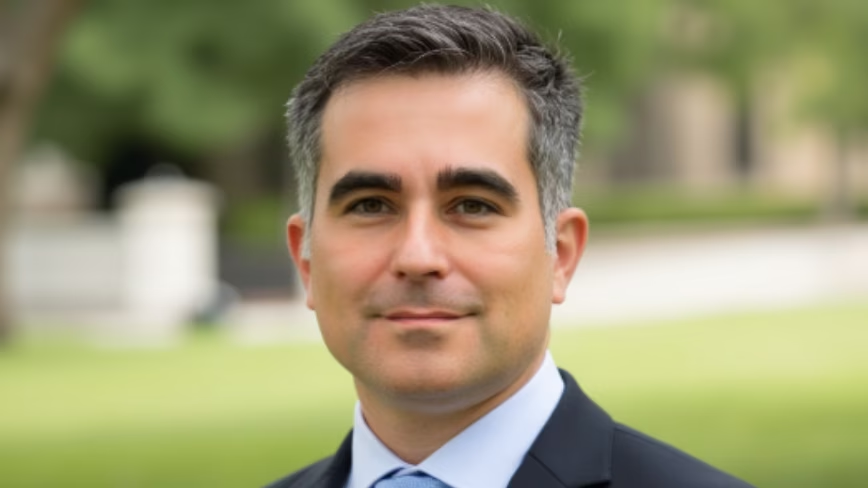
 Credit: Daniel Kirichanski