 Credit: Manoj Kumar Tuteja / Shutterstock
The United States is moving to push two long-stalled aviation frontiers into commercial service at once, using federal rulemaking and White House pressure to speed electric air taxis and civil supersonic flight towards market.
The effort ties together the Federal Aviation Administration, the Department of Transportation, and a set of executive orders signed in June 2025, and it could reshape how Americans travel over the next decade.
On the supersonic side, the FAA has published a proposed rule that would end a prohibition in place since 1973, a potential turning point for the long-promised supersonic revival.
That ban, written into 14 CFR 91.817, has stopped civil aircraft from exceeding Mach 1 over US land for more than five decades. It dates to public opposition in the 1960s, when test flights over cities such as Oklahoma City produced sonic booms that broke windows and generated thousands of damage complaints.
In its place the agency proposes an interim, noise-based standard rather than an outright speed limit.
Aircraft could fly faster than sound over land provided the sonic boom overpressure measured at the surface stays at or below 0.11 pounds per square foot, a threshold meant to keep the boom from being heard on the ground.
The proposal, docket FAA-2026-6935, is open for public comment until 17 August 2026, and a second rule covering takeoff and landing noise is expected later in the year.
The FAA aims to finalise both by mid-2027. “This means we can ultimately repeal the ban from the 1970s on supersonic flight over US territory while minimising noise impacts,” FAA Administrator Bryan Bedford said.
The change follows executive order 14304, “Leading the World in Supersonic Flight,” which directed the agency to scrap the overland ban and set the interim noise standard.
It is a clear win for firms betting on faster travel, among them Colorado-based Boom Supersonic, whose Overture jet has drawn pre-orders from major carriers, and Atlanta’s Spike Aerospace.
United Airlines has agreed to buy up to 50 Overture jets, with service targeted around the end of the decade. Even so, the technology remains expensive, and the flights are unlikely to be cheap.
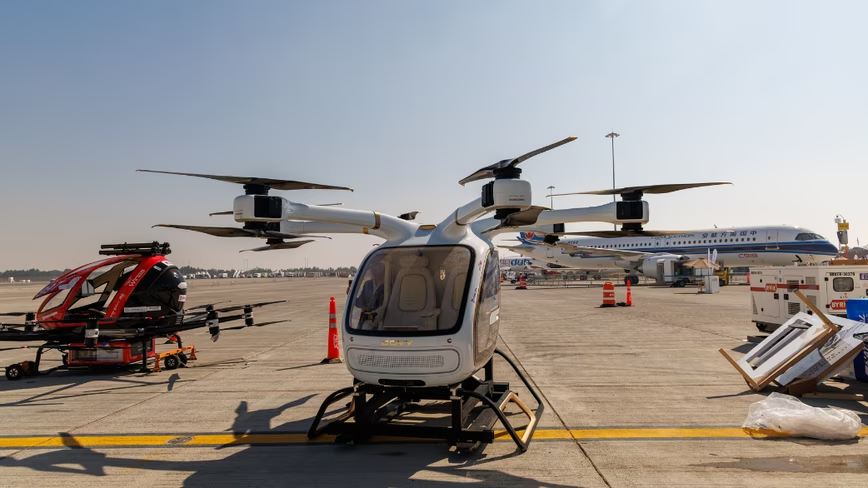
Air taxis are on a parallel track. Companion orders signed the same day established an eVTOL integration pilot programme, and the FAA has since selected eight projects spanning 26 states, running for three years and letting operators fly before full certification is complete.
Joby Aviation, Archer Aviation, Beta Technologies, and Wisk are among the operators named, and testing could begin as early as this summer.
Planned projects include Manhattan heliport services run with the Port Authority and regional links across Texas connecting Dallas, Austin, San Antonio, and Houston, part of a bet that short electric hops can undercut congested road journeys.
The commercial case is already being demonstrated. Joby recently flew the seven-minute JFK hop it plans to sell, a trip that can take an hour or more by car, while its work on airspace management points to the coordination that dense eVTOL traffic will require.
Crucially, neither Joby nor Archer holds full FAA type certification yet. Joby has cleared the fourth of the agency’s five certification stages, with the final one still to go, and the pilot programme is an accelerated route to gather operational data, not a waiver of safety review.
That caveat runs through the whole push. European rivals have repeatedly slipped their timelines against tough certification hurdles, a reminder that regulatory ambition and airworthiness are not the same thing.
Noise is the other open question. The 0.11 psf supersonic standard is interim, the community-noise rule is still unwritten, and residents living under new eVTOL corridors have yet to weigh in at scale.
What comes next is a stretch of public comment, flight testing, and certification decisions that will determine whether the timelines hold. For now, Washington has signalled that it wants both technologies flying commercially, and soon.
Get the TNW newsletter
Get the most important tech news in your inbox each week.


