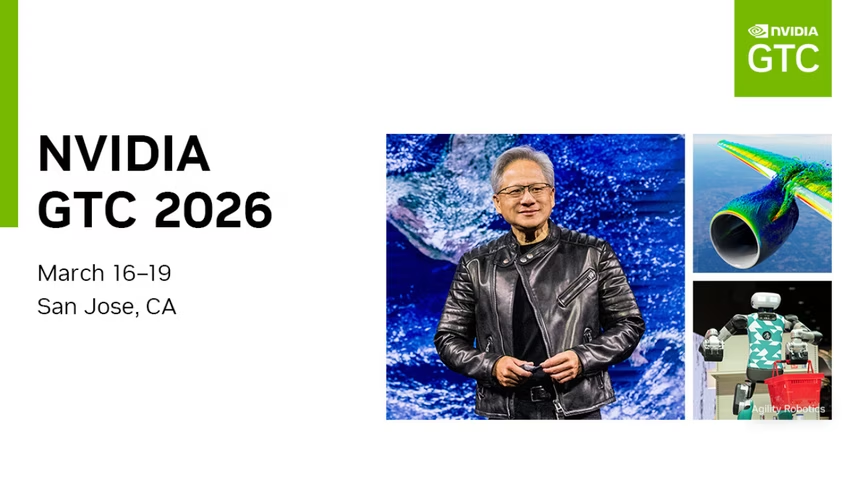

NVIDIA’s GTC 2026 opens in San Jose today with 30,000 attendees, a keynote at the SAP Center, and announcements that could reshape the next two years of AI infrastructure, from Vera Rubin deep-dives to an enterprise agent platform and a gigawatt deal with Mira Murati’s startup.
San Jose goes green every March. The city’s convention centre fills with developers, research engineers, and enterprise technology buyers who have flown in from 190 countries.
The SAP Center, normally home to the San Jose Sharks, is repurposed as an arena for a two-hour keynote watched simultaneously by hundreds of thousands more online.
Banks of screens, a leather jacket, and a CEO who speaks in roadmaps.
NVIDIA GTC 2026 opens today, 16 March, and runs through 19 March. It is, by any objective measure, the most closely watched event in the technology industry right now: the moment when Jensen Huang, founder and chief executive of the world’s most valuable chipmaker, tells an audience what the next phase of artificial intelligence will look like, and, by implication, who will profit from building it.
The company came into this week carrying significant momentum. In its fourth-quarter 2025 earnings report, released in February, NVIDIA posted revenue of $68.1 billion, up 73% year on year. It has reported record revenue in each of the past several quarters.
The valuation has oscillated with broader market conditions, geopolitical pressures, including the ongoing Iran conflict that is pushing oil prices higher, have weighed on tech stocks, but NVIDIA’s fundamental position has not shifted: it supplies the compute on which the global AI buildout depends.
GTC is where NVIDIA reminds everyone of that fact.
In the press release announcing GTC 2026, Huang framed the conference around a single idea: AI is no longer an application or a model. it is infrastructure.
“Every company will use it. Every nation will build it,” he said. “From energy and chips to infrastructure, models and applications, every layer of the stack is advancing at once.”
What is already known, or strongly anticipated, fills in a significant portion of the picture.
The broader programme: physical AI, quantum, and the energy question
Beyond the keynote, GTC 2026 runs 1,000+ sessions spread across ten venues in downtown San Jose. Physical AI, covering robotics, autonomous systems, digital twins, and the use of simulation environments for training, is a dominant thread.
Speakers include Ashok Elluswamy, VP of AI software at Tesla; Raquel Urtasun, CEO of Waabi; Deepak Pathak, CEO of Skild AI; and representatives from Johnson & Johnson, Disney Research Imagineering, and PhysicsX.
Disney’s GTC session has drawn particular attention: the company will show how it is using AI-powered physical robotics to bring animated characters into real-world environments, using NVIDIA Isaac simulation tools and reinforcement learning trained on GPU-accelerated infrastructure.
On Tuesday, 17 March, Dario Gil, now Undersecretary at the US Department of Energy, joins a session on AI in climate and energy research.
The inclusion of a senior government official is not incidental: the energy consumption of AI data centres has become a political question as much as a technical one, and NVIDIA is clearly interested in making the case that accelerated computing, despite its power demands, also accelerates solutions to the problems that power demand creates.
Quantum computing features in a dedicated session titled “The Genesis of Accelerated Quantum Supercomputing,” which outlines a vision for the convergence of AI and quantum hardware, with a claimed target of scientifically useful accelerated quantum supercomputers by 2028.
On Wednesday, 18 March, Huang moderates a panel on the state of open frontier models with leaders from A16Z, AI2, Cursor, and Thinking Machines Lab.
Here you can find the entire list with speakers.
Why this year feels different
GTC has been called, at various points, the Super Bowl of AI, the Woodstock of technology, and the real March Madness. Bank of America analysts told investors to treat GTC as a buying opportunity. The event has become the place where the AI industry’s direction is set, rather than observed.
What makes 2026 different from previous years is not the scale of the announcements, GTC has been big before, but the maturity of the technology being discussed.
Blackwell proved that NVIDIA could deliver on its roadmap. Vera Rubin is in production. The question the industry is now asking is not whether AI infrastructure will scale, but who controls what the infrastructure runs, and at what cost.
NemoClaw, if it launches as reported, represents NVIDIA’s answer to the software layer question. The Thinking Machines deal represents its answer to the frontier lab question. The Vera Rubin technical deep-dives represent its answer to the inference cost question.
Taken together, they form an argument that NVIDIA is not merely supplying the picks and shovels to the AI gold rush, but is increasingly shaping the mine itself. Jensen Huang has been making versions of that argument for several years. At GTC 2026, from the floor of the SAP Center, he will have more evidence than ever to make it with.
Get the TNW newsletter
Get the most important tech news in your inbox each week.


