 Credit: urcisxtrime / Canva
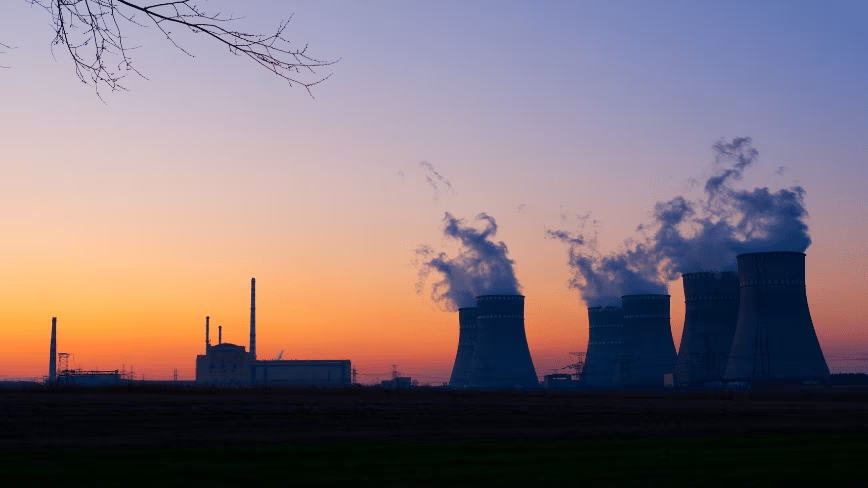
Nuclear reactors need water. They sit beside rivers and coastlines for a reason. The water carries heat away from the core. When it runs low or runs warm, the reactor has to power down.
That is happening across Europe right now. On Thursday, Romania’s state-owned Nuclearelectrica began disconnecting the country’s sole operating reactor, CNBC reported. The Danube is too low to cool it.
Romania had already tried a great deal to avoid that. It dredged the channel and sank rock-filled barges. Its navy detonated a controlled underwater explosion on the riverbed on 3 August. The aim was to push more water towards the cooling system at Cernavoda.
Cernavoda is the country’s only nuclear plant. Its two reactors normally supply about a fifth of Romania’s electricity.
France lost three reactors to jellyfish
The pattern repeats across the continent, and the causes are not identical. In Hungary, rain lifted the Danube enough to restart a turbine at Paks. That plant supplies nearly half the country’s electricity. Prime Minister Péter Magyar said on Monday that two of its eight turbines are running again.
France gets about 70% of its electricity from nuclear. EDF said on Wednesday it had cut output at several reactors for environmental reasons, on its production updates page. Earlier in the week it shut three reactors at Gravelines entirely.
The cause there was a “massive influx of jellyfish”, which triggered automatic protective shutdowns. It is the second year running that a jellyfish swarm has closed reactors at Gravelines, one of France’s largest plants.
France has reportedly had to shut a record number of nuclear plants this summer, across heat, wildfires and drought. Politico noted that the jellyfish arrived on the same date two years running.
The rivers tell the same story away from the reactors. The Danube runs about 2,850km and is a working freight route as well as a coolant. The Rhine is low enough that cargo vessels are picking their way past exposed riverbed at Kaub in Germany.
The response is arriving after the problem
In the UK, Prime Minister Andy Burnham convened the government’s Cobra emergency committee on Wednesday over heat, wildfires and drought. It is the second Cobra meeting on heatwaves this year, with temperatures forecast to reach 38C.
Gareth Remond-King heads the international programme at the Energy and Climate Intelligence Unit. He did not think much of the timing. “I think many would suggest that treating this as an emergency is perhaps a little overdue,” he told CNBC.
His larger point was that this is not a bad summer. “This is not something that is simply going to pass,” he said. It gets worse while emissions keep rising.
Governments are looking at upgraded cooling systems and at scheduling maintenance around the hottest weeks. Both are sensible. Neither changes the fact that the water is the constraint.
The Romanian measures show the limits. Dredging, sunken barges and a controlled detonation are the actions of a state with days rather than years to work with. They also have to be repeated the next time the river drops.
The bill is the size of the growth
Dutch bank Triodos published an analysis on 8 August. It puts the economic cost of this summer’s heat at €180bn, or roughly 1% of EU gross domestic product.
That number is worth sitting with. Forecasters expect the EU to grow about 1% this year. On those figures the heat costs the bloc exactly what it expects to gain.
Triodos attributes it mainly to lower labour productivity. Weaker harvests, dearer food, constrained energy production, higher electricity prices and transport disruption make up the rest.
Europe is siting AI compute into this grid
Here is why this matters to anyone building AI infrastructure in Europe. The energy coverage rarely makes the connection. Data centres need two things in quantity: firm power and cooling water.
Both just became less reliable in the places Europe is putting compute. This week Nebius agreed to lease capacity in south Wales. It is committing about £1.7bn across four UK sites.
Others are further along the same road. Germany’s Uniper is spending €5bn on data centres. The UK is preparing to float Nscale at $51bn on contracted compute it has not delivered yet.
To be clear about causation, data centres caused none of this summer’s shutdowns. The supply problem and the new demand are separate things. They are just arriving at the same grid in the same decade.
The scale is worth stating plainly. Cernavoda’s two reactors carry about a fifth of Romania’s electricity. Nebius alone plans to deploy more than a gigawatt of new capacity a year globally from 2027.
The industry has already noticed the risk elsewhere. Amazon is building a Texas data centre with its own gas plant so it will not touch the grid. More than 500 US jurisdictions now restrict or ban data centres.
Water is the constraint nobody prices
The water question keeps recurring, and everyone keeps treating it as local. Google’s $15bn Indian project ran into water and wildlife objections. Vantage says its newest Welsh facilities recirculate water rather than evaporating it.
Closed-loop cooling is the right engineering answer and it is becoming standard in new builds. Reactors built decades ago do not have that option. They carry the baseload that data centres now plug into.
That is the asymmetry. Designers can build the new sites around drought. Nobody can redesign the plants they draw power from before next summer.
What would settle it
Two things are worth watching, and both are checkable rather than rhetorical. The first is whether Cernavoda comes back this month, and how much dredging and detonation it took to get there.
The second is simpler. Will any European AI infrastructure announcement publish a water figure next to its megawatts? Everyone quotes capacity. Almost nobody quotes water.
Europe sells itself, credibly, as a serious place to build sovereign AI capacity. It is also a continent that this month blew up a riverbed to keep one reactor running.
Get the TNW newsletter
Get the most important tech news in your inbox each week.


