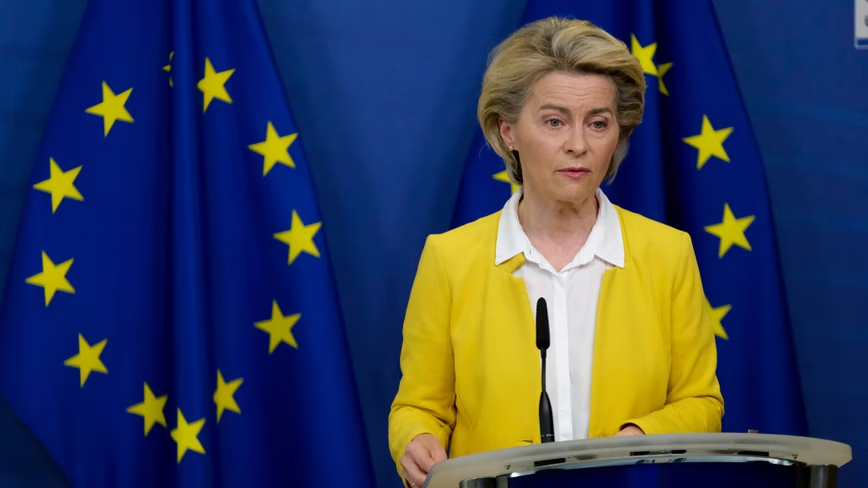
European Union Commission President Ursula von der Leyen delivers a statement at the EU Commission headquarters in Brussels, Belgium on April 14, 2021.
 Credit: Alexandros Michailidis via Shutterstock
The European Union plans to stop children under 13 from using social media and to prevent anyone under 15 from having a personal account, Ursula von der Leyen announced in her State of the Union address on Wednesday.
“No social media under the age of 13. No personal account under the age of 15,” the Commission president said, according to Bloomberg.
Still, kids who are 13 or 14 could still have accounts, but only with parental supervision and limited features. But this announcement answers a question that has divided EU countries in recent weeks, as the age limit remained undecided until Monday, with Commission experts supporting 13 and France opting for 15.
The Commission president’s announcement includes both ages if the text remains as stated today.
More details will be shared on Thursday, when the Commission will present the EU Kids Act. As for now, we have a few details on what the draft contains, such as that the law will require strict age checks on social media, video platforms, app stores, online games, AI companions, and chatbots,
Companies that will not follow the rules could face fines up to 6% of their annual sales.
Euronews, having received the draft the following day, outlined a system under which children under the age of three would be excluded, and teenagers aged 13 and 14 would have restricted accounts.
The draft also states that services must switch off features such as infinite scrolling and artificial notifications, and that “technology companies bear primary responsibility for making their products safe”.
To verify ages, platforms could use the Commission’s age verification app, which Brussels said was ready in April. The app uses zero-knowledge proofs, allowing users to prove they are old enough without sharing their identity documents.
Privacy concerns have already halted one national effort: in August, France’s Constitutional Council rejected the country’s under-15 ban, saying it was too harsh and did not protect users’ data well enough.
President Emmanuel Macron then asked Brussels to create an EU-wide rule. Other EU countries have been making their own rules since Australia banned under-16s in December, and the Commission has faced more calls to set a single standard.
No agreement will be reached quickly since the governments are still divided, with both Estonia and Belgium opposing age-based bans in full, and the European Parliament having earlier called for an age limit of 16; the proposal must have the support of both sides before it can become law, a process which Bloomberg has pointed out can take years.
The text that will be unveiled on Thursday will illustrate the extent to which the 13-and-15 formula remains valid when exposed to the draft and how far the new rules apply to AI chatbots.
Get the TNW newsletter
Get the most important tech news in your inbox each week.


