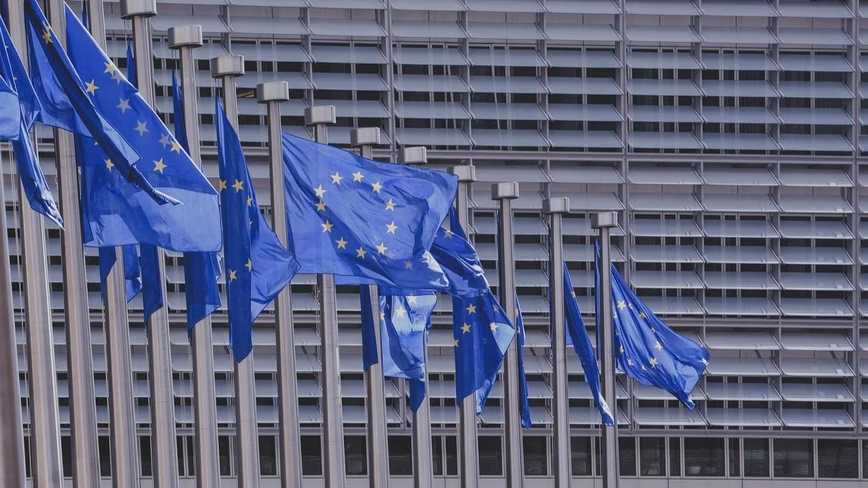
EU flags outside a government building
The collapse of Tuesday’s trilogue exposes deep divisions over whether high-risk AI systems embedded in consumer products should be exempt from the world’s strictest AI rules
After 12 hours of negotiations on Tuesday, EU member states and European Parliament lawmakers failed to reach a deal on proposed changes to the bloc’s landmark AI Act. Talks will resume in May, according to Reuters.
“It was not possible to reach an agreement with the European Parliament,” a Cypriot official said, Cyprus currently holding the rotating EU Council presidency.
The failed session was the final scheduled political trilogue on the AI Omnibus, a package of amendments to the AI Act that entered into force in August 2024, as well as proposed changes to the GDPR, the e-Privacy Directive, and the Data Act. The Omnibus is framed as a competitiveness measure, aimed at reducing regulatory burdens on businesses to help European companies keep pace with US and Asian rivals. Its critics, who include a large coalition of privacy and civil rights organisations, argue it is a rollback of hard-won protections dressed up as simplification.
The core unresolved question on Tuesday was whether high-risk AI systems embedded in products already regulated under EU product safety legislation — medical devices, toys, connected cars, industrial machinery — should be exempt from the AI Act’s additional requirements. The European Parliament, backed by industry groups, has been pushing for these systems to be covered by their existing sectoral rules only. The Council, representing member states, has shown limited enthusiasm for such a broad carve-out.
The Omnibus has come under sustained criticism from researchers and civil society organisations who argue that weakening the AI Act before its core provisions have even come into force risks dismantling one of Europe’s most distinctive regulatory assets. Michael McNamara, the Parliament’s lead negotiator on the AI Omnibus, acknowledged in an interview with Tech Policy Press that overlapping rules can be difficult to manage, but warned that shifting AI governance into sectoral laws could ultimately be “deregulatory rather than simplifying.”
Civil society groups have been more direct. Over 40 organisations signed a letter to the Parliament in mid-April arguing that the proposed changes weaken the AI Act’s fundamental rights protections, particularly for biometric identification systems, AI used in schools, and medical AI. The AI Act was widely seen as a global standard-setter when it entered into force.
The urgency behind the negotiations is structural. The AI Act’s core obligations for high-risk AI systems are currently set to apply from August 2, 2026, just three months away. The entire purpose of the AI Omnibus is to postpone that deadline to December 2, 2027, for stand-alone high-risk systems, and to August 2, 2028, for those embedded in regulated products.
For that postponement to take legal effect before the August deadline, a final political agreement, formal Parliament vote, Council endorsement, and publication in the Official Journal must all occur in a matter of weeks.
If talks continue to stall in May and no agreement is reached before June, the original August 2026 deadline will stand. That would mean that companies relying on the Omnibus’s extended timelines would suddenly face immediate compliance obligations for which many have not adequately prepared — a scenario Brussels has been working hard to avoid.
The Omnibus also contains one widely supported measure: a ban on AI systems generating non-consensual intimate images, including child sexual abuse material. This was added to the package following the controversy over Elon Musk’s Grok chatbot’s nudification capabilities in late 2025, both the Parliament and Council had already aligned on it. That the talks collapsed despite this area of consensus underlines how intractable the sectoral exemption question remains.
The resumption of talks next month will determine whether the EU can still claim to be doing this in an orderly way, or whether the world’s most ambitious AI regulation stumbles at the moment its hardest rules are meant to bite.
Get the TNW newsletter
Get the most important tech news in your inbox each week.


